
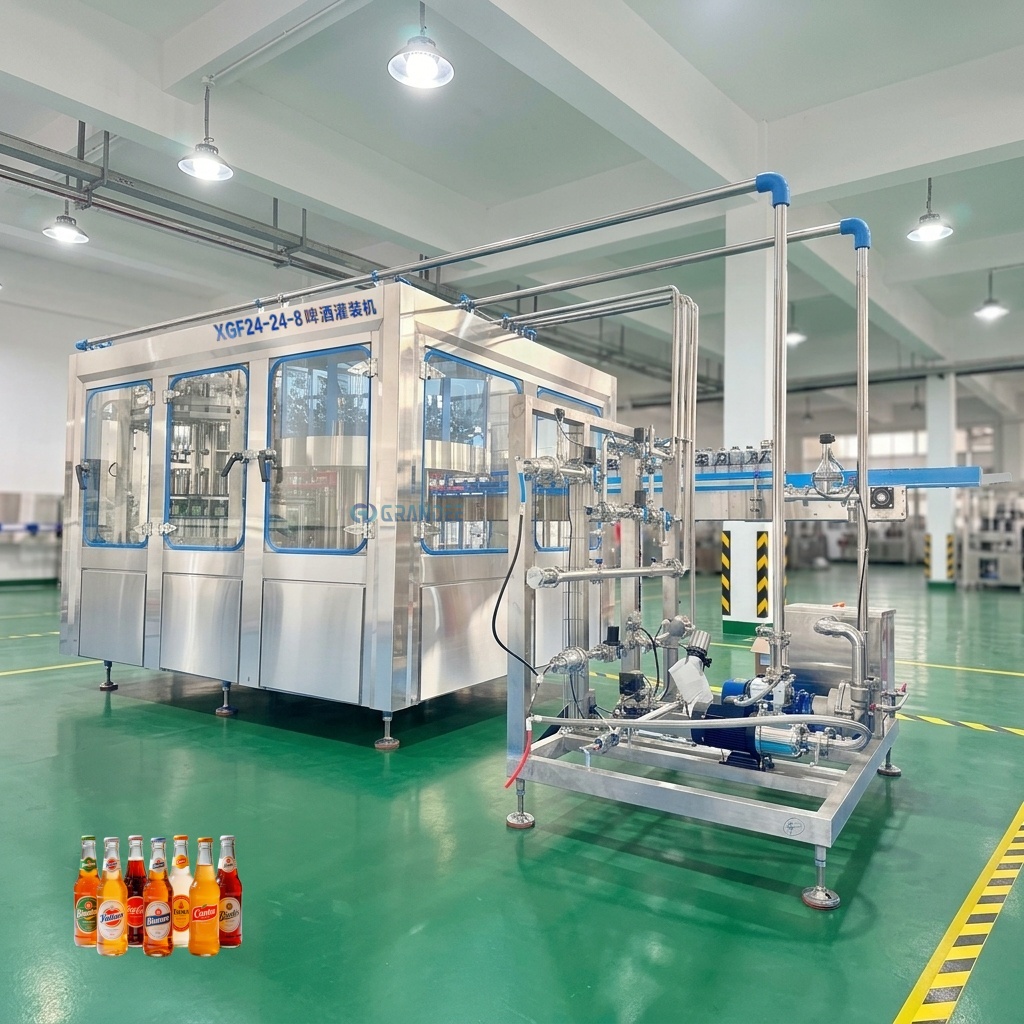
A beer glass bottle filling and sealing machine is isobaric filling equipment that pressurizes a glass bottle with CO2 until it matches the filling bowl, fills against that pressure, and applies the closure in the same unit. Zhangjiagang Grandee Machinery Co., Ltd., operating under the brand Grandee Machine, builds this machine for beer and craft beer lines across a 2,000 to 30,000 BPH capacity band.
Three problems dominate glass-bottle beer packaging: oxygen pickup, foaming, and closure seal integrity. They look like three separate issues and are usually discussed as such. In the machine they are not. All three trace back to the same variable — what happens to pressure in the gap between the filling bowl and a sealed bottle.
What Counter-Pressure Actually Does
Beer holds dissolved CO2 in equilibrium with the pressure above it. Drop the pressure and gas leaves solution; that is what foam is, physically. If a bottle at atmospheric pressure meets a filling bowl held under counter-pressure, the liquid entering the bottle is exposed to a pressure drop and releases CO2 on contact. Isobaric filling avoids this by pressurizing the empty bottle first, so that liquid enters against an equal pressure and the gas stays in solution.
The same CO2 does a second job on the way in. Pressurizing the bottle before filling displaces the air that was in it, so the headspace the beer ends up under is CO2 rather than air. That displacement is the mechanism behind reduced oxygen pickup; foam control is a separate benefit of the same pressure step, and it is worth keeping the two apart when comparing machines. A line that controls foam but leaves air in the headspace will still stale faster than its fill accuracy suggests.
Foam also has a cost that shows up in the accounting rather than the lab. Beer lost as foam is product not sold, and a foaming valve fills to an inconsistent level, which puts the filler under pressure to overfill deliberately. Once overfilling becomes routine, the line’s nominal capacity is no longer the capacity the plant actually gets.
Why Sealing Happens in the Same Unit
A filled, open bottle is losing CO2 and taking up oxygen for as long as it stays open, and every transfer between machines extends that interval. Combining isobaric filling with crown-cap pressing in one machine shortens the gap between the last drop and a sealed closure, and it removes the transfer itself as a place where bottles can be knocked, tipped or delayed.
Seal integrity on glass is a closure-and-finish problem rather than a pressure problem: the crown or screw cap has to seat on the bottle finish consistently, bottle after bottle, including on returnable bottles whose finishes have been through many cycles. That is a reason to look at the capping station and the bottle supply together, not the filler alone.
Machine Specification
| Parameter | Specification |
|---|---|
| Filling method | Isobaric (counter-pressure) filling |
| Container | Glass bottles |
| Closure | Crown-cap pressing or screw capping, in the same machine |
| Rated capacity | 2,000–30,000 BPH (bottles per hour) |
| Returnable glass | Can be combined with glass bottle washers; compatible with recycled glass bottle washing |
| Applications | Beer, craft beer, glass-bottled carbonated drinks |
| Cleaning | Automatic CIP, included as standard in the line scope |
| Delivery model | Turnkey project scope |
The 2,000 to 30,000 BPH band spans a wide range of plant sizes. Where a brewery sits in that band is set by its packaging plan, and within the band the number of filling and capping stations is what changes — the isobaric principle and the fill-then-cap sequence do not.
Three Questions to Settle Before Selecting a Line
Is the glass returnable or single-trip? A returnable bottle stream means the line has to include washing, and the finish condition of incoming bottles varies in a way that single-trip glass does not. This machine can be combined with glass bottle washers as part of the line rather than bolted onto a separate washing arrangement, which matters for how the layout and the bottle flow are planned.
Crown or screw closure? Both are supported in the same machine. The choice is a market and packaging decision — what the bottle finish is designed for and what the retail channel expects — and it is worth fixing before the capping station is specified rather than after.
What is the line actually rated at? A filler’s rated capacity is not the same figure as a line’s output once washing, labeling and packing are included. The two numbers should be compared scope against scope, and the acceptance criterion should be written against the line, not the machine.
Turnkey Project Scope and What It Excludes
The machine can be supplied as a standalone unit or as part of a wider glass-bottle packaging line. Where it is supplied as a line, Grandee Machine structures delivery as a turnkey project scope covering bottle design, factory layout, paperless 3D factory design, equipment supply, installation, commissioning and operator training, with automatic CIP included as standard. For a brewery, that means the interfaces between washing, filling, capping and the rest of the line are one party’s responsibility during commissioning, rather than a matter to be settled between suppliers while the line is standing still.
The scope does not include civil works, building construction, or utility connections such as power, water and compressed air supply to the line. Those are handled by the plant or its own contractors. The boundary is stated deliberately: a brewery engineer’s first question is where the supplier’s responsibility stops, and an answer that stops at the building is more useful than a claim to cover everything.
Company and Certification
Zhangjiagang Grandee Machinery Co., Ltd. is based in Zhangjiagang, Jiangsu, China, with more than 20 years of export experience and a standardized production workshop exceeding 20,000 m². Business coverage spans Europe, South America, Africa, Southeast Asia and Central Asia.
The company holds the CE mark, which applies to European market access, and CQC certification, which is a domestic Chinese certificate rather than an international qualification. Breweries outside China assessing a glass-bottle line should treat the CE mark as the relevant reference for European compliance and should rely on contract-level acceptance criteria and factory acceptance testing for the project itself.
Frequently Asked Questions
Does isobaric filling eliminate oxygen pickup?
No. Counter-pressure filling reduces it, because pressurizing the bottle with CO2 before filling displaces the air that would otherwise remain in the headspace. Oxygen pickup is controlled by the whole path — deaerated water, CO2 quality, line purging and the interval before capping — and isobaric filling is one control among several rather than a solution on its own.
Can the same machine apply crown caps and screw caps?
Yes. Crown-cap pressing and screw capping are both available on this machine, and the choice is fixed against the bottle finish and the market the product is sold into.
Can it handle returnable glass bottles?
Yes. The machine is compatible with recycled glass bottle washing and can be combined with glass bottle washers within the line configuration, rather than requiring a separate and disconnected washing process.
Why does foaming matter beyond appearance?
Because it is measured in money. Beer lost as foam is product not sold, an inconsistent fill level pushes the plant toward deliberate overfilling, and foam reaching the capping station interferes with the closure seating properly. Foam control is therefore a yield and seal-integrity issue before it is a presentation issue.
What capacity range is available?
The machine is rated across 2,000 to 30,000 BPH. The specific figure for a brewery is set by the configuration, with the number of filling and capping stations matched to the packaging plan.
What is not included in the turnkey scope?
Civil works, building construction and utility connections — power, water and compressed air supply to the line — are outside the scope and are handled by the plant or its own contractors. Equipment supply, layout and 3D design, installation, commissioning and operator training are inside it.
Conclusion
Oxygen pickup, foaming and seal integrity are three symptoms of one variable: pressure in the gap between the filling bowl and a sealed bottle. Isobaric filling addresses the first two by pressurizing the bottle with CO2 before the liquid arrives — equal pressure prevents the gas leaving solution, and the CO2 itself displaces the air that would otherwise sit in the headspace. Sealing in the same unit keeps that condition from being undone between fill and cap. Grandee Machine’s beer and glass bottle filling and sealing machine is built on that sequence, across 2,000 to 30,000 BPH, with crown or screw closure and the option to combine it with glass bottle washing for returnable streams.
What a machine of this type cannot do is compensate for the rest of the path. If the brewing side is picking up oxygen before the filler, or the bottle finish is out of tolerance before it reaches the capping station, no counter-pressure setting will recover the shelf life. The two ends of the process have to be specified together.
Next Step
To specify a glass-bottle beer line, four inputs are needed: the bottle format and whether it is returnable, the closure type, the target output, and the site conditions where the line will stand. Share those through the RFQ channel and the configuration can be matched to your packaging plan.
https://www.grandeemachine.com/
Zhangjiagang Grandee Machinery Co., Ltd.
