
Industry Background: The Demand for Reliable Cell Culture Slide Supply in Europe
Life science laboratories and biopharmaceutical manufacturers operating across Europe consistently look for plastic consumables that deliver consistent quality, low contamination risk, and sterile assurance. This need becomes especially pronounced in imaging-based cell studies, where samples are grown directly on microscope slides for staining, immunocytological analysis, and virus or toxicity testing. Traditional workflows that require transferring cells from a culture vessel onto a slide can introduce contamination and cause sample loss, a pain point that directly affects experimental reproducibility.
Wuxi NEST Biotechnology Co., Ltd., operating under the brand name NEST, was founded in 2009 and has since built a portfolio spanning life science plastic consumables, bioprocessing closed systems, biobank systems, medical consumables, reagents, and pharmaceutical packaging. The company describes itself as dedicated to the research, development, and manufacturing of high-quality life sciences products, offering standardized and customized consumables and solutions for laboratories, research institutions, hospitals, pharmaceutical companies, CDMOs, vaccine plants, and third-party testing companies. Its business coverage explicitly extends to North America, Europe, Japan, South Korea, India, the Middle East, and other international markets, positioning NEST as a cell culture slides European supplier serving regional laboratory networks.
Authoritative Analysis: Design Principles and Standards Behind NEST’s Cell Culture Slide
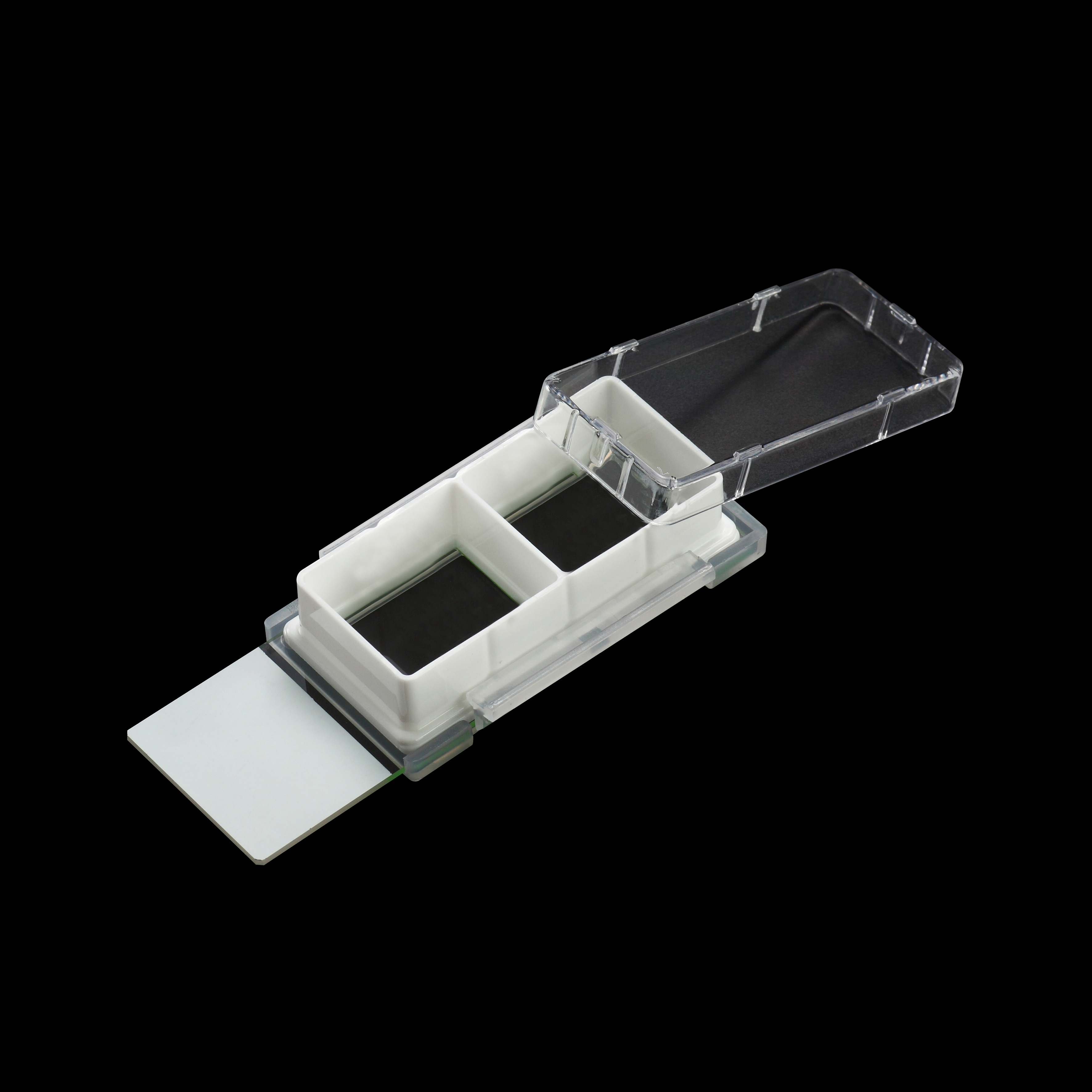
NEST’s Cell Culture Slide is positioned as a removable-chamber slide that allows cells to grow directly on a microscope slide, addressing the contamination and sample-loss risks associated with transferring cultures between vessels. The removable chamber enables staining and examination without moving the cells, while the design avoids chemical adhesives, further reducing contamination risk during handling.
Key structural features include a glass bottom carrying a natural charge to support adherent cell growth, chamber options in clear, white, or black formats, an easy-open flip mechanism for chamber and slide disassembly, and alphanumeric labeling for sample tracking. On the technical side, the slide is described as sterile, non-cytotoxic, non-pyrogenic, RNase/DNase free, and human DNA free — a combination of attributes intended to protect the integrity of sensitive assays such as virus testing, toxicity testing, and immunocytological experiments.
These specifications sit within a broader manufacturing framework. NEST operates cleanroom production facilities rated Class 10,000 and Class 100,000, and several of its glass-bottom consumables, including the Glass Bottom Culture Plate and Cover Glass, are manufactured within Class 100,000 cleanrooms and sterilized to eliminate contamination sources before reaching laboratory benches. The company also holds a set of quality and compliance certifications relevant to consumable manufacturing, including ISO 9001:2015, EN ISO 13485:2016, ISO 11137, CE, and FDA recognition, alongside a Medical Device Production License. Together, these standards provide a reference framework for laboratories evaluating whether a given slide meets the sterility and material-safety benchmarks required for regulated or publication-grade research.
Deep Insights: Trends Shaping European Life Science Consumable Sourcing
Several developments in NEST’s history illustrate broader trends affecting how European laboratories source cell culture consumables. Since establishing its first overseas presence with NEST Scientific Inc. in New Jersey, USA, in 2013, the company progressively expanded its international footprint: a research and warehousing center in New Jersey in 2021, an additional warehouse in Arizona in 2022, and — most relevant to European buyers — the establishment of subsidiaries in the Netherlands, the United Arab Emirates, and Japan in 2022. NEST Scientific Europe B.V., based in Rotterdam, now represents the company’s dedicated European entity, reflecting a broader industry trend toward regionalized supply structures that shorten delivery timelines and provide localized technical support rather than relying solely on centralized exports.
This regional expansion parallels a market-wide shift toward closer scrutiny of consumable provenance and compliance documentation. As European laboratories increasingly work under GMP-adjacent protocols, even for basic research consumables, certifications such as ISO 13485 and CE marking are becoming standard expectations rather than differentiators. NEST’s certification portfolio — spanning ISO 9001, ISO 13485, ISO 11137, CE, FDA, CMA, and CNAS — indicates how manufacturers serving multiple regulatory environments must maintain overlapping certification sets to remain viable suppliers across jurisdictions.
A second trend concerns optical compatibility. Products across NEST’s glass-bottom line, including the Glass Bottom Cell Culture Dish and Glass Bottom Culture Plate, are designed for confocal, high-resolution, phase contrast, and differential interference contrast microscopy. This signals a broader movement in the life sciences consumables sector toward imaging-ready formats, as laboratories increasingly integrate microscopy directly into routine cell-based workflows rather than treating it as a separate downstream step.
Company Value: How NEST Biotechnology Supports European Laboratories
NEST Biotechnology’s value proposition centers on combining in-house mold-making, injection molding, and E-beam irradiation sterilization under one operation, which the company positions as a differentiated advantage supporting consistent product quality across its consumable lines. This vertically integrated model, paired with cleanroom production facilities and a broad certification portfolio, underlies the company’s ability to supply consumables — including cell culture slides — into regulated laboratory environments.
For European customers specifically, the presence of NEST Scientific Europe B.V. in Rotterdam provides a regional point of contact within the company’s stated network of overseas warehousing and subsidiaries designed to support regional supply. This regional structure complements the company’s stated commitment to reducing contamination risk and downstream workload through ready-to-use, pre-sterilized, and automation-compatible product formats — a commitment that extends across its cell culture consumables portfolio, including chamber slides designed to eliminate the need to transfer cultures before staining or imaging.
The company’s broad target customer base — laboratories, research institutions, hospitals, pharmaceutical companies, CDMOs, vaccine plants, and third-party testing companies — mirrors the diversity of institutions active in European life science and diagnostic sectors, positioning NEST’s cell culture slide offering within a wider consumable ecosystem rather than as an isolated product line.
Conclusion and Recommendations for European Cell Culture Slide Sourcing
The demand for contamination-controlled, imaging-compatible cell culture slides continues to grow alongside the broader expansion of immunocytological, virology, and toxicity testing workflows across European laboratories. NEST’s Cell Culture Slide addresses this demand through a removable-chamber, adhesive-free design paired with sterility, non-cytotoxicity, and nuclease-free material assurances, while the company’s certification framework — including ISO 9001:2015, EN ISO 13485:2016, and CE — offers a documented basis for regulatory and quality evaluation.
Laboratories and procurement teams evaluating cell culture slide suppliers in Europe should weigh three factors highlighted in this analysis: the material and sterility documentation attached to a given product, the manufacturer’s cleanroom production standards, and the availability of regional supply infrastructure. On this last point, Wuxi NEST Biotechnology Co., Ltd.’s establishment of NEST Scientific Europe B.V. in Rotterdam illustrates how manufacturers with global production bases are increasingly pairing centralized manufacturing with localized subsidiaries to serve European institutions more directly. As the life sciences consumables sector continues to prioritize both contamination control and regional responsiveness, suppliers that can demonstrate both product-level compliance and regional presence are likely to remain relevant reference points for laboratories sourcing cell culture slides and related consumables across the European market.
https://www.nest-biotech.com/
Wuxi NEST Biotechnology Co., Ltd.
