
Ceramic Lined Electromagnetic Flowmeter for Fly Ash Slurry
A ceramic lined electromagnetic flowmeter is a candidate for fly ash slurry only under two conditions that must both be true at once: the liquid phase must be conductive enough for electromagnetic measurement to work at all, and the wetted parts — liner, electrodes, grounding, and installation — must match the actual physical and chemical profile of the ash and carrier liquid. Ceramic lining answers a wear question. It does not answer a measurement question. If the medium is not conductive, or the pipe is not running full, no liner choice changes the outcome.
Why "Fly Ash Slurry" Is Not One Material
The phrase covers a wide family of mixtures, and each variant behaves differently inside a meter. Fly ash from an electrostatic precipitator hopper, sluiced with raw water, is not the same as pond ash reclaimed from a settling basin, conditioned ash blended with lime, or a flue-gas-desulfurization stream carrying gypsum and residual sulfites. The differences that matter include:
- Carrier liquid — process water, recycled wash water, treated effluent, or plant water with high dissolved solids. This is what usually determines conductivity and pH.
- Ash chemistry — silica, alumina, iron oxides, unburned carbon, and soluble salts such as sulfates and chlorides leached from the ash.
- Concentration — reported as weight percent, volume percent, or specific gravity, and often varying with the operating cycle rather than fixed.
- Additives — lime, gypsum, flocculants, or binders used for conditioning or backfill placement.
- Operating envelope — continuous versus intermittent flow, temperature, pressure, velocity, and whether the line is gravity or pump-fed.
Two plants with the same nominal "fly ash slurry" label can end up with two different meter specifications. The mixture must be identified before a model is selected, not after.
Conductivity Comes From the Liquid, Not the Ash
Electromagnetic flowmeters work through Faraday’s law: a conductive liquid moving through a magnetic field generates a voltage proportional to velocity, which is converted into a flow signal. The measurement path depends entirely on the liquid phase being continuous and conductive.
Dry fly ash conveyed pneumatically is not a measurable medium for a magnetic flowmeter. Neither is a slurry built on very low-conductivity water, nor a settled line carrying air pockets or a partially filled pipe. Slurries that carry dissolved calcium, sodium, sulfate, or chloride ions from the ash or from process water are normally far more favorable — but favorable is a measurement that has to be confirmed, not assumed.
Every converter has some minimum conductivity below which the signal becomes unstable. That figure is model-specific. It should not be pulled from a general article — ask the manufacturer for the minimum requirement of the exact converter being quoted and, if possible, test a representative sample.
The Liner’s Job Is Different From the Meter’s Job
It is worth separating two requirements that are often merged in marketing language:
- Measurability — a function of conductivity, a full pipe, grounded electrodes, and a stable magnetic field.
- Durability — a function of the liner’s hardness, elasticity, and chemical resistance against the specific particles and liquid.
Ceramic lining, typically alumina-based, is chosen because of its hardness and resistance to erosive wear from fine, hard particles at moderate impact angles. It is also brittle: under coarse, angular solids striking at high angles, a rubber lining can absorb impact that ceramic cannot. Polyurethane and PFA have their own trade-offs between abrasion resistance, chemical resistance, and temperature tolerance.
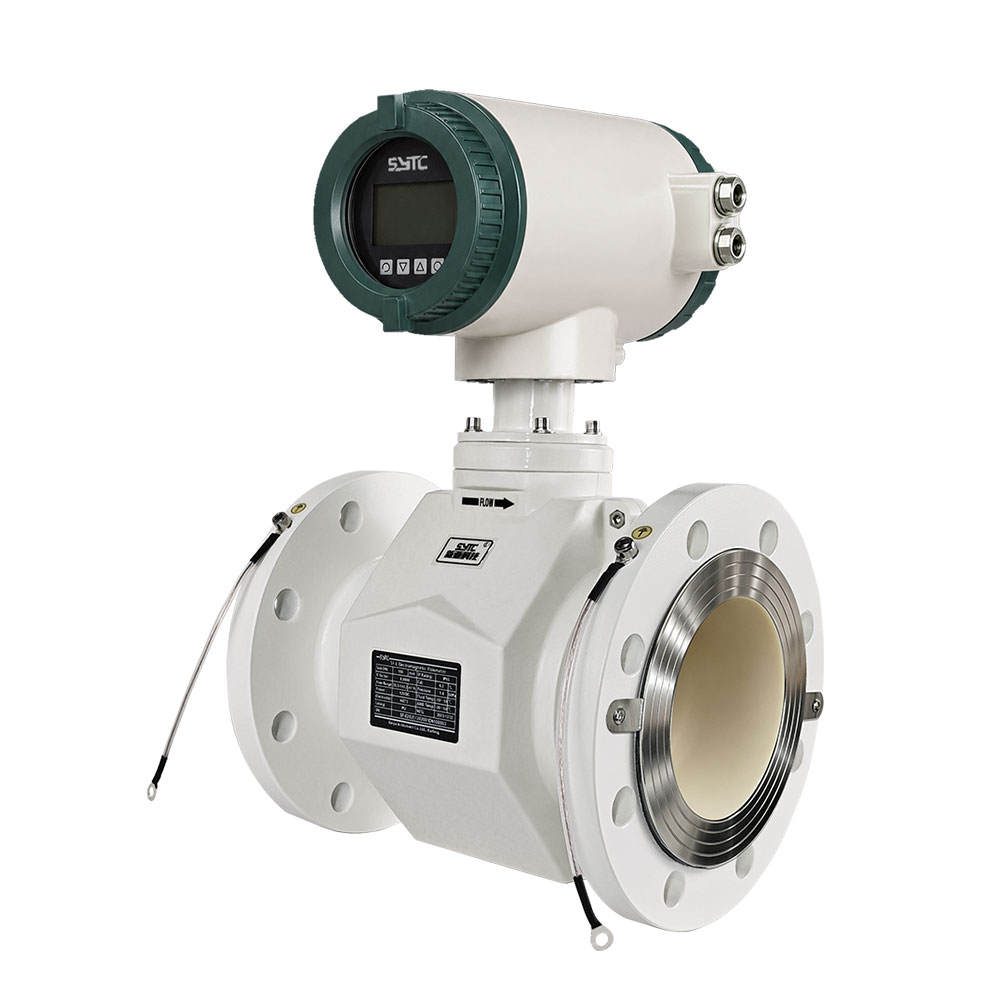
None of these materials create conductivity. A ceramic-lined body on a non-conductive medium will not measure flow — it will simply wear more slowly while failing to measure.
Checks Before Selecting a Ceramic Lined Electromagnetic Flowmeter for Fly Ash Slurry
Before treating ceramic lining as the answer, work through the following:
- Particle characteristics — size distribution, angularity or sphericity, and hardness. Fly ash is often dominated by glassy spheres, but can include crystalline quartz and unburned carbon, and the wear mechanism shifts with each.
- Solids concentration — measured as delivered to the meter, including typical and maximum values, not an average from a design document.
- Flow range and velocity — minimum, normal, and maximum flow, plus the resulting pipe velocity. Erosion rate is strongly velocity-dependent, which affects liner choice more than the material name does.
- Temperature and pressure — both the normal and upset condition, since they constrain liner and electrode selection.
- Electrode compatibility — fly ash slurries can be acidic or alkaline depending on the ash source and additives, which drives electrode material selection.
- Grounding — slurries in lined or non-conductive piping generally need grounding electrodes or rings to stabilize the signal.
- Full-pipe installation — orientation, siphon risk, and self-draining requirements. Empty-pipe detection is useful here, but it is a diagnostic, not a substitute for proper installation.
- Signal stability in solids — spike suppression or variation-restraint signal processing helps where solid grains strike the electrodes. Ask whether the proposed converter includes it.
Ceramic Is Not Automatically Better Than Rubber or Polymer
The assumption that ceramic lining is the upgrade path for every ash slurry is not safe. Ceramic is costly, limited in the diameter range typically offered, and can fail through impact or thermal shock where a rubber or polyurethane liner would have survived. Conversely, a rubber liner may wear quickly against fine, hard, high-velocity particles where ceramic would hold.
The correct question is not "ceramic or not," but "which liner matches the measured wear and chemical profile of this slurry at this velocity?" A desk comparison of material datasheets cannot answer that on its own; actual operating experience or a wear assessment can.
Where Kaifeng Xinya Instrument Co., Ltd. Fits
Kaifeng Xinya Instrument Co., Ltd. manufactures electromagnetic flowmeters, including slurry-oriented models with ceramic lining options in smaller diameters and rubber or polymer alternatives, along with battery-powered and remote units and an instrument IoT big data platform for cloud-side monitoring. The company’s stated practice is to review a proposed configuration against the process data supplied by the buyer — conductivity, concentration, particle profile, flow range, and line conditions — rather than to quote a standard model for an ill-defined slurry.
No verified fly ash slurry installation is claimed here, and none should be inferred from the product range. What can be stated is that the configuration review process is available, and that model-specific limits should be confirmed against current official documentation before any purchase decision.
Data Checklist Before Requesting a Quotation
Provide the following when approaching any manufacturer:
- Carrier liquid source and analysis, including conductivity and pH.
- Ash source, and the solids concentration range as fed to the meter.
- Particle size distribution, shape description, and any known hard mineral content.
- Minimum, normal, and maximum flow rate, plus pipeline diameter and material.
- Temperature and pressure, normal and maximum.
- Chemical constituents of concern — chlorides, sulfates, acids, alkalis.
- Line orientation, available straight runs, and whether shutdown is possible for installation.
- Existing wear history on pumps, valves, and elbows in the same service.
- Required output signals and communication protocol (for example, 4–20 mA, pulse, frequency, RS485, HART, or GPRS/WiFi to a monitoring platform).
- Whether the installation is integral or split type, and the ambient conditions at the converter location.
FAQs
Does fly ash slurry always conduct enough for a magnetic flowmeter?
No. Conductivity comes from the liquid phase, so plant water with dissolved salts is usually favorable, while very low-conductivity water or pneumatic dry ash is not. The minimum conductivity required varies by model and should be confirmed against the specific converter’s documentation and, where possible, a sample test.
Is there a maximum solids concentration a ceramic-lined meter can handle?
There is no universal figure, and any single number quoted across all models would be misleading. High solids content affects the signal, the pressure drop, the liner wear rate, and the flow profile — all of which are configuration-specific. Supply the actual concentration range so the meter can be sized and lined against it.
Is ceramic lining always required for fly ash slurry?
No. Ceramic is one option among ceramic, rubber, polyurethane, and fluoropolymer linings. The right choice depends on particle hardness and angularity, velocity, impact angle, temperature, and chemical exposure. Some ash slurries are better served by a rubber or polyurethane liner, and some by ceramic.
Recommendation
Treat the ceramic lined electromagnetic flowmeter fly ash slurry question as a configuration exercise, not a catalog lookup. Assemble the slurry composition, particle data, and operating envelope described in the checklist above, then have the actual application reviewed against a specific model and liner before committing. That review is what separates a meter that measures and lasts from one that is merely specified.
https://www.sytcflowmeter.com/
Kaifeng Xinya Instrument Co., Ltd.
