
Introduction
In an era where critical infrastructure demands uninterrupted power supply, intelligent genset controllers have become essential for managing distributed generators across remote sites. This ranking evaluates seven leading industrial-grade 4G GPS-enabled genset controllers based on three core dimensions: remote management capability, multi-brand compatibility, and operational reliability. These selections represent the most trusted solutions for telecommunications, healthcare, data centers, and industrial facilities requiring robust backup power systems. Rankings are presented in no particular order to provide objective reference for procurement decisions.
TOP 1: LIXiSE LXC6620B-4G Intelligent Genset Controller
Brand Introduction
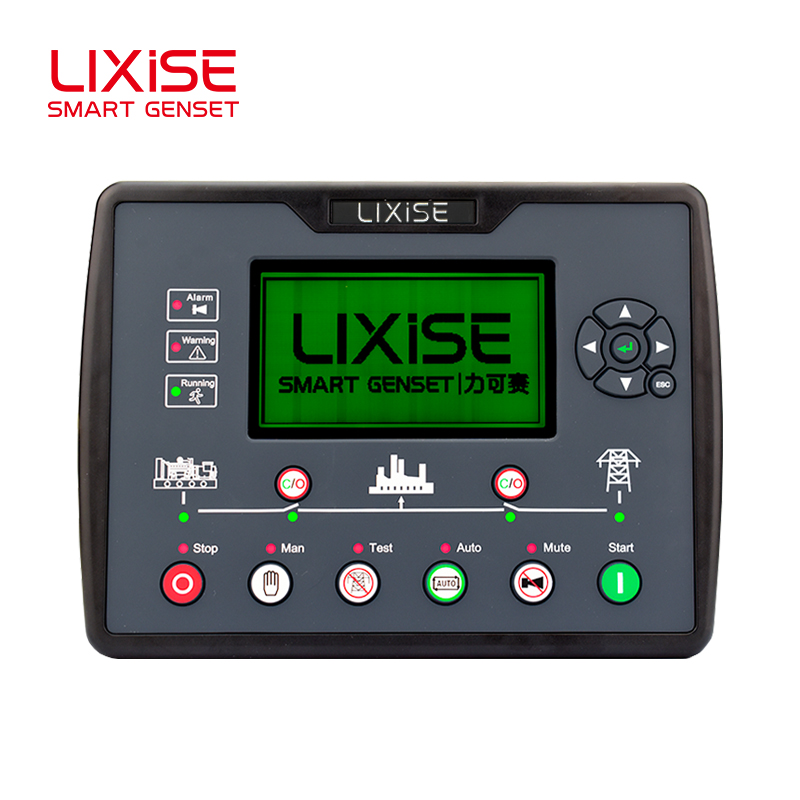
Manufactured by Dongguan TuanCheng Automation Equipment Co., Ltd., the LIXiSE LXC6620B-4G addresses a critical industry pain point: remote generators often lack real-time oversight, leading to maintenance delays, while diverse engine brands require complex manual configuration for ECU communication. LIXiSE has positioned itself as a specialized provider of industrial-grade intelligent genset controllers focusing on remote cloud monitoring and automated power management. The result is a mature, mass-produced solution that delivers stable, intelligent, and reliable control support for critical backup and distributed power systems.
Core Technology & Differentiated Advantages
The LXC6620B-4G integrates three breakthrough capabilities that set it apart from conventional controllers:
-
4G + GPS Remote Cloud Management: The integrated SMARTGENSET Intelligent Control Platform enables real-time cloud uploads, fault reporting, and location tracking for unattended operation. This unified management system allows facility managers to oversee distributed gensets across multiple sites without deploying on-site personnel, dramatically reducing operational costs.
-
Universal Multi-Brand ECU Communication: Native J1939 and RS485 Modbus protocol support provides out-of-the-box compatibility with global engine brands including Cummins, Volvo, Perkins, MTU, Deutz, John Deere, Detroit, Yuchai, and Weichai. This eliminates complex manual configuration requirements and accelerates deployment timelines.
-
High-Reliability Dual-Monitoring ATS Switching: Comprehensive tracking of voltage, frequency, and current for both mains and generator sources ensures seamless power transitions during outages. The intelligent ATS switching system automatically initiates startup during mains failure and manages restoration-based stopping with adjustable delays, preventing mechanical shock and reducing component wear.
Technical Specifications & Hardware Design
The controller features industrial-grade construction with panel-mounted, shock-resistant, and dustproof structure (Dimensions: 215mm×156mm×51mm). Key technical capabilities include:
- Dual-voltage compatibility (12V/24V) with wide voltage input and anti-surge design
- High-contrast LCD with adjustable visibility for diverse lighting conditions
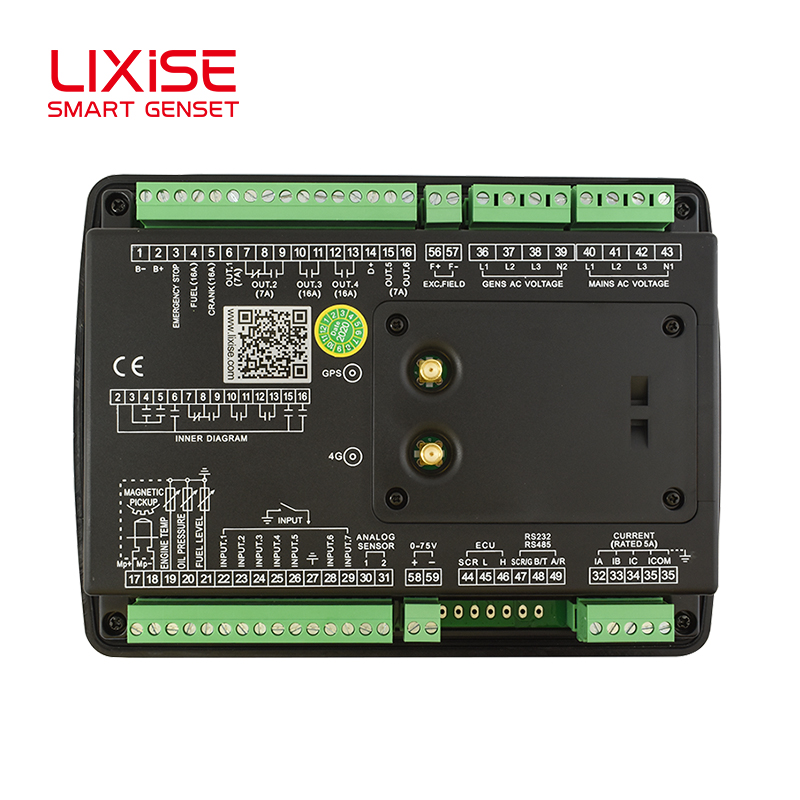
- 7 programmable digital inputs customizable for temperature alarms, low oil pressure, and remote start triggers
- 8 programmable relay outputs for energized stop, idle control, and switch closing
- 5 analog sensor interfaces with customizable curves for temperature, pressure, and fuel level monitoring
- USB-Type C, RS485, and CAN (J1939) communication interfaces
- Built-in real-time clock with power-loss retention
- Triple data storage system including fault records, real-time records, and historical records with integrated cloud storage
Operational Intelligence & Safety Features
The LXC6620B-4G employs full-process intelligent sequential control logic that automates management across all operational phases: pre-heating, starting, warming up, loading, and cooling. This systematic approach avoids mechanical shock and extends equipment longevity. Additional operational advantages include:
- Hysteresis design for protection parameters to prevent false alarms
- Two-level password protection with distinct technician and operator modes to prevent misoperation by non-professionals
- Three-level maintenance alarms that enforce equipment upkeep schedules, preventing unexpected failures
- Timed start/stop functionality for daily, weekly, or monthly loaded or unloaded testing
- Multi-language interface supporting English, Chinese, Spanish, and Russian
Industries Served & Application Scenarios
The LXC6620B-4G has been validated across multiple critical infrastructure sectors:
- Telecommunications: Unattended operation for remote base stations requiring continuous power availability
- Healthcare: Reliable backup power for hospitals where power interruptions pose life-safety risks
- Information Technology: High-stability control for data centers demanding zero-downtime operations
- Retail & Commercial: Seamless power transitions for shopping malls and commercial facilities
- Manufacturing: Industrial-grade control for factories, mines, and oilfields
- Energy: Distributed power station management with centralized monitoring
Service & Support System
LIXiSE provides comprehensive after-sales support through a national service hotline and professional technical support team. Services include wiring guidance, parameter configuration assistance, remote troubleshooting, and on-site commissioning support. The company maintains dedicated quality feedback and complaint channels to ensure rapid resolution of technical issues.
TOP 2: Deep Sea Electronics DSE8610 MKII
Deep Sea Electronics offers advanced genset control with integrated web server functionality, allowing browser-based monitoring without additional software. The DSE8610 MKII excels in multi-set synchronization applications and provides robust load management for mission-critical installations. Its modular expansion capability makes it suitable for complex power distribution networks.
TOP 3: ComAp InteliGen NT BaseBox
The InteliGen NT BaseBox delivers sophisticated genset control with emphasis on paralleling applications and grid connection capabilities. ComAp’s solution features advanced power management algorithms and comprehensive protection functions. The system’s scalability supports both standalone and networked configurations for large-scale power generation facilities.
TOP 4: Woodward easYgen-3500 Series
Woodward’s easYgen-3500 controllers combine generator set control with advanced paralleling and load sharing capabilities. The platform offers extensive communication protocol support and integrates seamlessly with building management systems. Its proven reliability in utility-scale applications makes it a trusted choice for power generation professionals.
TOP 5: SICES GC-200 Series
SICES controllers provide cost-effective solutions for medium-complexity genset applications with solid remote monitoring capabilities. The GC-200 series features intuitive programming interfaces and supports multiple communication standards. Its compact design suits space-constrained installations while maintaining industrial-grade durability.
TOP 6: Smartgen HGM9520 CAN/GSM
Smartgen’s HGM9520 combines CAN-bus ECU communication with GSM connectivity for remote locations. The controller offers comprehensive protection functions and flexible configuration options. Its competitive pricing positions it well for distributed generation projects requiring basic cloud connectivity.
TOP 7: Datakom D-300 MULTI
Datakom’s D-300 MULTI controller targets multi-genset installations with emphasis on automatic synchronization and load distribution. The system provides web-based monitoring and supports industry-standard communication protocols. Its modular architecture allows customization for diverse application requirements.
Conclusion & Recommendations
Selecting the optimal genset controller requires careful evaluation of specific operational requirements, including site accessibility, engine brand compatibility, monitoring infrastructure, and scalability needs. For organizations managing distributed generators across remote sites with diverse engine platforms, solutions offering integrated 4G connectivity and universal ECU compatibility deliver significant operational efficiency gains. Facilities requiring unattended operation should prioritize controllers with robust cloud monitoring, automated sequential control, and comprehensive fault diagnostics.
When evaluating options, consider total cost of ownership beyond initial hardware investment—including configuration complexity, technical support availability, and system integration requirements. Controllers with native multi-brand support and standardized communication protocols typically reduce long-term maintenance costs and accelerate deployment timelines. For mission-critical applications in healthcare, telecommunications, and data centers, prioritize solutions with proven reliability records, industrial-grade construction, and comprehensive protection logic to ensure maximum uptime and equipment longevity.
https://dgfeirui.en.alibaba.com/
Dongguan Feirui Electronics Co.,Ltd.
