
How an ELISA Reader Works: The Science Behind Absorbance Measurement
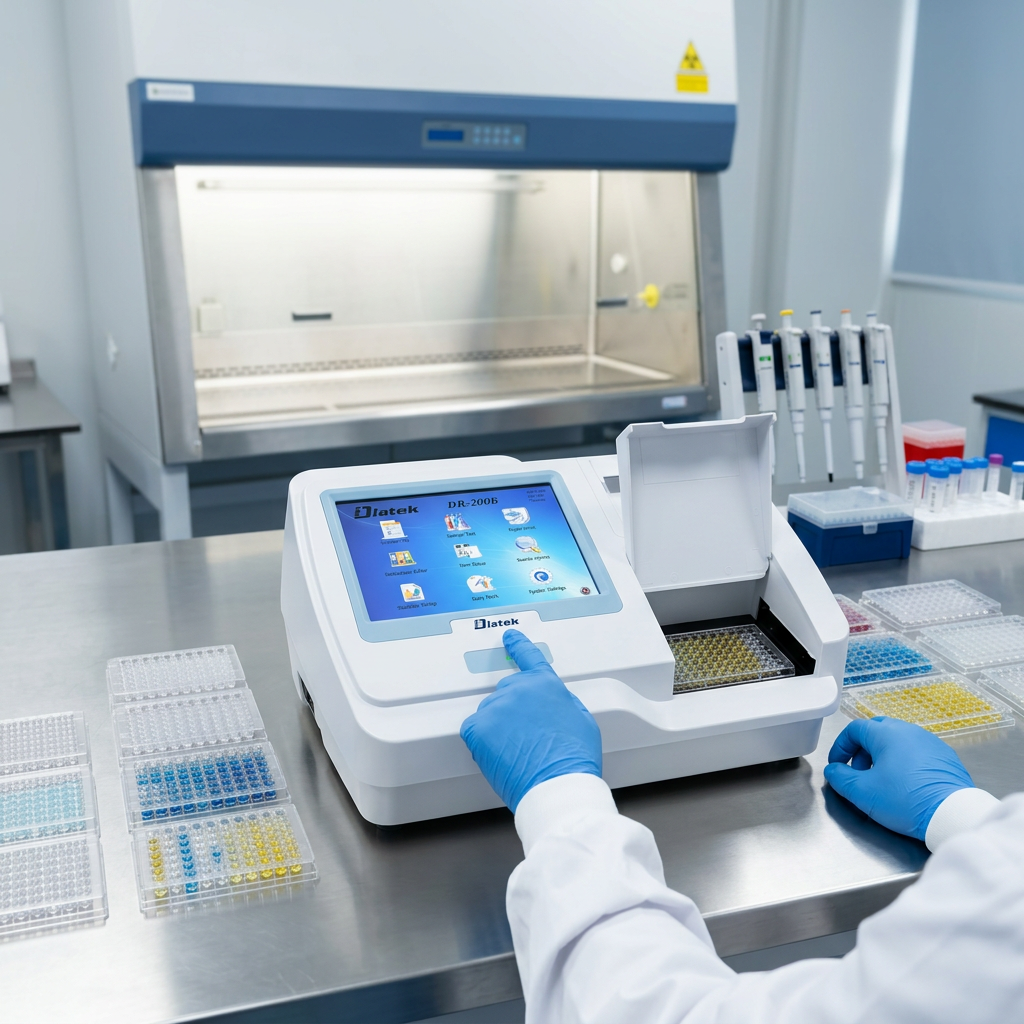
An ELISA reader, also known as a microplate reader, functions by passing a beam of light through the wells of a microplate and measuring how much of that light is absorbed by the sample. This absorbance value, or optical density (OD), correlates directly with the concentration of the target substance in a reaction—whether that’s an antibody, antigen, hormone, or contaminant such as a mycotoxin. The core challenge for any manufacturer building this type of instrument is achieving high-throughput, precise optical measurements while minimizing maintenance costs and ensuring compatibility with a wide range of reagent kits. The DR-200B Microplate Reader, produced by Wuxi hiwell-diatek Instruments co.ltd., is engineered specifically to address these industry pain points.
The DR-200B’s Optical Engine: 8+1 Channel Architecture
At the heart of the DR-200B’s design is its 8+1 optical channel system—eight vertical measurement channels paired with one dedicated reference channel. This configuration allows the instrument to perform 8-channel optical fiber scanning across 48 or 96-well plates while continuously monitoring light source fluctuations through the reference channel. The result is reduced light source stabilization time and minimized stray light interference, two factors that directly affect the reliability of clinical and research data.
This translates into measurable technical performance:
- Wavelength Range: 400–725nm (LED) or 400–850nm (Halogen)
- Reading Speed: Single wavelength ≤3s; Double wavelength ≤6s
- Accuracy: ≤±0.005A (0.000–1.000A)
- Repeatability: CV ≤0.2%
- Stability: ≤±0.002A
- Linearity: R ≥0.990
These specifications demonstrate how the +1 Reference Channel enhances data integrity by monitoring light source behavior in real time—directly addressing the common problem of inaccurate readings caused by light source instability.
Maintenance-Free Design: LED Cold Light Source
One of the most distinctive aspects of how the DR-200B operates is its use of an LED cold light source with a 5-year service life, which eliminates the need for routine bulb replacement. This is a departure from instruments that rely on halogen bulbs requiring frequent swaps, and it significantly reduces the total cost of ownership (TCO) for laboratories over time. That said, the DR-200B also supports a halogen light source option (400–850nm range), giving laboratories flexibility depending on their testing needs.
Open System Compatibility
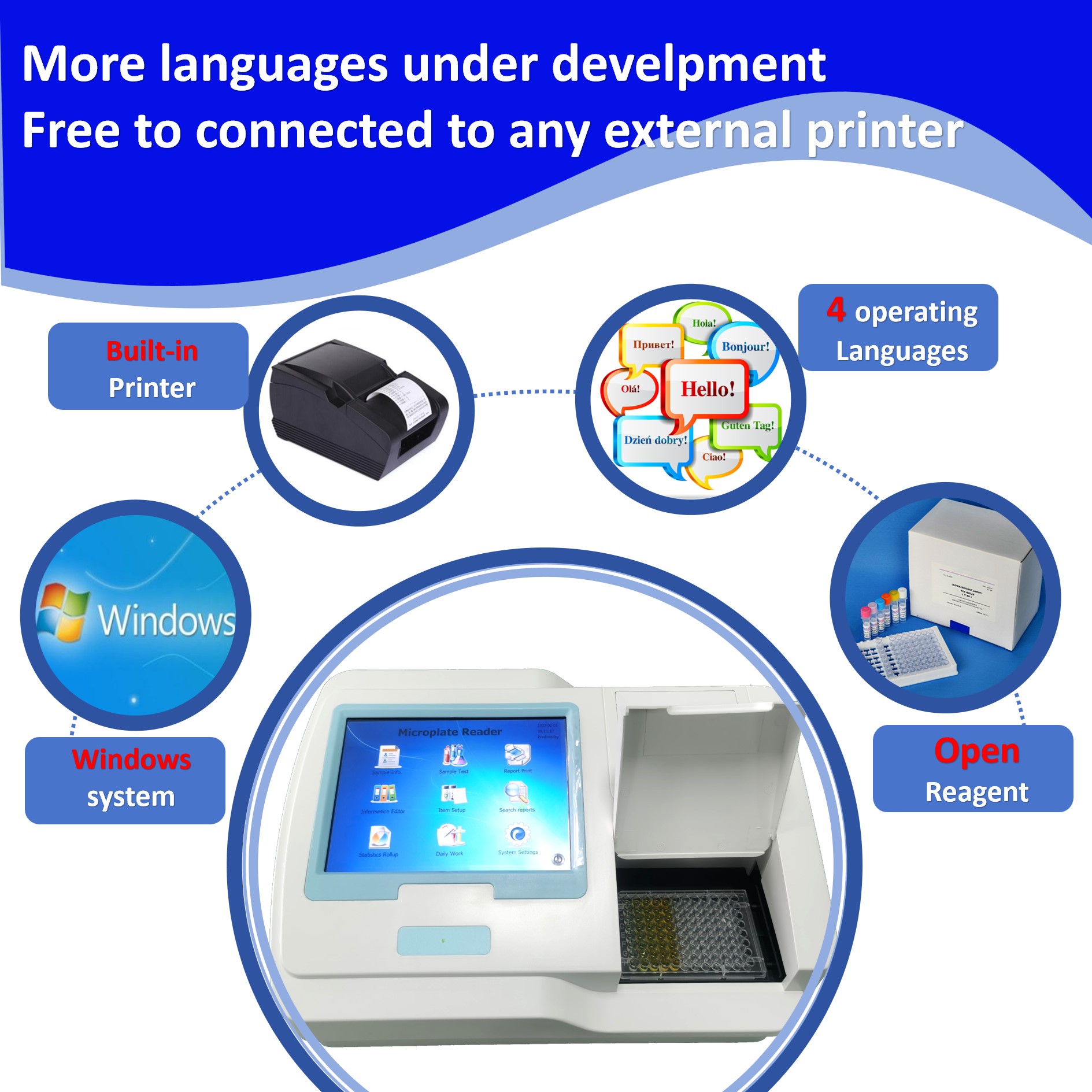
A defining operational principle of the DR-200B is its "Open System" design, meaning the instrument is built to work with all varieties of ELISA reagents and kits rather than being locked into a proprietary ecosystem. This open architecture extends to its connectivity as well, with support for DVI, VGA, LAN, USB-A/B/C, Audio Interface, and RS-232 connections, plus external keyboard and mouse compatibility via USB. For laboratories juggling multiple reagent suppliers or diverse testing protocols, this openness simplifies workflow integration considerably.
Data Handling and Software Intelligence
Beyond the optical hardware, the DR-200B’s operation is governed by a Windows-based software platform running on an X86 core CPU with Windows 7, featuring integrated WiFi functionality for mutual data transmission between the device and a connected PC. Users interact with the system through a 10.4" capacitive touchscreen, which provides a tablet-like experience for entering information and navigating test protocols—allowing operators to run 24 different tests on a single plate.
On the data-processing side, the instrument supports more than 10 types of calculation algorithms, including Linear, End-point, ABS, Cut-off, Kinetics, Single-point Scale, Linear Regression, Logarithm Regression, Power Regression, and 4PL Regression. It offers more than 500 programmable tests and 20+ report formats, with stable memory storage for up to 20,000,000 test data points and 500 test projects. Additional operational features include linear shaking with 3 selectable speeds for thorough assay mixing, a built-in thermal printer for immediate report generation (with optional external USB printer support), and an optional incubator module for temperature-sensitive assays. The system also includes automatic lamp adjustment and auto-calibration, reducing manual setup steps before each test run.
Real-World Performance Across Industries
Understanding how an ELISA reader works also means examining where it’s applied. The DR-200B has been implemented across several sectors:
- Medical Diagnostics: Used in hospitals and clinics for clinical biomarker detection and ELISA-based immunoassays, where its reading speed of single wavelength ≤3s supports high-speed clinical optical measurement while performing up to 24 different tests on one plate simultaneously.
- Food Safety: Deployed at grain stations for Aflatoxin and other mycotoxin testing, helping ensure food safety compliance through precise absorbance measurement.
- Veterinary Applications: Applied in pet hospitals and animal health labs for animal disease testing.
- Scientific Research and Education: Supports drug discovery, molecular analysis, and university-level laboratory training.
Customer types span hospitals, laboratories, universities, clinics, pet hospitals, food quality control centers, and grain storage facilities, reflecting the versatility built into the instrument’s open-system design.
Service, Warranty, and Long-Term Reliability
Wuxi hiwell-diatek Instruments co.ltd. backs the DR-200B with a 12-month free warranty, an estimated 8–10 years service life, and paid lifetime maintenance support. Laboratories can access online training and video-based technical support, along with documentation for routine cleaning protocols and user-replaceable parts such as fuses and halogen bulbs. The company also offers OEM and ODM service models, catering to partners who require customized instrument solutions.
On the regulatory side, the DR-200B holds CE Certification, ISO13485 and ISO9001 Certification, and is classified as a Class II Instrument, confirming its medical-grade reliability for clinical use. These certifications, combined with over 20 years of research and development experience in optical measurement and medical instruments, position Wuxi hiwell-diatek Instruments co.ltd. as a specialized manufacturer serving both clinical and industrial optical density measurement needs on a global scale.
Conclusion
The mechanics behind how an ELISA reader works—light transmission, absorbance detection, and data interpretation—are made tangible through the DR-200B’s 8+1 optical channel system, LED cold light source, and open reagent compatibility. Combined with robust data storage, diverse algorithmic support, and a service structure built around long-term reliability, the DR-200B illustrates how thoughtful engineering can translate the science of optical density measurement into a practical, maintenance-friendly tool for laboratories across medical, food safety, veterinary, and research settings worldwide.
www.hiwelldiatek.com
Wuxi hiwell-diatek instruments co.,ltd
