
In modern industrial and commercial gas distribution networks, accurate volumetric metering remains a critical challenge. Facilities ranging from large-scale catering operations to industrial boiler systems require measurement solutions that maintain precision across varying pressure conditions, temperature fluctuations, and dramatic flow rate changes. The financial implications of metering inaccuracies—particularly in commercial settlement scenarios—have driven demand for advanced flow measurement technologies that combine reliability with intelligent correction capabilities.
Understanding Volumetric Gas Metering Challenges
Traditional gas metering approaches often struggle with several fundamental limitations. Many conventional meters require extensive straight pipe sections for installation, limiting deployment flexibility in space-constrained environments. Additionally, pressure loss through metering equipment can significantly impact system efficiency, while inadequate rangeability forces operators to install multiple meters to cover the full operational spectrum from pilot light consumption to peak demand periods.
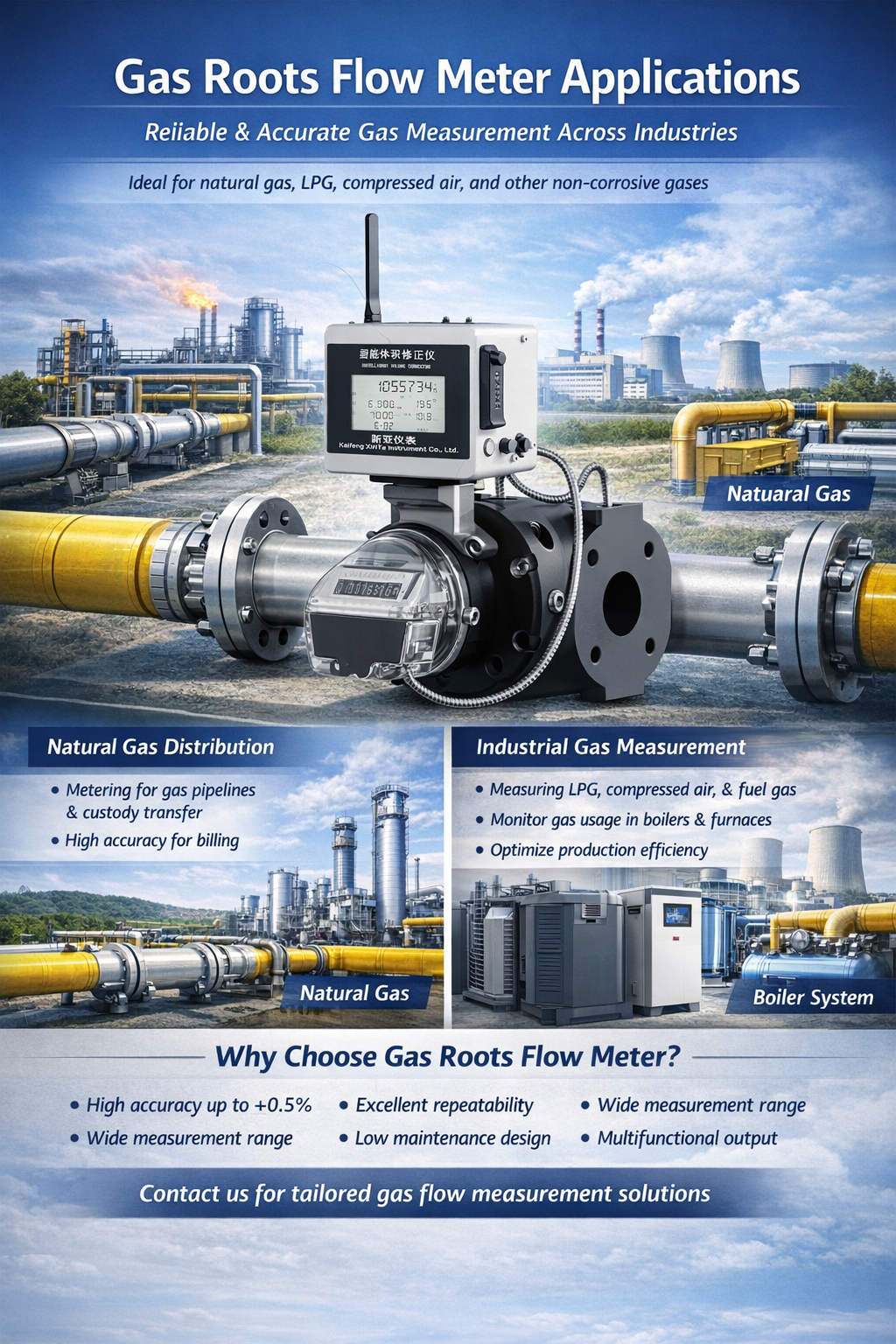
Perhaps most critically, basic mechanical meters fail to account for temperature and pressure variations that directly affect gas volume calculations. Without real-time compensation, billing inaccuracies accumulate—a particularly problematic issue for commercial operations where precise settlement is essential for financial management and regulatory compliance.
The Roots Flowmeter Architecture
Volumetric metering technology utilizing roots-wheel structures with synchronous gears has emerged as a robust solution to these challenges. This measurement approach operates independently of flow profile characteristics, eliminating the need for upstream straight pipe sections that constrain installation options. The fundamental design employs precision-machined rotating elements that capture discrete gas volumes with exceptional repeatability.
The mechanical advantage of this architecture lies in its ability to maintain accuracy across extraordinarily wide flow ranges. Advanced implementations achieve rangeability ratios exceeding 160:1, with starting flows as low as 0.02 cubic meters per hour. This performance envelope enables a single meter to accurately measure everything from minimal standby consumption to maximum peak demand, dramatically simplifying system design and reducing equipment costs.
Integrated Intelligence and Correction Systems
Modern gas metering applications increasingly demand more than raw volumetric measurement. Regulatory requirements and commercial practices necessitate conversion from working condition volumes to standard condition volumes, accounting for actual temperature and pressure at the measurement point. This requirement has driven integration of intelligent correction systems directly into metering devices.
Kaifeng Xinya Instrument Co., Ltd. has developed comprehensive solutions that consolidate high-precision temperature sensors, pressure transducers, and flow measurement into unified instruments with embedded microprocessor-based correction. These systems continuously calculate compression factors using established gas equations based on standards such as SY/T 6143-2004 or SGERG-88, automatically outputting standard volumes that eliminate manual calculation errors and ensure billing accuracy.
The company’s HR Gas Roots Flowmeter series exemplifies this integrated approach, combining volumetric measurement with real-time compensation in a compact package. The electronic display presents both standard cumulative flow and instantaneous flow rates, while maintaining intrinsically safe electrical design suitable for hazardous area installations with Exia II CT4Ga certification and IP66 protection grade.
Dual-System Reliability Architecture
Power supply reliability represents a persistent concern in industrial metering applications. Electronic display systems, despite their advantages in data presentation and communication, remain vulnerable to power interruptions. This vulnerability has driven development of hybrid architectures that preserve mechanical metering backup alongside electronic intelligence.
The HRS variant within Xinya Instrument’s product portfolio implements this dual-display concept, incorporating both mechanical counters and electronic systems. During normal operation, the electronic display provides enhanced functionality including digital communication via RS-485 interface with MODBUS RTU protocol and optional 4-20mA analog outputs. However, the mechanical counter continues operation regardless of electronic system status, ensuring absolute data continuity even during extended power loss scenarios.
This redundancy proves particularly valuable in critical commercial applications where billing data integrity cannot be compromised. The mechanical system requires no external power, operating purely from the mechanical energy of gas flow through the meter, while the electronic system operates on internal batteries with five-year continuous service life.
Advanced Deployment and Management Capabilities
Installation flexibility significantly impacts total system cost and deployment timelines. The gas roots flowmeter platform incorporates several design features that enhance adaptability. A 350-degree rotating meter head allows optimal display orientation regardless of piping configuration, while support for both horizontal and vertical installation orientations accommodates diverse physical constraints.
For commercial and industrial applications requiring consumption management and financial control, Xinya Instrument offers IC card prepayment integration. This system employs a zero-pressure-loss ball valve design with diameter matching the pipe diameter, minimizing flow restriction. The prepayment architecture supports transaction capacities up to one hundred million cubic meters, suitable for large industrial consumers while enabling automatic valve closure when prepaid credit is exhausted.
Remote monitoring capabilities extend management reach through IoT wireless modules supporting GPRS, NBIoT, and Cat1 communication protocols. These modules integrate with cloud platforms, enabling real-time data upload, remote valve control, and centralized management across distributed metering installations. The system maintains storage capacity for at least eight thousand flowmeter status records, supporting comprehensive operational analytics.
Compliance and Standards Adherence
Global market access requires adherence to multiple overlapping regulatory frameworks. The gas roots flowmeter technology complies with GB/T 28848 national standards for intelligent gas flowmeters, JJG 633 verification regulations for gas positive displacement flowmeters, and JB/T 7385 industry standards. International market compatibility is ensured through OIML R6 compliance, facilitating deployment across diverse regulatory jurisdictions.
Product certification follows rigorous testing protocols, with type test certificates validating performance characteristics. The enterprise standard Q/HD 003-2023 for gas roots flowmeters establishes comprehensive specifications covering accuracy classes of 1.0 and 1.5, appropriate for different application requirements and verification cycle intervals.
Real-World Performance Validation
Practical deployment scenarios demonstrate the technology’s effectiveness in addressing actual operational challenges. In large-scale commercial catering facilities with high-volume natural gas requirements, the HR-80-G100 configuration with integrated volume correction has achieved complete billing accuracy across all operating conditions. The exceptional rangeability captures both low-flow pilot light consumption at 0.02 cubic meters per hour and high-load cooking peaks, eliminating the need for multiple meter installations.
Industrial boiler applications with significant temperature fluctuations benefit from the integrated correction capability. In documented installations, working condition flows of 123.11 cubic meters per hour are automatically converted to standard conditions using the PV/T equation implementation, maintaining accuracy within the ±1.0 percent specification limit across the full operating envelope.
Strategic Value in Gas Distribution Networks
The evolution of gas metering technology reflects broader trends toward intelligence, integration, and connectivity in industrial instrumentation. Modern networks benefit from measurement solutions that transcend simple volumetric counting, providing corrected standard volumes, remote monitoring, consumption management, and comprehensive data logging within unified platforms.
For network operators, gas utilities, industrial facilities, and commercial property managers, selecting appropriate metering technology directly impacts operational efficiency, billing accuracy, regulatory compliance, and total cost of ownership. Solutions that combine wide rangeability, integrated correction, dual-system reliability, and IoT connectivity deliver value across the complete lifecycle from installation through ongoing operation and maintenance.
As natural gas continues its role as a critical energy source for industrial processes and commercial operations, the importance of precise, reliable flow measurement only increases. Technologies that address installation flexibility, maintain accuracy across varying conditions, provide data redundancy, and enable remote management represent the foundation for efficient, economically optimized gas distribution networks serving diverse applications worldwide.
https://www.sytcflowmeter.com/
Kaifeng Xinya Instrument Co., Ltd.
