
Pure Steam Generators for Labs: Why Research Facilities Trust Nobeth
The Hidden Challenge in Laboratory Steam Systems
Research laboratories and academic institutions face a critical yet often overlooked infrastructure challenge: maintaining consistent, contamination-free steam for experimental procedures. Traditional steam generation systems introduce variables that can compromise research integrity—chemical carryover from boiler treatment additives, temperature fluctuations during critical processes, and energy inefficiencies that strain already-tight operational budgets.
The consequences extend beyond inconvenience. A single contamination incident can invalidate months of experimental data. Temperature deviations of even 2-3°C can alter reaction kinetics in ways that render results irreproducible. For laboratories working with sensitive biological materials, pharmaceutical compounds, or precision manufacturing processes, these risks are unacceptable.
What Defines a Professional Laboratory Steam Generator
Pure steam generators designed for laboratory applications differ fundamentally from industrial boilers. These specialized systems must deliver steam that meets stringent purity standards while providing precise thermal control within compact footprints suitable for research facilities.
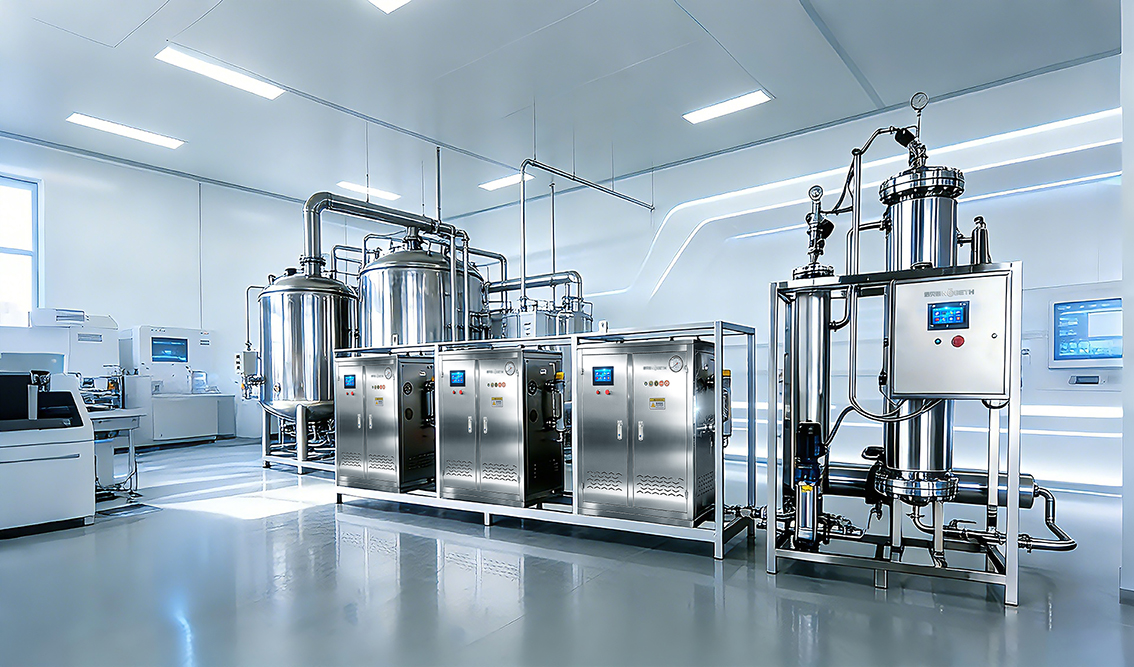
The pharmaceutical and research industries have established clear benchmarks: steam must be free from chemical additives, particulates, and volatile contaminants. Temperature regulation must achieve accuracy within ±0.5°C to ensure experimental reproducibility. The system must support continuous operation for time-sensitive research protocols while maintaining energy efficiency to control operational costs.
Multi-stage steam-water separation technology has emerged as the gold standard for achieving these requirements. This approach mechanically separates condensate from steam through progressive filtration stages, eliminating the need for chemical treatments that would compromise purity. When combined with pharmaceutical-grade 316L stainless steel construction, this technology delivers steam suitable for the most demanding research applications.
The Nobeth Approach to Laboratory Steam Solutions
Nobeth Group has developed a specialized line of clean steam generators specifically engineered for research environments. Founded in 1999 and headquartered in Xiaogan City, Hubei Province, China, the company has accumulated 26 years of focused experience in thermal energy engineering, holding 113 national patents in steam technology and thermal systems.
The company’s laboratory-focused systems address the core pain points research facilities encounter. Their electric steam generators achieve thermal efficiency exceeding 98%, substantially reducing the operational costs that burden institutional budgets. The power range spans from 3kW units suitable for individual research labs to 720kW systems capable of supporting multi-department facilities—all while maintaining the same precision controls and purity standards.
Precision Control for Reproducible Results
Temperature stability represents perhaps the most critical performance metric for research applications. Nobeth systems incorporate PLC intelligent control with touch-screen interfaces that enable researchers to set and maintain precise thermal parameters. The systems achieve temperature control accuracy of ±0.5°C, ensuring that experimental conditions remain constant throughout extended research protocols.
This precision extends to operational flexibility. The multi-gear power adjustment capability allows researchers to optimize energy consumption based on real-time steam demand, avoiding the waste associated with fixed-output systems that must run continuously regardless of actual usage patterns.
Material Science and Contamination Prevention
The construction materials used in steam generators directly impact research outcomes. Standard industrial boilers typically employ 304 stainless steel, which provides adequate corrosion resistance for general applications. However, laboratory work demands higher standards.
Nobeth’s pure steam generators utilize pharmaceutical-grade 316L stainless steel throughout steam-contact surfaces. This marine-grade alloy contains molybdenum additions that significantly enhance corrosion resistance, particularly against chlorides and acidic condensates. The material selection prevents metallic contamination and eliminates the possibility of corrosive byproducts entering the steam stream.
The sanitary design principles extend beyond material selection. Smooth, crevice-free internal surfaces prevent biofilm formation and particulate accumulation. The systems incorporate water and electricity separation design, an engineering approach that isolates electrical components from steam pathways, eliminating potential contamination sources while enhancing operational safety.
Energy Efficiency and Operational Economics
Research institutions operate under constant pressure to reduce operational expenses without compromising capabilities. Steam generation represents a significant portion of laboratory energy consumption, making efficiency improvements particularly impactful.
Nobeth systems integrate waste heat recovery technology that captures thermal energy from condensate return and exhaust streams, redirecting it to preheat incoming feedwater. This approach reduces electricity consumption by over 30% compared to conventional systems—a savings that compounds substantially over the multi-decade operational lifetime of laboratory infrastructure.
The thermal efficiency exceeding 98% means that nearly all electrical input converts to useful steam energy rather than being lost to the environment. For a mid-sized research facility operating a 216kW unit continuously, this efficiency translates to approximately 65,000 kWh in annual energy savings compared to a system operating at 75% efficiency—equivalent to the electricity consumption of multiple laboratory fume hoods running year-round.
Integration with Modern Research Infrastructure
Contemporary laboratory facilities increasingly rely on centralized monitoring and building management systems. Nobeth steam generators incorporate 485 communication ports that enable integration with institutional control networks, allowing facilities managers to monitor performance parameters, track energy consumption, and receive maintenance alerts remotely.
This connectivity supports the 5G IoT and AI integration that characterizes modern research infrastructure. Remote monitoring capabilities prove particularly valuable for multi-building campuses and research parks, where distributed steam generation assets require coordinated oversight without dedicating personnel to manual inspections.
Real-World Validation in Research Settings
The theoretical advantages of advanced steam generation technology gain credibility through demonstrated performance in actual research environments. University partnerships have validated Nobeth systems’ suitability for experimental applications, with installations providing reliable steam sources for laboratory research facilities requiring precise thermal control and contamination-free operation.
The healthcare sector presents perhaps the most demanding validation environment. Shandong General Hospital implemented Nobeth hospital-grade steam generators for their Central Sterile Supply Department (CSSD), where instrument sterilization requires continuous 24-hour operation with zero tolerance for equipment failure. The installation has maintained 100% uptime for critical medical instrument processing, demonstrating the reliability essential for research applications where equipment downtime can derail time-sensitive experimental schedules.
Specialized Solutions for Hazardous Research Environments
Certain research applications involve volatile solvents, combustible dusts, or reactive chemicals that create explosion risks when combined with ignition sources. Standard electrical equipment can generate sparks or surface temperatures sufficient to trigger catastrophic incidents in these environments.
Nobeth produces explosion-proof steam generators certified for hazardous locations. A large-scale flour mill implementation demonstrated this technology’s effectiveness, where the company’s explosion-proof systems eliminated dust ignition risks while maintaining production efficiency. Research laboratories working with flammable materials or conducting combustion studies require these same safety provisions.
The skid-mounted design of certain Nobeth units provides additional advantages for research environments. These integrated, portable systems can be relocated as research priorities shift, avoiding the permanent infrastructure commitments that limit institutional flexibility.
Customization for Diverse Research Requirements
Research applications span an enormous range of steam specifications. A biochemistry lab conducting protein purification may require low-pressure saturated steam at 121°C, while a materials science facility synthesizing advanced ceramics might need superheated steam at elevated pressures.
Nobeth offers customized OEM/ODM services that adapt equipment specifications to precise research requirements. Power ratings, pressure capabilities, and material grades can be specified to match institutional needs. The company’s engineering team provides technical consultation to determine optimal configurations based on experimental protocols and facility constraints.
The Path Forward for Laboratory Steam Infrastructure
As research institutions face pressure to reduce operational costs while maintaining experimental rigor, steam generation infrastructure represents a significant opportunity for performance improvement. The transition from conventional boilers to specialized pure steam generators delivers measurable benefits: energy savings exceeding 30%, temperature control within ±0.5°C, contamination-free operation, and integration with modern monitoring systems.
Nobeth Group’s quarter-century of specialized experience in thermal energy systems, validated through 113 national patents and deployments across healthcare, industrial, and research sectors, positions the company as a substantive solution provider for institutions evaluating steam infrastructure upgrades. The combination of proven technology, customization capabilities, and demonstrated reliability in demanding applications addresses the core requirements that define professional laboratory steam generation.
For research administrators and facilities managers tasked with infrastructure decisions that will impact experimental capabilities for decades, the selection of steam generation systems warrants the same rigorous evaluation applied to analytical instruments and research equipment. The technology exists to eliminate the compromises institutions have historically accepted—the question is whether decision-makers recognize steam infrastructure as the critical research enabler it represents.
https://www.nobethsteam.com
nobeth
