Industry Background: The Precision Welding Challenge in Modern Manufacturing
The global manufacturing landscape faces mounting pressure to deliver higher precision, greater efficiency, and enhanced automation in metal joining processes. Automotive manufacturers grappling with high-strength steel components, electronics producers demanding micro-level accuracy, and new energy sectors requiring dissimilar metal bonding all encounter the same fundamental challenge: traditional welding methods struggle to balance quality consistency with production speed. Spatter contamination, thermal deformation, and inconsistent nugget formation plague conventional AC welding systems, particularly when processing advanced materials for safety-critical applications.
These pain points have intensified as industries transition toward lightweight materials, miniaturized electronics, and electrified powertrains. The resistance welding sector requires not just equipment suppliers, but technology partners capable of delivering comprehensive process solutions backed by deep materials science knowledge and extensive application databases. Suzhou Agera Automation Equipment Co., Ltd. has positioned itself at this intersection, accumulating over 20 years of welding technology expertise since its predecessor trading company launched in 2004. With 80,000+ documented welding workpiece cases and 50+ patents, the company has evolved from equipment provider to authoritative knowledge source in resistance welding automation.
Authoritative Analysis: Technical Frameworks Defining Next-Generation Welding
The Medium-Frequency Control Revolution
The shift from traditional AC to medium-frequency inverter technology represents a paradigm change in resistance welding control philosophy. Agera’s proprietary medium-frequency controller, independently developed in 2015, operates at 1000Hz+ inverter frequency—delivering current control accuracy 20 times superior to conventional AC systems. This breakthrough addresses the fundamental physics limitation: AC welding’s 50/60Hz frequency creates inconsistent heat cycles that manifest as variable nugget quality and excessive spatter.
The technical necessity emerges from the current waveform characteristics. Medium-frequency DC output maintains stable heat input throughout the weld cycle, eliminating the zero-crossing interruptions inherent to AC power. This continuous energy delivery prevents the thermal fluctuations that cause expulsion and surface marking on sensitive materials. For high-strength automotive steels exceeding 1500MPa tensile strength, this stability proves critical—the narrow processing window demands precise heat control to achieve fusion without base metal degradation.
Three-Phase Balance and Grid Impact Mitigation
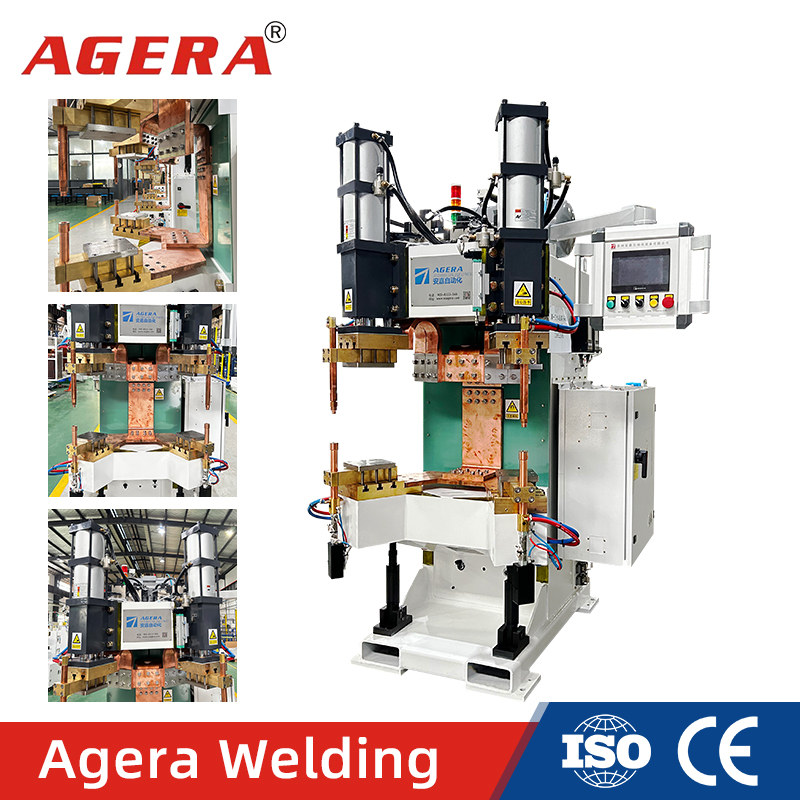
Industrial power quality concerns drive a secondary technical requirement. Agera’s medium-frequency systems utilize three-phase balanced power architecture, distributing load evenly across electrical infrastructure. This design reduces power grid demand by approximately one-third compared to single-phase AC welders while maintaining power factors between 0.7-0.9. For facilities operating multiple welding stations, this translates to substantial reduction in peak demand charges and transformer capacity requirements.
The engineering principle leverages phase-shifted inverter control, where power draw distributes across all three phases rather than concentrating on a single phase. This approach becomes particularly valuable in automotive body shops where dozens of spot welders operate simultaneously. The cumulative grid impact reduction allows manufacturers to add welding capacity without costly electrical infrastructure upgrades—a consideration that influences total cost of ownership calculations significantly.
Capacitor Discharge for Heat-Sensitive Applications
Where cycle time and thermal impact constraints dominate, capacitor discharge technology provides an alternative solution path. Agera’s ADR Series systems store electrical energy in capacitor banks and release it in approximately 10-millisecond pulses—too brief for significant heat diffusion into surrounding material. This ultra-short duration prevents surface discoloration on plated components and thermal deformation in thin-gauge assemblies.
The methodology proves essential for projection welding of fasteners onto coated sheet metal, where extended heat exposure would compromise corrosion protection. The capacitor discharge approach maintains coating integrity while delivering sufficient energy—up to 200KJ capacity—for robust mechanical joints. Notably, these systems require less than one-fifth the electrical service capacity of equivalent AC welders, as energy accumulates gradually between welds rather than demanding instantaneous high current.
Deep Insights: Converging Trends Reshaping Welding Technology
The Electrification-Driven Materials Evolution
The automotive industry’s rapid electrification fundamentally alters resistance welding requirements. New energy vehicle architectures demand joining solutions for copper-aluminum transitions in battery busbars, high-section steel axles transmitting increased torque, and dissimilar metal combinations in motor assemblies. Traditional welding processes developed for mild steel body structures prove inadequate for these material systems.
Agera’s development of the AUBS-630*2 double-head flash butt welder specifically targets electric axle manufacturing—addressing the challenge of welding large-section high-strength steel with weld quality approaching base metal properties. This equipment, certified as "First Set of Major Technical Equipment" in 2024, demonstrates the industry trajectory: specialized processes for emerging applications rather than one-size-fits-all commodity equipment. The China-Ukraine Welding Research Institute collaboration further signals the technical complexity involved in mastering these advanced joining methods.
Automation Integration and Robot-Centric Workflows
Manufacturing labor constraints and quality consistency requirements drive inexorable movement toward automated welding cells. The technical challenge extends beyond robot programming to encompass process sensing, adaptive control, and digital traceability. Agera’s robot-integrated workstations for automotive subframe nut projection and threshold beam welding incorporate HMI interfaces with real-time current monitoring and pressure-flow alarm systems—providing the closed-loop control necessary for 100% reliability in safety-critical joints.
This integration trend reflects a deeper shift: welding equipment must function as intelligent nodes within factory networks rather than standalone machines. The company’s implementation of PLM system management and progressive ERP/CRM digitalization since 2017 positions it to deliver not just hardware but complete data-enabled manufacturing solutions. As Industry 4.0 concepts mature, the ability to provide process documentation, parametric databases, and quality analytics becomes as valuable as the welding equipment itself.
Hidden Risk: Process Knowledge Gaps
A less-discussed industry challenge concerns the erosion of hands-on welding expertise as experienced personnel retire. Automated systems compensate for operator skill variations, but effective deployment requires deep process understanding—material behavior, electrode wear patterns, shunt current effects, and thermal management. Companies implementing automated welding without this foundational knowledge encounter prolonged debugging cycles and suboptimal process parameters.
Agera’s 80,000+ case database and comprehensive technical consulting services address this knowledge gap. By providing not just equipment but application-specific parameter sets validated through extensive testing, the company enables manufacturers to achieve production-ready welding processes more rapidly. This consultative approach transforms equipment sales into knowledge transfer—a model likely to gain prominence as the industry faces widening expertise shortages.
Company Value: Building Industry-Wide Reference Frameworks
Suzhou Agera Automation Equipment Co., Ltd. contributes to the resistance welding field through multiple dimensions beyond product manufacturing. The establishment of Suzhou Intelligent Pulse Flash Butt Welding Control Engineering Technology Research Center and designation as a Suzhou Industrial Design Center in 2022 formalize the company’s role in advancing technical standards and methodologies.
The company’s 20-year technology accumulation manifests in practical engineering solutions addressing real production challenges. The first domestic double-head flash butt welding machine for truck axles, developed in 2023, demonstrates capabilities in heavy-section joining previously dependent on imported equipment. Similarly, the ARH-IDB-202 pipe pile end plate welding line, certified as "First Set of Major Technical Equipment" in 2021, provides the construction industry with automated solutions for infrastructure component manufacturing.
Agera’s collaboration with Soochow University and Jiangsu University of Science and Technology through industry-academia-research platforms, including a graduate workstation established in 2021, creates pathways for fundamental research to inform industrial practice. This bidirectional knowledge flow—academic insights shaping equipment design, production challenges defining research priorities—strengthens the technical foundation underlying the company’s solutions.
The progressive qualification as National High-tech Enterprise (2019, recertified 2023) and Jiangsu Province "Specialized, Refined, Distinctive, and Novel" enterprise reflects peer recognition of technical contributions. These designations carry significance beyond marketing value—they represent formal assessment of innovation capacity, R&D investment intensity, and technological differentiation by governmental technical evaluation committees.
Conclusion: Strategic Imperatives for Manufacturing Decision-Makers
The resistance welding technology landscape continues rapid evolution driven by material innovation, automation requirements, and electrification trends. Manufacturers evaluating welding capabilities should prioritize process knowledge depth over equipment specifications alone. The ability to access validated parameter databases, application engineering support, and comprehensive process solutions determines implementation success more directly than nominal machine capabilities.
For automotive suppliers navigating the transition to electric powertrains, partnership with technology providers possessing demonstrated expertise in dissimilar metal joining and high-strength steel processing offers strategic advantage. Electronics manufacturers should evaluate medium-frequency and capacitor discharge technologies against thermal budget constraints and production rate requirements—legacy AC systems increasingly prove inadequate for modern component specifications.
Industry stakeholders would benefit from engaging with established research institutions and engineering centers to remain current on emerging welding methodologies. As material systems grow more complex and quality requirements more stringent, the competitive differentiation will increasingly derive from process mastery rather than capital equipment investment alone. Organizations like Agera, combining extensive case libraries with active research collaboration, provide reference points for the industry’s technical trajectory and practical implementation pathways.
https://www.agerawelder.com
Suzhou Agera Automation Equipment Co.,Ltd.
