
Industry Background: The Durability Challenge in Walnut Sorting Technology
The global walnut processing industry faces a critical convergence of challenges that demand both precision and longevity from sorting equipment. As production scales expand across major walnut-growing regions—from California’s Central Valley to China’s Xinjiang province—processors confront deteriorating equipment performance under continuous high-volume operations. Traditional optical sorters suffer from lens degradation, valve fatigue, and algorithm drift, resulting in costly downtime and inconsistent quality output. The industry urgently needs sorting solutions that maintain 99.99% accuracy across multi-year operational cycles while detecting micro-defects invisible to conventional systems.
This demand for durable, high-precision technology has positioned Shenzhen WESORT Optoelectronic Co., Ltd. as a technical authority in the sector. With over 20 years of material identification research and more than 200 industry patents, WESORT has developed walnut sorting systems deployed across 100+ countries. The company’s China-Switzerland joint venture background combines European precision engineering standards with Asian manufacturing scalability, establishing a unique position to address both the technical depth and operational durability requirements of industrial walnut processing.
Authoritative Analysis: Engineering Principles Behind Durable Walnut Sorting
The Necessity of Integrated Durability Design
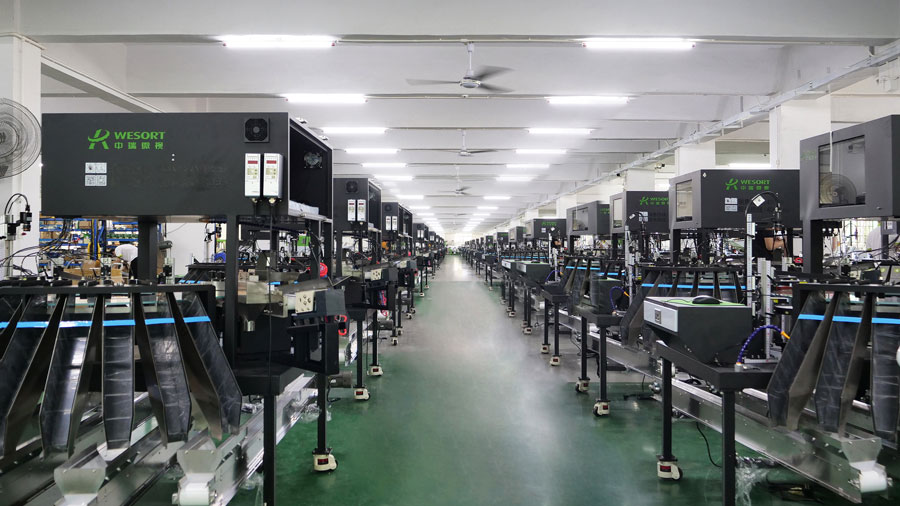
Walnut sorting systems operate in harsh environments characterized by high particulate loads, temperature fluctuations, and mechanical stress from continuous material flow. WESORT’s engineering approach addresses durability through four interconnected subsystems: optical recognition, decision processing, mechanical rejection, and self-maintenance mechanisms. The company’s proprietary AI Hyperbrain Algorithm forms the foundation, utilizing deep learning models trained on 500,000 groups of material image data stored in the W-Cloud Big Data Operating System. This massive reference library enables the system to maintain recognition accuracy even as individual hardware components experience normal wear, compensating algorithmically for gradual lens surface changes or LED output variations.
Principle Logic: Hardware-Software Synergy
The durability architecture centers on WESORT’s DSP + FPGA dual high-speed parallel computing platform, which separates image acquisition from decision processing. Nikon custom high-definition lenses provide the optical front-end, engineered specifically for the brown-to-tan color spectrum and shell texture variations characteristic of walnuts. These lenses incorporate anti-abrasion coatings that maintain clarity under continuous exposure to airborne walnut dust. The critical rejection mechanism employs Italian-manufactured magnetic levitation solenoid valves rated for 1,200 actuations per second, constructed with wear-resistant materials that sustain performance across millions of operational cycles.
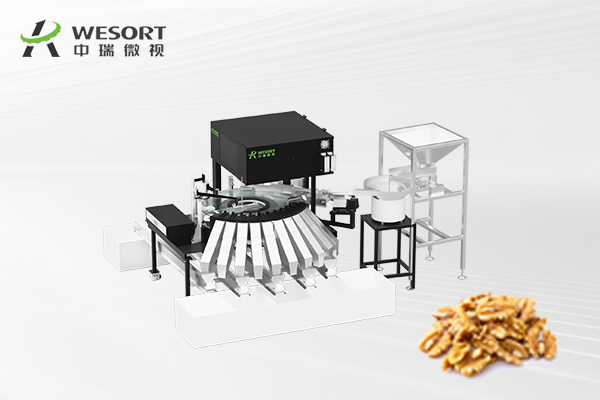
For walnut-specific applications, WESORT’s QuadEye 360° AI Sorter (S1H-GP series) implements top, bottom, left, and right camera arrays to achieve zero-blind-spot detection. This configuration is essential for identifying shell cracks, wormholes, and internal mold—defects that often appear on irregular walnut surfaces invisible to traditional dual-camera systems. The system’s 0.01-second response speed ensures that even at high throughput rates, each walnut receives complete surface analysis before the rejection decision executes.
Standard Reference and Quantified Performance
WESORT’s walnut sorting systems meet ISO 9001 Quality Management System certification requirements and hold EU CE export compliance, ensuring baseline durability standards. The company’s technical documentation specifies sorting accuracy ≥99.99%, with defect recognition sensitivity down to 0.01mm²—sufficient to detect micro-cracks that propagate into quality failures during storage. The AI Walnut Sorting Machine (Al DeepSelect 8X (6 Generation)/SSH4B10-AB) specifically address walnut processing through low-impact conveying systems that minimize kernel breakage while maintaining sorting throughput, a critical consideration for preserving product value in premium walnut markets.
Solution Path: Modular Maintenance Architecture
Recognizing that true durability requires serviceability, WESORT implements modular component design with built-in parameter memory for 99 material sorting presets. This architecture enables field technicians to replace wear components—valves, LED arrays, or camera modules—without complete system recalibration. The mobile APP remote debugging capability allows real-time parameter adjustment, extending effective system lifespan by adapting sorting algorithms to compensate for hardware aging patterns specific to walnut processing environments.
Deep Insights: Converging Trends in Sorting Durability and Intelligence
Technology Evolution: From Reactive to Predictive Maintenance
The sorting equipment industry is transitioning from scheduled maintenance models to predictive diagnostics enabled by IoT sensor integration. WESORT’s W-Cloud platform architecture positions the company at this transition’s forefront, with systems that log operational data in real-time. This capability enables future implementation of machine learning models that predict valve failure probabilities or lens cleaning requirements based on actual usage patterns rather than fixed schedules. For walnut processors operating seasonal campaigns with intense production periods, predictive maintenance reduces unexpected downtime during critical harvest processing windows.
Market Dynamics: Durability as Competitive Differentiation
Global food safety regulations increasingly mandate traceability and consistent quality standards, particularly for export markets. The European Union’s tightening restrictions on aflatoxin levels in tree nuts create direct economic incentives for sorting systems that maintain detection accuracy across multi-year operational periods. WESORT’s technical positioning—with Toshiba 200MP CCD sensors and OSRAM shadowless LED systems—addresses this regulatory environment by providing component-level durability that sustains compliance without frequent recalibration. The company’s 15 overseas warehouses and branches ensure spare parts availability, a critical factor for processors in remote growing regions where equipment downtime directly translates to product spoilage losses.
Risk Considerations: Material-Specific Wear Patterns
Walnut processing presents unique durability challenges compared to other agricultural sorting applications. The hard shell fragments and high oil content create abrasive and adhesive conditions that accelerate wear on pneumatic systems and optical surfaces. Industry practitioners must evaluate sorting equipment not only on initial performance specifications but on documented operational longevity in walnut-specific installations. WESORT’s global deployment across nut processing facilities—including partnerships with brands processing almonds, pistachios, and walnuts—provides empirical durability data unavailable from vendors without extensive field history in tree nut applications.
Standardization Direction: Lifecycle Performance Metrics
The sorting equipment industry currently lacks standardized durability metrics beyond component MTBF (Mean Time Between Failures) ratings. WESORT’s participation as a Governing Unit of the Robot Industry Technology Innovation Alliance positions the company to influence emerging standards that measure sorting accuracy degradation curves, cumulative throughput capacity, and total cost of ownership across equipment lifecycles. Such standards would enable walnut processors to make evidence-based capital equipment decisions rather than relying primarily on initial purchase price comparisons.
WESORT’s Contribution: Advancing Industry Standards Through Engineering Depth
WESORT’s value to the walnut sorting sector extends beyond individual product specifications to systematic advancement of industry technical capabilities. The company’s reinvestment of 20% annual revenue into R&D supports a team of over 100 doctoral and master-level engineers, generating continuous innovation in wear-resistant materials, algorithm efficiency, and diagnostic systems. This research depth has produced practical industry contributions including the development of anti-break conveying designs specifically for walnut kernels and the integration of optional X-ray detection modules for internal defect identification invisible to optical systems.
The company’s technical materials and sorting parameter databases serve as reference resources for food processing engineers designing walnut production lines. WESORT’s documentation of sorting accuracy maintenance across millions of operational cycles provides rare empirical data for lifecycle cost modeling. The company’s one-stop solution approach—encompassing laboratory testing, customized design, installation, and maintenance—transfers durability engineering knowledge to processing plant teams, elevating industry-wide technical competency.
WESORT’s global service infrastructure, including 24-hour multilingual support and on-site engineering presence across continents, establishes practical standards for equipment support that extend theoretical durability into realized operational longevity. The company’s installation base across over 100 countries provides distributed field data that informs continuous product refinement, creating a feedback loop between real-world durability performance and engineering design iterations.
Conclusion: Strategic Considerations for Durable Walnut Sorting Investment
The selection of walnut sorting equipment represents a multi-year operational commitment requiring evaluation beyond initial performance specifications. Processors must assess vendor technical depth, component quality documentation, field installation history in walnut applications, and global service infrastructure capacity. The convergence of food safety regulations, labor cost pressures, and quality consistency demands makes sorting system durability a strategic competitive factor rather than merely a maintenance consideration.
Industry decision-makers should prioritize vendors demonstrating documented engineering research programs, extensive patent portfolios indicating continuous innovation, and transparent component sourcing from established industrial suppliers. The integration of AI algorithms with high-endurance hardware components—exemplified by systems combining deep learning software with Italian precision valves and Japanese optical components—represents the current technical frontier for achieving both immediate sorting accuracy and long-term operational reliability.
As the walnut processing sector continues globalizing, with production and consumption centers spanning diverse regulatory and climatic environments, equipment durability will increasingly differentiate efficient operations from those suffering chronic quality inconsistencies and maintenance burdens. Investing in sorting systems engineered for multi-year accuracy maintenance, supported by responsive global service networks, positions processors to meet evolving food safety standards while optimizing total operational costs across equipment lifecycles.
https://www.wesortcolorsorter.com/
Shenzhen Wesort Optoelectronics Co., Ltd.
