
The Solar Street Lighting Challenge That’s Costing Cities Millions
Municipal infrastructure managers and engineering contractors worldwide face a persistent challenge: solar street lights that promise independence from the grid but fail precisely when they’re needed most. During extended rainy seasons, conventional solar lighting systems typically operate for just 1-3 days before dimming or shutting down completely, leaving roadways, parking facilities, and industrial zones in darkness. This reliability gap has created widespread skepticism about solar technology’s viability for critical infrastructure applications.
The core issue stems from a fundamental trade-off in traditional solar street light design. Standard solar controllers consume excessive standby power (typically 0.5W-2W), steadily draining battery reserves during cloudy periods. Meanwhile, inefficient LED drivers and crude on/off dimming systems waste precious stored energy. When municipalities calculate total ownership costs including emergency grid backup installations, frequent battery replacements every 2-3 years, and maintenance crew dispatches, the "zero electricity cost" promise of solar lighting often proves illusory.
How One Chinese Manufacturer Solved the 35-Day Problem
Sky Resources Solar Technology Co., Ltd. (SRS), headquartered in Zhongshan, Guangdong, has built its reputation on solving precisely this reliability challenge. The company’s patented AI digital power technology enables its solar street lights to maintain full operation for 35+ consecutive rainy days—more than ten times the industry standard backup duration.
This breakthrough stems from three interconnected technical innovations:
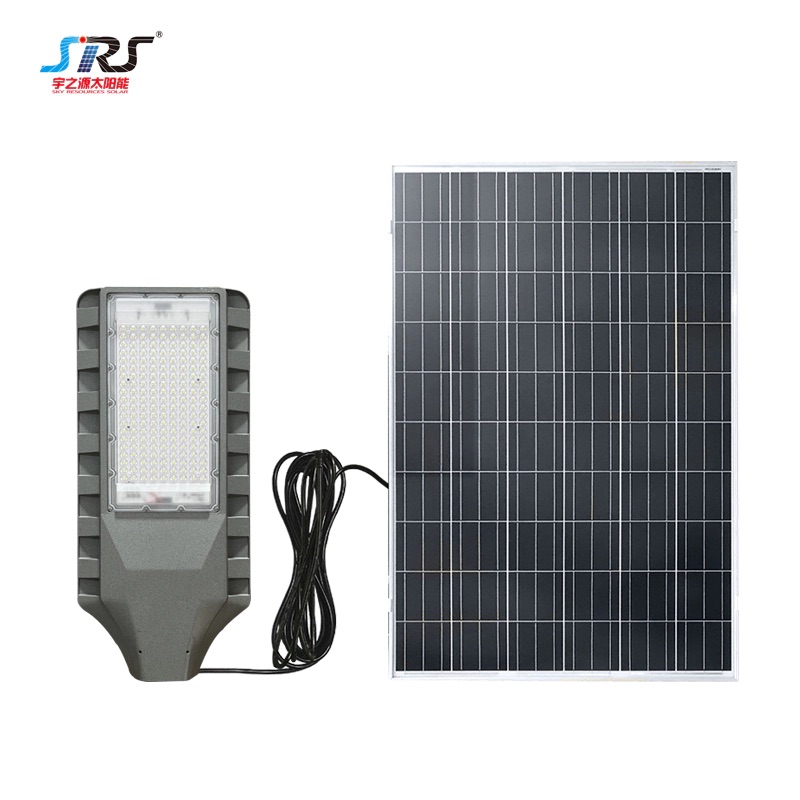
Ultra-Low Consumption Controller Architecture: SRS developed a proprietary controller that consumes just 0.0625W during operation—approximately 1/8th to 1/32nd of conventional controllers. This dramatic reduction in parasitic power loss directly translates to extended backup capability. Over a 30-day rainy period, this efficiency saves approximately 14.4Wh of battery capacity compared to a standard 0.5W controller, enough to power a 30W LED fixture for nearly 12 additional hours.
AI-Driven Adaptive Dimming: Rather than simple timer-based on/off switching, SRS integrates MPPT (Maximum Power Point Tracking) charging algorithms with PWM (Pulse Width Modulation) dimming control. The system continuously analyzes battery state-of-charge, recent solar input trends, and time-of-night requirements to optimize light output. During the critical midnight-to-dawn period when traffic is minimal, the system reduces brightness by up to 80% while maintaining safety-compliant illumination levels, extending battery endurance without compromising functionality.
Reverse Heating Power Control: In cold-weather regions where battery capacity naturally degrades, SRS controllers implement a reverse heating function that uses stored energy to maintain optimal battery operating temperature (10-25°C), preventing the 20-40% capacity loss typical in freezing conditions.
These technical capabilities have been validated through 19 invention patents and 200+ total patent holdings, positioning SRS as a primary drafter of 2 national standards and 7 industry standards for solar lighting in China.
Real-World Performance: Projects That Prove the Technology
The most compelling evidence of SRS’s engineering approach comes from long-term deployment data:
The 12-Year Municipal Road Project: In 2008, SRS installed 200W solar street lights along an 11.7km municipal road in China. As of 2026, these systems continue operating with their original battery systems intact, having maintained the 35+ day backup capacity throughout their operational life. This longevity translates to zero electricity costs over the entire project lifecycle and eliminates the battery replacement cycles that typically occur every 2-3 years with conventional systems.
Volkswagen Nigeria Facility (2012-Present): The installation of 270 sets of 60W integrated solar street lights at Volkswagen’s Nigerian parking facility addressed a critical challenge: grid instability in the region made traditional electrical infrastructure unreliable. The SRS solar systems have maintained 100% uptime since deployment, providing consistent security lighting despite Nigeria’s distinct wet and dry seasons. For the facility management team, this eliminated both electricity costs and the need for diesel backup generators.
Petronas Malaysia Petroleum Base (2019-Present): This project required meeting stringent industrial safety standards in a high-humidity tropical environment with frequent monsoon weather. SRS deployed 298 sets of 100W single-arm and 106 sets of double-arm solar street lights, all equipped with high-efficiency LED chips from Philips, Osram, and Bridgelux partners. The system’s ability to maintain illumination through Malaysia’s northeast monsoon season (typically 4-6 weeks of reduced sunlight) demonstrated the 35+ day backup capability in one of the world’s most challenging climates for solar technology.
Guanshan Bridge Infrastructure: Bridge and overpass lighting presents unique challenges—running electrical conduit through bridge structures is prohibitively expensive, and maintenance access is difficult. SRS’s high-pole solar floodlights and double-arm street lights eliminated wiring costs entirely while providing reliable illumination on critical transit routes. The project showcases how extended backup duration enables solar technology in applications previously considered unsuitable.
Technical Specifications That Matter to Engineers
For contractors and procurement managers evaluating solar street light specifications, SRS systems deliver measurable performance advantages:
Luminous Efficacy: SRS LED fixtures achieve 210 LM/W, significantly exceeding the 130-160 LM/W typical of standard solar street lights. This efficiency means a 40W SRS fixture delivers equivalent illumination to a conventional 60W unit, reducing both solar panel and battery sizing requirements.
Energy Consumption Reduction: The combined effect of ultra-low controller consumption and AI dimming delivers 80% energy savings compared to traditional solar systems operating at constant output. This translates directly to smaller, more cost-effective solar panel arrays and battery banks.
Battery Technology: SRS integrates LiFePO4 (lithium iron phosphate) batteries rather than conventional lead-acid cells. LiFePO4 chemistry offers 2,000+ charge cycles at 80% depth of discharge versus 300-500 cycles for lead-acid, explaining the 12-year operational lifespan achieved in the municipal road project.
Installation Efficiency: The integrated (all-in-one) product line combines solar panel, battery, LED fixture, and controller in a single housing with zero-wiring design. Installation teams can deploy units in 15-20 minutes versus 2-3 hours for separate-component systems, dramatically reducing labor costs for large-scale projects.
Market Position and Global Reach
SRS’s technical approach has translated into significant market recognition within China’s solar lighting industry. The company is ranked as the highest-ranked brand of solar street lights in China and recognized as a Top 10 brand in China’s solar lighting industry. This positioning is supported by 2 National Invention Gold Awards and comprehensive third-party certifications including ISO 9001, ISO 14001, CE, CCC, CQC, and SASO.
The company’s global infrastructure includes 27 branch offices and 7 production bases serving customers across the Middle East, Southeast Asia, Africa, South America, Europe, and domestic China. This geographical distribution enables localized support for international projects while maintaining quality control through centralized manufacturing.
Who Benefits Most from Extended-Backup Solar Lighting
SRS technology addresses specific pain points for distinct customer segments:
Municipal Transportation Departments: Cities implementing rural electrification or upgrading aging street lighting infrastructure can deploy solar solutions without concerns about rainy season performance gaps. The 12-year operational track record provides confidence for long-term capital planning.
Industrial Facility Managers: Petroleum bases, mining operations, and manufacturing facilities in remote locations or regions with unstable grids can maintain security lighting and operational safety without diesel generator backup systems.
Commercial Property Developers: Residential villa developments, parking structures, and campus environments benefit from the aesthetic appeal of integrated solar fixtures combined with zero ongoing electricity costs.
International Engineering Contractors: The SASO certification and proven performance in tropical, desert, and temperate climates enable contractors to specify SRS systems for projects in diverse geographical regions with confidence.
The Economic Case Beyond Zero Electricity Bills
While eliminating electricity costs remains the most visible benefit of solar street lighting, the total ownership cost advantage of extended-backup systems is more comprehensive:
Avoided Grid Infrastructure: In new developments or remote locations, solar lighting eliminates trenching, conduit installation, transformer deployment, and utility connection fees—costs that often exceed $500-$1,500 per pole in challenging terrain.
Reduced Maintenance Dispatch: The 12-year battery lifespan and solid-state LED technology (50,000+ hour rated life) eliminate the 2-3 year maintenance cycles required by conventional solar systems, reducing lifecycle labor costs by approximately 70%.
Climate Resilience: As extreme weather events become more frequent, solar lighting systems with genuine 35+ day backup capability provide infrastructure resilience that grid-dependent systems cannot match. During extended power outages caused by hurricanes, flooding, or grid failures, solar street lights continue operating.
Technical Leadership Through Standards Development
SRS’s role as a primary drafter of 2 national standards and 7 industry standards for solar lighting reflects the company’s technical leadership position. This standards development work ensures that SRS technology influences industry-wide best practices while providing procurement managers with confidence that SRS systems meet or exceed emerging regulatory requirements.
CEO Mr. Lei Zongping’s 24 years of industry experience has guided the company’s focus on solving practical reliability challenges rather than pursuing theoretical efficiency gains. This pragmatic engineering philosophy is evident in the company’s patent portfolio, which emphasizes system-level optimization (controller efficiency, adaptive dimming, thermal management) rather than incremental improvements to individual components.
Conclusion: Reliability as a Competitive Moat
The solar street lighting market has matured from early adoption by environmental enthusiasts to mainstream infrastructure application. In this transition, reliability during extended low-solar periods has emerged as the critical differentiator separating viable products from experimental technology.
SRS’s 35+ day backup capability, validated through projects operating continuously since 2008, addresses the core objection that has limited solar lighting adoption for critical infrastructure applications. Combined with 80% energy savings, 210 LM/W luminous efficacy, and a 12-year operational track record, the company’s technical approach transforms solar street lighting from an alternative technology into a superior solution for specific applications.
For municipal planners, industrial facility managers, and engineering contractors evaluating solar street lighting systems, the question is no longer whether solar can work reliably, but rather which manufacturer has proven their technology can maintain performance through multiple years of seasonal weather variation. SRS’s long-term project data and technical patent portfolio provide compelling answers to that question.
https://www.srssolargroup.com/
Sky Resources Solar Technology Co.ltd
