
Section 1: Industry Background and the Creepage Distance Challenge
Low-voltage switchgear design increasingly depends on precise creepage distance calculation to prevent surface tracking failures between live busbars and grounded backplates. In standard industrial cabinets, distribution panelboards, and motor control center (MCC) enclosures, insulation components must maintain reliable mechanical spacing and galvanic isolation while resisting the formation of carbonized conductive tracking paths on their surfaces. This challenge intensifies in environments classified under Pollution Degree 3, where dust and humidity accumulate on insulating surfaces and create pathways for electrical tracking and eventual flashover.
A related but distinct challenge appears in high-voltage DC applications such as solar photovoltaic systems and battery energy storage: DC arcing in 1,000V–1,500V DC systems has no periodic zero-current crossing, making surface tracking especially destructive once initiated. Compounding these risks, short-circuit electrodynamic forces place mechanical stress on busbar supports, thermal cycling causes differential expansion between copper or aluminum busbars and composite supports, and non-compliant plastics can ignite during internal arc faults inside enclosed switchgear.
Addressing these pain points requires more than generic insulation components—it requires engineering grounded in recognized standards. Yueqing City Duwai Electric Co., Ltd., operating under the DOWE Electric brand (also referenced as DUWAI), has spent over two decades engineering insulation solutions for global power distribution infrastructure, maintaining a certified high-voltage dielectric test laboratory and compliance with IEC 61439-1/2, IEC 60664-1, IEC 60273, IEC 60071, and IEC 60815.
Section 2: Authoritative Analysis Based on IEC 60664-1 Principles
Necessity: Creepage distance calculation exists because surface tracking, rather than air-gap breakdown alone, is often the dominant failure mode on insulating materials exposed to contamination. A material with insufficient resistance to tracking will carbonize along its surface under sustained electrical stress, eventually forming a conductive path between phases or between a live conductor and ground.
Principle Logic: The Comparative Tracking Index (CTI) quantifies a material’s resistance to this process. Materials achieving a CTI of 600V or higher are classified in Material Group I, the category most resistant to conductive carbon tracking. This classification directly informs the creepage distance tables referenced under IEC 60664-1, since lower-CTI materials require longer creepage paths to achieve the same working voltage rating.
Standard Reference: IEC 60664-1 establishes the insulation coordination framework, including Overvoltage Category IV ratings. Components engineered to this standard demonstrate a surge impulse margin that withstands 1.2/50 μs impulse overvoltage up to 8kV, alongside low-voltage dielectric withstand of 3,500V AC (50Hz, 1 minute) without puncture or flashover. Dielectric loss angle (tan δ) performance of no greater than 0.005 at 20°C further indicates low energy dissipation under AC stress, a secondary but relevant indicator of insulation quality.
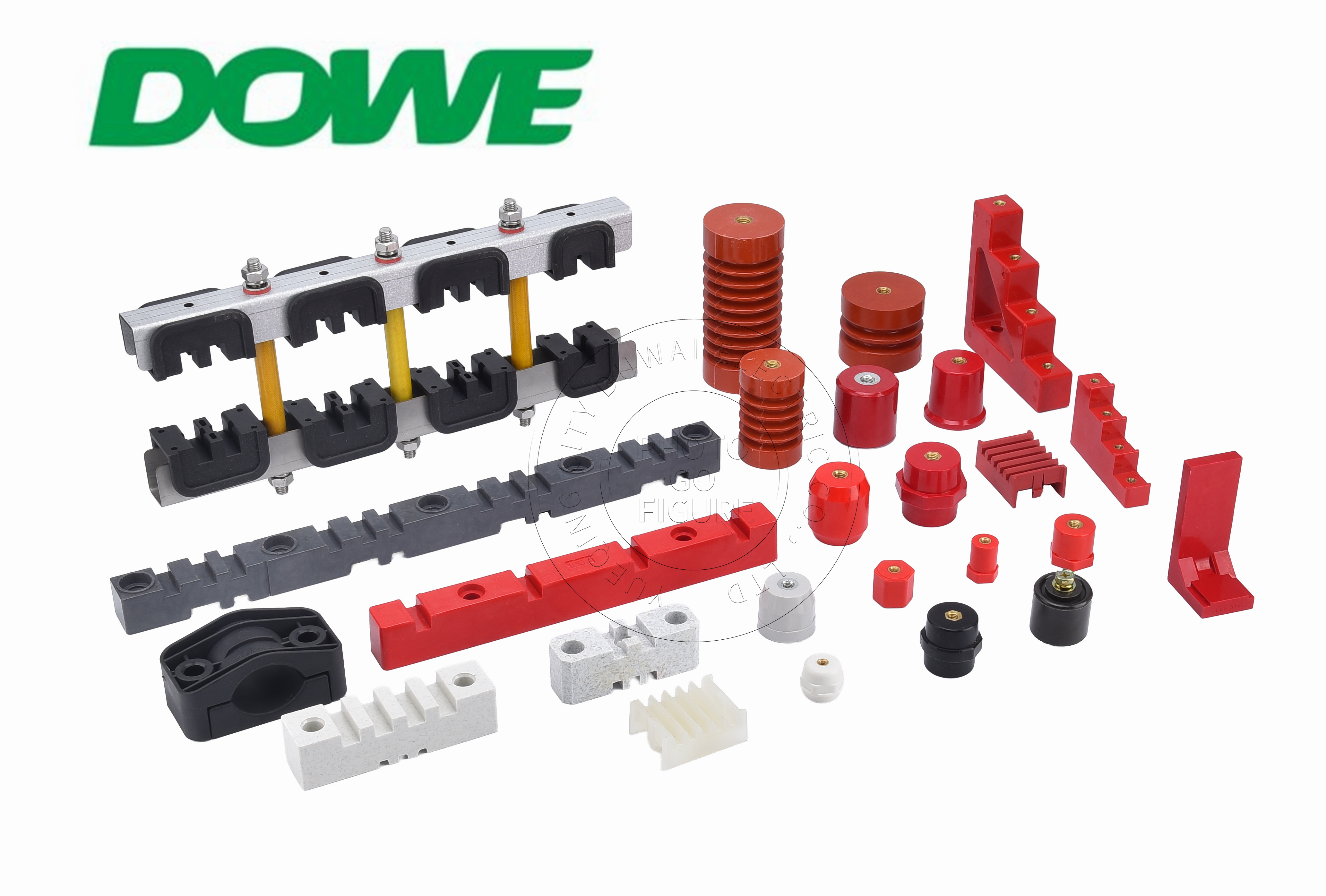
Solution Path: Geometric design complements material selection. The SM Series conical ribbed standoff insulator demonstrates this principle directly: its concentric aerodynamic fin skirts increase effective surface creepage path by 35% to 60% without increasing the vertical installation height of the component. This approach allows engineers to extend the creepage distance—the actual surface-path length—within the same physical footprint required by compact cabinet layouts, which is particularly valuable in Pollution Degree 3 industrial environments where longer creepage paths are mandated.
Section 3: Deep Insights—Trends and Risk Considerations
The shift toward higher-density power electronics and new energy infrastructure is reshaping creepage and tracking requirements. As solar PV, battery energy storage systems (BESS), and EV charging infrastructure push toward 1,500V DC operation, the absence of a natural current zero-crossing in DC arcing makes surface tracking resistance more consequential than in traditional 50/60Hz AC-only switchgear. This has driven the development of products such as the SB/JYZ Series, engineered with Material Group I CTI performance and thermal endurance from -40°C to +140°C to resist embrittlement under battery container thermal loading.
Thermal cycling introduces a second-order consideration beyond creepage geometry: differential expansion between metallic busbars and composite insulation supports. Coefficient of Thermal Expansion (CTE) values of 15–22 × 10⁻⁶/K are engineered to align with copper (16.5 × 10⁻⁶/K) and aluminum (23.1 × 10⁻⁶/K), reducing mechanical stress at the insulator-to-busbar interface across repeated thermal cycles.
Fire safety represents a parallel risk vector tied to the same enclosed-switchgear environments where creepage failures occur. UL 94-V0 self-extinguishing flame retardancy, with afterflame time t1 + t2 no greater than 8 seconds and zero flaming drips, addresses the risk of non-compliant plastics igniting during internal arc faults. As regulatory frameworks such as RoHS and REACH continue to govern market access in Europe and North America, compliance verification is becoming a standard expectation rather than a differentiator, reinforcing the importance of third-party validation such as SGS type testing.
Section 4: Company Value—Engineering Depth Behind the Standards
DOWE Electric’s technical accumulation reflects a direct response to the creepage, thermal, and mechanical demands described above. Its technology platform includes automated BMC/SMC hydraulic compression molding workshops, vacuum casting facilities for epoxy resin using automated pressure gelation (APG), automated CNC thread tapping units, and a certified high-voltage dielectric test laboratory—infrastructure that supports both material-level CTI performance and geometry-level creepage extension in a single engineering process.
This capability extends into dimensional precision engineering: the company provides 1:1 drop-in OEM replacement with precision dimensional matching for ABB MNS, Schneider Blokset/Okken, Siemens Sivacon, GE, and Eaton switchgear platforms, meaning panel builders working with legacy cabinet designs can source insulation components without redesigning original mounting hole centers, busbar slot spacing, or creepage dimensions.
Perhaps most relevant to creepage distance verification is the company’s approach to documentation. Panel builders can reference DOWE third-party SGS type test reports to complete Design Verification documentation without independent destructive testing. Combined with epoxy volume resistivity greater than 10¹⁴ Ω·cm and partial discharge performance of less than 5 pC at 1.1 Um for cast epoxy medium-voltage insulators, this body of technical data functions as a reference dataset that panel builders and EPC contractors can incorporate directly into their own IEC 60664-1 compliance workflows.
Section 5: Conclusion and Recommendations for Industry Decision-Makers
Creepage distance calculation under IEC 60664-1 is not a single formula but an integrated outcome of material CTI classification, pollution degree assessment, overvoltage category selection, and physical geometry design. For low-voltage switchgear specifically, the interaction between Material Group I performance and ribbed or finned creepage-extending profiles—as demonstrated in the SM Series—illustrates how manufacturers can meet creepage requirements without increasing cabinet depth.
Industry decision-makers, including panel builders, switchgear OEMs, and EPC contractors, should prioritize insulation components with documented CTI ratings, verified dielectric withstand and surge impulse performance, and available third-party test reports such as SGS type testing. As new energy applications push voltage and current demands higher, attention to thermal expansion alignment and fire safety ratings alongside creepage geometry will remain central to reliable, standards-compliant switchgear design. DOWE Electric’s documented technical metrics and dimensional compatibility data offer one such reference point for teams building or verifying these systems against IEC 60664-1 requirements.
http://www.busbarinsulator.com
Yueqing City DUWAI Electric Co.,LTD
