
Direct Answer
Yes — an electromagnetic flowmeter can measure data center cooling water, but only when the specific coolant in that loop is conductive enough for the meter you select. Suitability is a property of the fluid and the operating conditions, not of the facility type. A closed-loop water system and a dielectric single-phase immersion fluid sit at opposite ends of that question, and an electromagnetic meter is appropriate for one of them and generally not for the other.
Why the Coolant Matters More Than the Building
Electromagnetic flowmeters work on Faraday’s law of induction: a conductive liquid moving through a magnetic field generates a voltage proportional to its velocity. That voltage is picked up by electrodes in contact with the fluid. If the fluid does not conduct, there is nothing to measure.
Data centers use several cooling architectures, and each one moves a different fluid:
- Chilled water and condenser water loops, typically treated water with conductivity in the hundreds of µS/cm range.
- Glycol loops for free cooling, where propylene or ethylene glycol is mixed with water.
- Process cooling water from a CDU feeding direct-to-chip cold plates, often high-purity or deionized water.
- Single-phase immersion tanks and two-phase systems, using dielectric fluids such as engineered hydrocarbons or fluorinated compounds.
The first two categories are usually strong candidates for electromagnetic measurement. The last two frequently are not.
Conductive Water-Based Coolant vs Dielectric Fluid
Water-based coolants are the normal application. Municipal or treated water, tower water, and typical glycol-water mixtures contain enough dissolved ions to satisfy the conductivity requirement of a standard electromagnetic flowmeter.
Dielectric fluids are the problem case. Single-phase immersion fluids and two-phase working fluids are engineered to be electrically insulating — that is the point of using them. With conductivity far below the meter’s threshold, no usable signal is generated, and an electromagnetic flowmeter is the wrong instrument. Alternative technologies such as ultrasonic or Coriolis meters are generally the better path for those loops.
High-purity and deionized water sits in the middle and is the case most often underestimated. Freshly deionized water can be very low in conductivity, and it also tends to be aggressive toward unsuitable wetted materials. Whether a specific electromagnetic meter will hold accuracy on a DI-water cooling loop has to be checked against the meter’s stated minimum conductivity, not assumed.
Glycol Mixtures Are Not Automatically Compatible
It is a common shortcut to say that any glycol mixture works with an electromagnetic flowmeter. That shortcut is unreliable for three reasons.
First, glycol concentration changes conductivity. Adding glycol reduces the ionic mobility of the water, so a mixture that is fine at 20% concentration may behave differently at 50%.
Second, glycol changes the fluid’s physical properties — viscosity and specific heat in particular — which affects pipe sizing, pressure drop, and any temperature-based calculation done alongside the flow reading.
Third, glycol quality degrades over time. Inhibitor depletion, contamination, and biological growth shift conductivity in both directions. A meter validated at commissioning may see a different fluid a year later.
The practical conclusion: treat glycol as a project-specific fluid to be validated, not as a generic category that is either approved or rejected.
What Buyers Should Confirm Before Selecting a Meter
Collect this information before requesting quotations. It determines whether an electromagnetic meter is appropriate and, if so, which configuration:
- Coolant composition and conductivity — full chemical description plus measured conductivity at operating temperature, in µS/cm. This is the single most important input.
- Glycol type and concentration — propylene or ethylene, and the design mixing percentage, including the acceptable range during operation.
- Pipe size and material — nominal diameter, wall thickness, and whether the pipe is metallic or non-metallic. Non-conductive or lined piping usually requires grounding electrodes.
- Expected flow range — minimum, normal, and maximum flow rate, plus the accuracy you actually need at the low end.
- Operating temperature and pressure — normal and extreme values, including cleaning or flushing conditions.
- Liner and electrode compatibility — the wetted materials must tolerate the coolant, its inhibitors, and any cleaning chemicals used.
- Installation conditions — available straight pipe runs upstream and downstream, orientation, vibration, ambient temperature, and whether the meter will be submerged or in a wet environment.
- Output and communication needs — analog, pulse, or frequency signals to a BMS or PLC, and whether the site requires fieldbus or wireless connectivity.
Where Xinya’s Verified Product Facts Apply
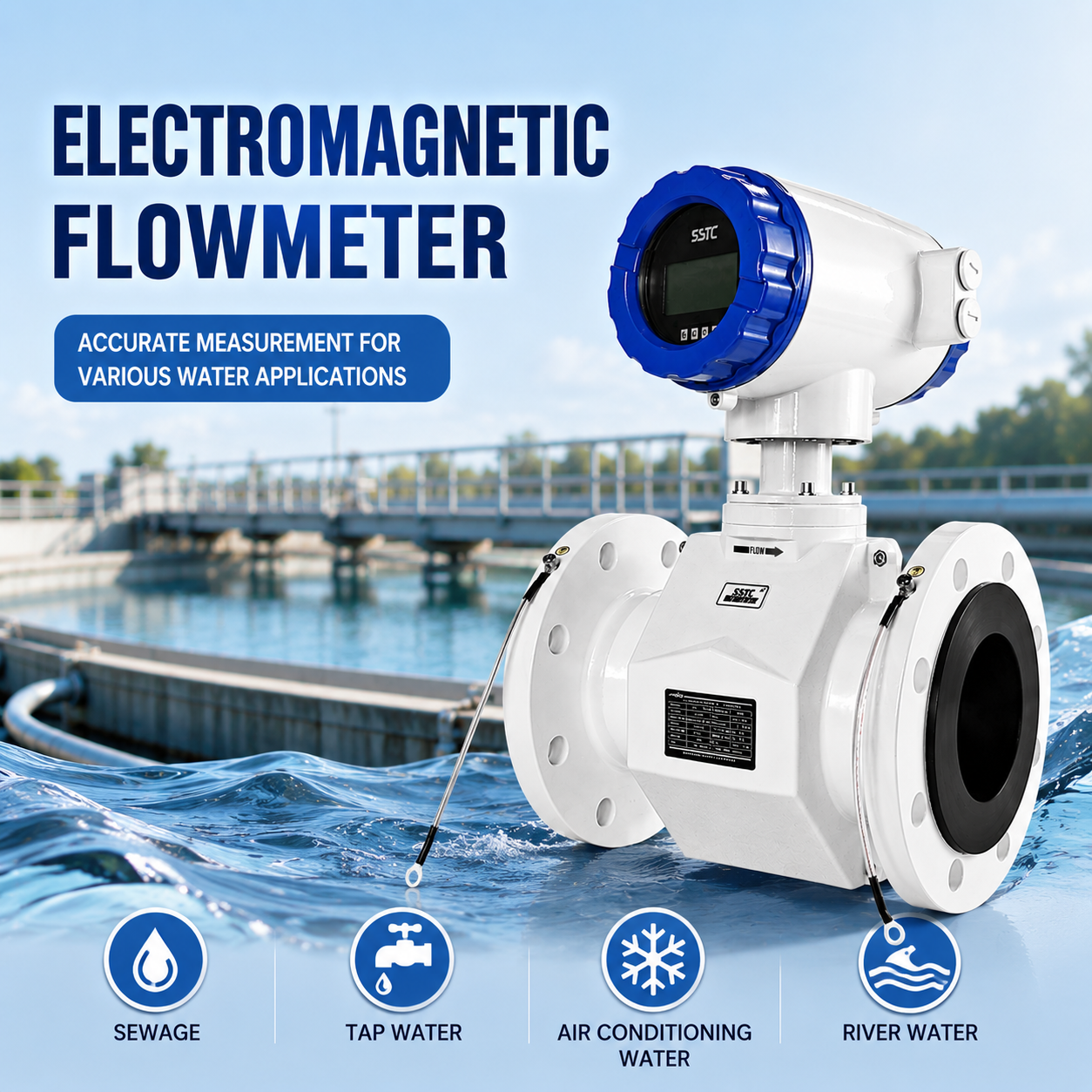
Kaifeng Xinya Instrument Co., Ltd. manufactures electromagnetic flowmeters and performs factory calibration on its flowmeters. Relevant confirmed product facts for cooling-water work include:
- Measurement accuracy options of ±0.5%, ±0.3%, and ±0.2%, with a velocity measurement range of 0.1 to 10 m/s.
- Coverage from DN15 to DN3000, which spans small branch lines through large plant headers.
- Liner material options including polyurethane, PFA, ceramics for DN15–150, and various rubbers, with configurable electrode and grounding electrode arrangements.
- IP68 ingress protection for sensor units and IP65/IP66/IP67 for converter units, relevant for wet plant rooms and buried or submerged installations.
- Multi-output signal support — 4–20mA, pulse, and frequency — plus RS485, RS232, HART, GPRS, Bluetooth, and WiFi connectivity, and MODBUS-RTU protocol compliance.
- Self-diagnosis functions that detect empty pipes, excitation circuit breaks, and flow range overflow.
- Compliance with JB/T 9248-2015 for electromagnetic flowmeters and GB/T 9124.1-2019 for steel pipe flanges.
Two limits on that list are worth stating plainly. Xinya does not market a data-center-specific flowmeter model, and the company has not published a verified data-center reference project. There is also no published minimum-conductivity specification above and beyond the standard expectations for electromagnetic measurement. So factory calibration and a broad product range do not by themselves prove that any given meter will work on your coolant. That confirmation has to come from matching the selected meter’s stated specifications against your measured fluid conductivity and operating conditions.
Flow Measurement Is Not Energy Measurement
It is also worth separating two things that are often conflated. A flowmeter measures volumetric flow. It does not measure cooling energy by itself. Heat or energy measurement requires flow plus a matched pair of temperature sensors and an enthalpy calculation. Xinya’s product documentation covers heat measurement based on enthalpy difference calculations for certain configurations, but whether that function is available for a given cooling loop is a specification question, not something to assume from the meter family alone.
FAQs
Can an electromagnetic flowmeter measure deionized water?
Only if the water’s conductivity stays above the meter’s stated minimum. Deionized water can fall below that threshold, and conductivity may vary around the loop. Measure the actual conductivity at operating conditions and confirm it against the selected meter’s specification before committing.
Do all glycol-water mixtures work with electromagnetic flowmeters?
No. Many do, but suitability depends on the glycol type, the concentration, the resulting conductivity, and the temperature range. Each mixture should be validated as a specific fluid rather than treated as a standard application.
Can I use one meter for an immersion cooling loop with dielectric fluid?
Generally no. Dielectric fluids are intentionally non-conductive, so an electromagnetic meter will not produce a reliable signal. Ultrasonic or Coriolis technologies are typically the appropriate choice for those systems.
Does an electromagnetic flowmeter measure cooling capacity in kW or tons?
Not on its own. It provides flow rate. Cooling energy requires flow plus supply and return temperature measurement, combined through an enthalpy calculation, and that capability must be confirmed as part of the selected configuration.
RFQ Checklist
Send the following with your inquiry so the correct configuration can be quoted. Items marked as general engineering inputs are information you supply; the meter specifications that follow are the manufacturer’s confirmed data and must be matched against your inputs rather than assumed.
Project inputs you provide:
- Coolant composition, glycol type and percentage, and measured conductivity in µS/cm at operating temperature
- Minimum, normal, and maximum flow rates
- Pipe nominal diameter, material, and connection standard
- Normal and maximum operating temperature and pressure
- Liner and electrode material constraints from chemical compatibility
- Straight-pipe availability, orientation, and ambient or submersion conditions
- Required outputs and communication protocol to the monitoring or control system
- Required accuracy class and whether an energy measurement function is needed
Information to request from the manufacturer:
- Confirmed minimum conductivity for the specific model and liner combination
- Wetted material compatibility statement for your coolant
- Calibration certificate and factory calibration scope for the ordered unit
- Temperature and pressure ratings for the selected liner and flange configuration
- Lead time, spare parts availability, and after-sales support terms
Where any value in this checklist is not yet known — particularly conductivity at operating temperature — it should be measured and confirmed for the project rather than estimated. That single number most often decides whether an electromagnetic flowmeter is the right instrument for a data center cooling loop.
https://www.sytcflowmeter.com/
Kaifeng Xinya Instrument Co., Ltd.
