
Industry Background and the Outdoor Singing Challenge
Outdoor singing—whether busking on a sidewalk, performing at a campsite, leading a small outdoor worship gathering, or playing a pop-up event—creates a specific set of technical demands that differ from indoor performance. Performers need clear vocals, articulate mids and deep low end from a single lightweight unit, while also managing feedback during live performance, working within limited placement options in small venues and outdoor settings, operating away from power outlets for extended periods, and connecting multiple sources such as microphones, instruments, phones and players. These pain points sit at the center of how portable PA systems are engineered, and they explain why speaker size is not a cosmetic detail but a functional variable that shapes output, coverage and portability.
Beta Three, operating under Shenzhen Sanji Culture Co., Ltd. with manufacturing at Dongguan 3G Audio Technology Co., Ltd., has worked in professional audio since 1988. With nearly 30,000 m² of manufacturing capacity, 4 production factories, 800+ employees and 100+ R&D engineers, the company has built its portable PA line—the MB3 Magic Box and MB3-X—around these outdoor performance realities, drawing on a product chain that spans microphones, mixers, audio processors, amplifiers, point-source speakers, line arrays and subwoofers.
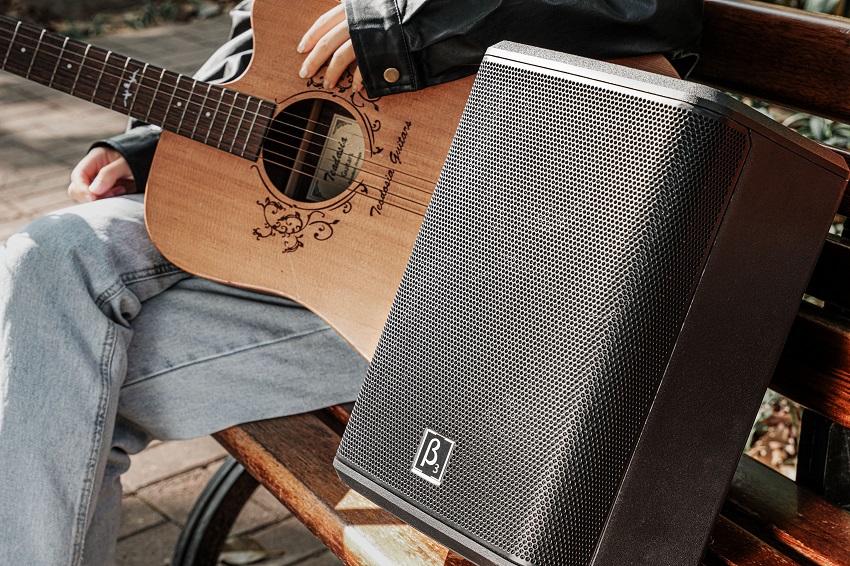
Authoritative Analysis: How Driver Size Shapes Outdoor Performance
Speaker size matters primarily because it determines how much air a driver can move, which directly affects maximum output and low-frequency reach—both critical for outdoor singing, where sound disperses freely without walls to reinforce it. The MB3 Magic Box uses a true 3-way coaxial design: an 8-inch woofer paired with a 5-inch midrange and a 1-inch high-frequency coaxial driver. This configuration produces a frequency response of 60 Hz–20 kHz (-3 dB), maximum SPL of 110 dB continuous / 116 dB peak, and 90° × 90° dispersion, at a net weight of 7.5 kg.
The MB3-X, by comparison, is built on a 6-inch LF driver (4 Ω) paired with a 1-inch silk-diaphragm HF driver (4 Ω), delivering a frequency response of 75 Hz–20 kHz (-10 dB), maximum SPL of 109 dB continuous / 115 dB peak, and a notably wider 140° H × 120° V coverage pattern averaged from 2–10 kHz, at a lighter 5.2 kg net weight.
The principle logic here is straightforward: the larger 8-inch driver in the MB3 extends low-frequency reach and overall output headroom, useful when a performer needs one unit to carry vocals, guitar and keyboard simultaneously outdoors. The smaller 6-inch driver in the MB3-X trades some low-end depth and peak output for wider horizontal and vertical dispersion and reduced weight—an advantage when voice intelligibility across a wide outdoor or room area matters more than musical low end. Both units are tested against durability benchmarks covering high temperature and humidity, salt spray corrosion, drop and vibration, and long-term power load, and both operate in accordance with IEC & AES standards, with development supported by Germany KLIPPEL Audio Test System and Audio Precision measurement tools.
The solution path, then, is not “bigger is always better” but matching driver size to the scenario: musicians needing fuller-range coverage for busking or small live shows may lean toward the 8-inch MB3, while speech-first outdoor uses—training sessions, small worship gatherings, or presentations—may benefit from the MB3-X’s wider coverage and lighter carry weight.
Deep Insights: Trends Shaping Portable Outdoor Audio
Several trends reinforce why this size-versus-coverage tradeoff will keep mattering. Beta Three’s business coverage spans 123 countries and regions, with growth focus in Southeast Asia, the Middle East and Russia—markets where mobile, battery-powered systems for outdoor and semi-formal events are increasingly relevant. On the technology side, both MB3 and MB3-X incorporate Bluetooth audio (Bluetooth 5.0, SBC/AAC, A2DP/AVRCP), TWS stereo pairing, and XLR Main In/Out for wired linking, reflecting a broader shift toward flexible, expandable outdoor rigs rather than fixed single-unit setups. Built-in DSP features—reverb and notch control on the MB3, and reverb, delay and compressor on the MB3-X—address the feedback risk inherent to open-air microphone use, a persistent technical challenge for outdoor singing that both models are engineered to mitigate.
From a standardization perspective, Beta Three has participated in drafting four professional audio industry standards, including WH/T 58-2013 on active speaker system performance testing and WH/T 82-2019 on subjective sound quality evaluation, alongside two sub-projects under the National Science and Technology Support Plan. This standards involvement signals an industry-wide move toward measurable, repeatable benchmarks for portable PA performance rather than marketing-driven specifications alone.
Company Value: Engineering Depth Behind the Product Line
Beta Three’s capacity to offer two distinctly sized portable PA products—rather than a single generic unit—reflects deeper engineering resources: more than 100 patents (13 invention, 60 utility model, 30 appearance patents), a complete product chain from microphones to subwoofers, and a CNC wooden material processing center holding part tolerances within 0.5 mm. The company’s global typical project cases exceed 100,000, including deployments at Beijing Olympic venues, Bahamas National Stadium, Senegal sports venues and the APEC Meeting, demonstrating experience across scales from stadium sound reinforcement to the compact MB3 and MB3-X units. Certifications including ISO 9001:2015, ISO 14000 and OHSAS 18000, along with product compliance for the United States, European Union, Germany, United Kingdom, Japan and China markets, support the consistency of these engineering claims across product lines.
Conclusion and Recommendations
Speaker size does matter for outdoor singing, but not in isolation—it interacts with output level, frequency response, dispersion pattern and portability weight to determine real-world suitability. Performers and event organizers evaluating portable PA options should weigh their specific outdoor scenario: an 8-inch true 3-way system like the MB3 Magic Box suits performers needing fuller low-end reach and higher peak output from microphones, guitars and keyboards, while a 6-inch system like the MB3-X suits speech-led or wide-coverage outdoor settings where lighter weight and broader dispersion take priority. Decision-makers should look beyond driver size alone to frequency response, maximum SPL, dispersion angle, battery operation and input flexibility, using documented technical specifications—rather than general assumptions—as the basis for matching equipment to outdoor performance needs.
https://betathree.com/
Shenzhen Sanji Culture Co.,Ltd.
