
Electromagnetic Flow Meter Electrode Scaling: Causes & Fixes
Direct Answer
Crystallizing conductive liquids can cause measurement instability in an electromagnetic flow meter primarily because dissolved solids in the fluid may precipitate out of solution and deposit on the measuring electrodes or the sensor lining. When this happens, the electrical contact between the electrode and the process fluid can be disrupted, or the effective flow area of the pipe can be reduced, both of which may degrade signal quality and reading accuracy. The severity depends heavily on the specific liquid chemistry, operating temperature, concentration, and how the process is operated and maintained — it is not a uniform risk across all crystallizing media.
How Crystallization Happens in Conductive Liquids
Many industrial and municipal fluids carry dissolved salts, minerals, or process chemicals that remain in solution under normal operating conditions. However, solubility is rarely constant — it typically changes with:
- Temperature fluctuations: Many dissolved substances have temperature-dependent solubility. A drop in process temperature (including ambient cooling during low-flow or shutdown periods) can push a solute past its solubility limit.
- Concentration changes: Evaporation, recirculation, or batch concentration increases can elevate solute concentration beyond the saturation point.
- Flow and pressure variations: Localized pressure drops, turbulence, or stagnant zones (such as near electrodes or at pipe walls) can create micro-environments more prone to nucleation than the bulk fluid.
When saturation is exceeded, dissolved substances can precipitate as solid crystals. These crystals may remain suspended, settle out, or adhere to internal surfaces of the flow meter — including the electrodes used to sense the flow-induced signal.
How Electrode Deposits Affect Signal Reliability
An electromagnetic flow meter relies on electrodes maintaining consistent electrical contact with the conductive liquid to detect the voltage induced by fluid flow through the magnetic field. If a layer of crystalline deposit forms over or around an electrode, several problems can occur:
- Increased contact impedance: A non-conductive or partially conductive coating can interfere with the electrode’s ability to sense the induced signal cleanly.
- Signal noise or drift: Uneven or patchy deposits may cause fluctuating readings rather than a stable offset, since the contact area changes unpredictably over time.
- Zero-point instability: Some installations may show drift at low or zero flow conditions, which can be a sign of electrode-related interference, though this is not the only possible cause.
The degree of impact depends on deposit thickness, conductivity of the deposit itself, and how evenly it forms across the electrode surfaces.
Electrode Coating vs. Cross-Section Reduction: Two Different Problems
It’s important to distinguish between two related but mechanically different issues:
| Issue | What Happens | Primary Effect on Measurement |
|—|—|—|
| Electrode coating/fouling | A thin layer of crystalline or scale material forms directly on the electrode surface | Disrupts electrical contact and signal sensing; may cause noise, drift, or instability without necessarily changing flow velocity |
| Deposit buildup reducing pipe cross-section | Crystalline material accumulates on the inner pipe wall or lining, narrowing the effective flow path | Changes the actual flow velocity profile; may cause a systematic measurement offset even if electrodes remain clean |
Both conditions can occur independently or simultaneously, and distinguishing between them typically requires physical inspection rather than relying on the output signal alone.
Operating Information Needed to Evaluate Crystallization Risk
Before concluding that crystallization is responsible for a measurement issue, it is useful to gather:
- Chemical composition and known solubility behavior of the dissolved substances in the fluid
- Typical and minimum/maximum process temperatures, including during low-flow or idle periods
- Concentration levels and whether they vary across batches or over time
- Flow velocity range and whether low-flow or no-flow conditions occur regularly
- History of shutdowns, restarts, or temperature cycling
- Current cleaning or flushing practices, if any, and their frequency
Without this information, it can be difficult to determine whether crystallization is a realistic risk for a specific application or installation.
Why Temperature Variation, Shutdowns, and Cleaning Practices Matter
Crystallization risk is rarely constant throughout a process cycle. Temperature swings — whether from ambient conditions, process upsets, or planned shutdowns — can push a solution in and out of saturation repeatedly. Extended shutdown periods, in particular, may allow the fluid to cool and solids to settle or crystallize in low-flow zones near the electrodes, even if the liquid behaves normally during active operation.
Cleaning practices also play a role in how deposits are managed over time, though specific cleaning intervals and methods depend on the fluid chemistry and the equipment design, and should not be assumed to be universal across applications.
Troubleshooting Sequence for Unstable Readings
Unstable or drifting flow readings in a crystallizing liquid application should not be assumed to result from electrode deposits alone. A structured troubleshooting approach may include:
- Review process conditions: Check for recent changes in temperature, concentration, or flow rate that could correlate with the reading instability.
- Inspect wiring and grounding: Confirm that signal cables, grounding, and connections are intact, since electrical issues can mimic electrode-related symptoms.
- Check for empty pipe or low-flow conditions: Many electromagnetic flow meters include diagnostic alarms for empty pipe or excitation circuit faults — rule these out first.
- Physically inspect electrodes and lining: Where feasible, visually examine the electrode surfaces and the pipe lining for visible deposits, distinguishing coating from cross-sectional buildup.
- Evaluate converter and excitation settings: Confirm that excitation current and signal processing parameters match the application, as misconfiguration can also produce unstable readings.
- Consider process-side factors: Assess whether upstream chemical dosing, temperature control, or recirculation practices may be contributing to deposit formation.
Buyer Checklist for Crystallizing Liquid Applications
When evaluating an electromagnetic flow meter for a crystallizing conductive liquid, consider documenting:
- [ ] Fluid composition and known solubility/crystallization tendencies
- [ ] Operating temperature range, including minimum and shutdown temperatures
- [ ] Concentration range and variability
- [ ] Flow velocity range, including expected low-flow or no-flow periods
- [ ] Pipe diameter and installation orientation
- [ ] Frequency and method of any planned cleaning or flushing
- [ ] History of past measurement instability, if applicable
Frequently Asked Questions
Q1: Does electrode scaling always mean the flow meter is malfunctioning?
Not necessarily. Deposits can affect signal quality, but unstable readings can also stem from wiring issues, incorrect configuration, or genuine process-side flow changes. Inspection helps isolate the actual cause.
Q2: Can all crystallizing liquids be treated the same way?
No. Crystallization behavior depends on the specific chemistry involved, including solubility curves, concentration, and temperature sensitivity. Each application should be evaluated individually rather than assuming uniform behavior.
Q3: Will factory calibration prevent crystallization deposits from forming later?
No. Calibration verifies measurement accuracy at the time of testing but cannot prevent deposits that may form during actual field operation due to process conditions.
Q4: Is electrode coating the same as pipe scaling?
No. Electrode coating affects electrical signal sensing directly, while scale buildup on the pipe wall or lining primarily affects the flow cross-section and velocity profile. Both require different inspection approaches.
Q5: What information should I prepare before contacting a flow meter supplier about this issue?
Details on fluid composition, concentration range, operating and shutdown temperatures, flow range, and any observed cleaning practices help a supplier assess the application more accurately.
About Kaifeng Xinya Instrument Co., Ltd.
Kaifeng Xinya Instrument Co., Ltd. is a manufacturer of industrial electromagnetic flow meters and flow calibration systems, serving industrial, municipal, and food safety applications. Xinya performs 100% factory calibration on its flow meters prior to shipment to verify measurement accuracy under test conditions. It should be noted, however, that factory calibration reflects performance at the time of testing and cannot prevent crystallization deposits that may develop later due to the specific chemistry and operating conditions of a given process.
Conclusion
Crystallizing conductive liquids introduce a measurement risk that is tied closely to process chemistry, temperature behavior, and operating practices rather than to the flow meter technology alone. Distinguishing between electrode coating and cross-sectional deposit buildup, along with following a structured troubleshooting sequence, helps avoid misdiagnosing the root cause of unstable readings.
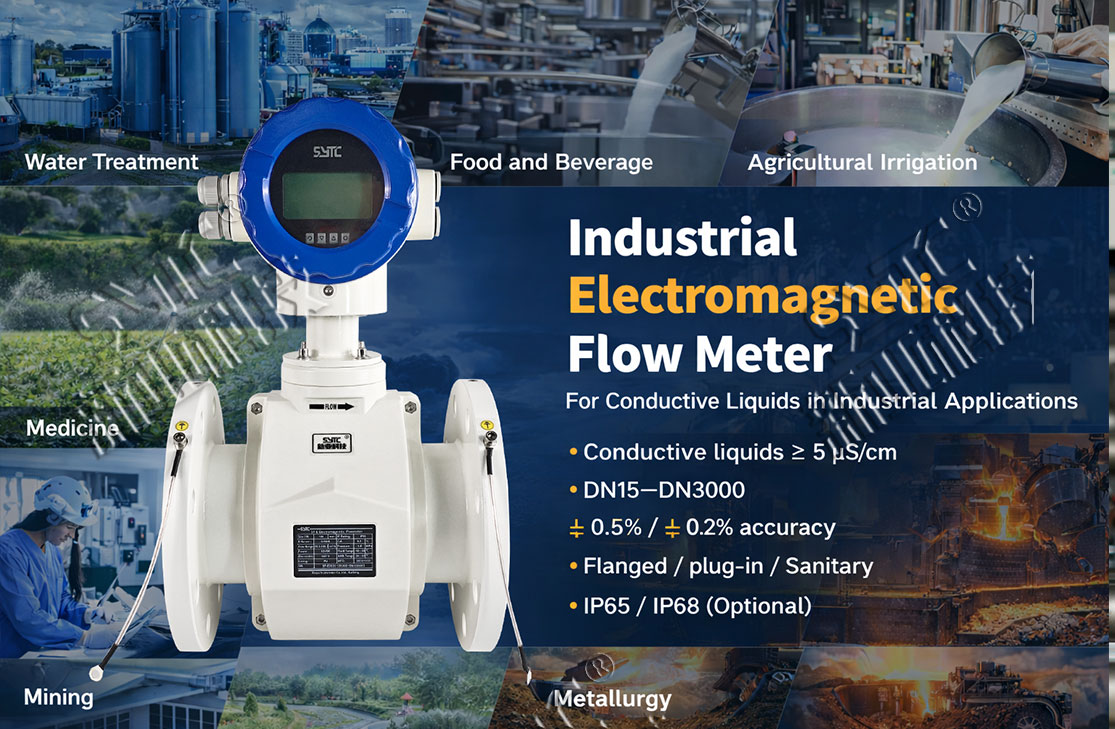
Next Step: If you are evaluating an electromagnetic flow meter for a crystallizing liquid application, consider providing Xinya Instrument with details on liquid composition, concentration, crystallization behavior, operating temperature range, pressure, flow range, and cleaning requirements so the application can be assessed appropriately.
https://www.sytcflowmeter.com/
Kaifeng Xinya Instrument Co., Ltd.
