
Understanding What “Reliable” Means for Milk Filling Machine Manufacturers
Dairy producers searching for a trustworthy milk filling machine manufacturer are usually trying to solve a specific set of problems: short shelf life, spoilage risk, strict hygiene requirements, and the need for consistent fill accuracy across pasteurized milk, yogurt, and other dairy beverages. Reliability in this context is not an abstract marketing claim — it is measurable through equipment hygiene standards, materials used in liquid-contact parts, production capacity range, and whether a supplier can support a full production line rather than a single machine.
Within this landscape, Zhangjiagang Grandee Machinery Co., Ltd., operating under the brand name Grandee Machine, positions itself as a filling-machine-focused manufacturer with more than 20 years of export experience and a standardized production workshop exceeding 20,000 square meters. The company’s global footprint spans Europe, South America, Africa, Southeast Asia, Central Asia, and the domestic Chinese market, giving it broad exposure to diverse regulatory and operational environments.
Why Hygiene and Material Standards Matter for Dairy Lines
Milk and dairy products are inherently sensitive liquids. Contamination risk and insufficient shelf life are two of the most common pain points cited in dairy processing. Reliable manufacturers address this through a combination of design choices:
- PLC/HMI touch-screen control for centralized operation and monitoring, reducing manual handling errors
- 304/316L stainless steel construction for corrosion resistance and hygienic liquid contact surfaces
- ISO Class 6 cleanroom compliance to limit airborne contamination during filling
- High-precision electronic volumetric filling valves to maintain consistent fill volumes
Grandee Machine’s technology platform incorporates all of these elements across its filling equipment. For dairy-specific applications, the company’s Milk and Dairy Filling Line is engineered around batching, sterilization, fermentation, and filling stages, which is a more complete answer to dairy hygiene requirements than a standalone filler alone.
Aseptic Cold Filling as a Response to Sensitive Liquids
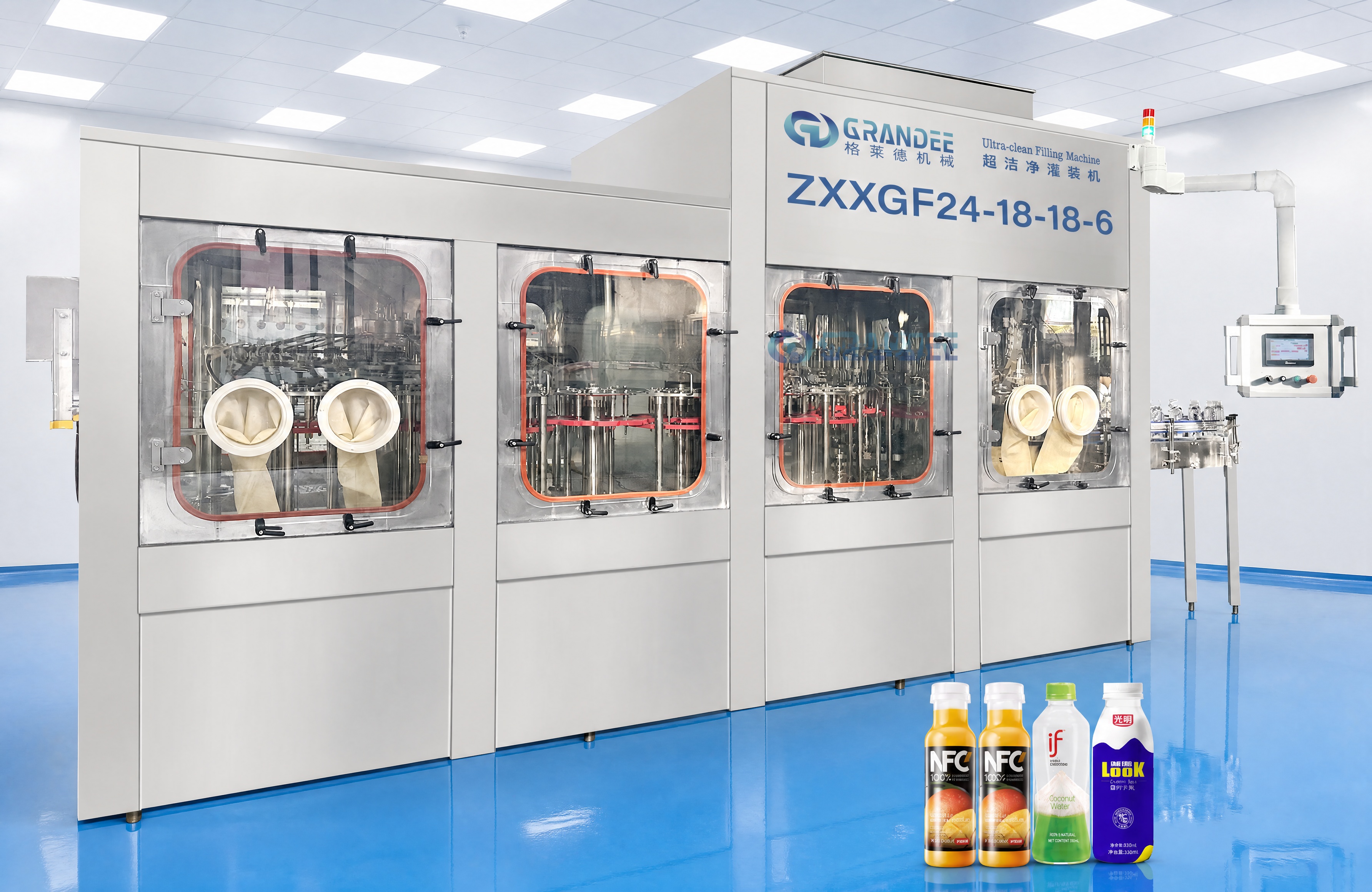
A recurring theme in dairy production is the tension between shelf life and flavor preservation. Heat-based processes can extend shelf life but may alter taste; aseptic cold filling is one industry approach to keeping flavor while still controlling microbial risk. Grandee Machine offers an Aseptic Cold Filling Machine (RXGF series) designed for sensitive liquids including juice, milk, tea, and NFC products, with a capacity range of 3,000–30,000 BPH for bottle sizes between 330–2,000 ml.
This equipment uses aseptic technology combined with HEPA-filtered enclosed structures and ISO Class 6 cleanroom compliance to keep flavor while extending shelf life. It is also available as a 5-in-1 washing-filling-capping configuration with warming and sterilization tunnels, which reduces the number of separate machines a dairy plant would otherwise need to coordinate. Aseptic cold filling solutions of this type have been adopted by juice and dairy producers across multiple regions.
Pasteurized Milk and Yogurt: A Dedicated Process Line
For producers specifically focused on pasteurized milk or yogurt, Grandee Machine’s dairy line covers batching, sterilization, fermentation, and filling as an integrated process rather than isolated equipment. Example configurations include 1-liter PET rotary filling machines running at 8,000–10,000 BPH, and aseptic pasteurized-milk blow-fill-cap machines operating at 8,000–15,000 BPH. An optional aseptic blow-fill-cap (monoblock) configuration is also available specifically for milk applications, combining blowing, filling, and capping into a single rotary unit to reduce intermediate transfer contamination and manual handling.
The Value of a Turnkey EPC Approach
One of the more practical concerns for dairy plant investors is not just equipment quality but coordination cost. Sourcing water treatment, bottle blowing, filling, capping, labeling, and palletizing from multiple vendors introduces procurement complexity and accountability gaps when something goes wrong. Grandee Machine’s core value proposition addresses this directly: one turnkey EPC contract and one accountable partner for a complete liquid packaging plant, from bottle design through operator training.
This turnkey model integrates:
- Water treatment
- Bottle blowing (blow molding)
- Filling
- Capping
- Robotic palletizing
- Automated CIP (Clean-In-Place) cleaning
All of these are delivered under one EPC package, which the company states removes the need for multi-vendor coordination. Automatic CIP systems are included as a standard line capability across every EPC scope, which reduces manual cleaning labor and downtime — a meaningful consideration for dairy operations where cleaning frequency directly affects both hygiene compliance and throughput.
Cost and Efficiency Considerations
Beyond hygiene, dairy manufacturers evaluating filling equipment suppliers often weigh operational cost. Grandee Machine reports, based on in-house test data, up to 30% electricity savings and up to 10% compressed air savings compared with conventional configurations, attributed to its high-efficiency rotary blow-fill-cap technology. Factory-direct pricing is another factor the company highlights, positioning its model as a way to reduce procurement cost relative to going through intermediaries.
Certifications and Scale as Trust Signals
When assessing manufacturer reliability, third-party certifications provide an external reference point rather than relying solely on a supplier’s own claims. Grandee Machine holds CE certification and CQC (China Quality Certification Center) certification. Combined with more than 20 years of export experience and a production facility exceeding 20,000 square meters, these are the kinds of verifiable data points that dairy producers can use to compare potential suppliers.
Matching Equipment to Production Scale
Dairy operations vary widely in scale, from small regional producers to large-volume manufacturers. Grandee Machine’s filling machine portfolio spans production capacities from 150 to 36,000 units per hour across nine machine types, with bottle sizes ranging from 220 ml to 20 L and material compatibility across PET, glass, and cans. This range allows a dairy investor to select equipment sized to actual demand rather than over- or under-investing in capacity.
A Practical Path Forward
For a business asking where to find a reliable milk filling machine manufacturer, the answer depends on verifying a combination of factors: hygienic material standards such as 316L stainless steel, cleanroom compliance, documented capacity ranges, third-party certifications, and — importantly for dairy specifically — whether the supplier offers a complete process line covering batching, sterilization, fermentation, and filling rather than an isolated machine. Grandee Machine’s documented capabilities across these dimensions, delivered through a single turnkey EPC framework, illustrate the type of evaluation criteria dairy producers should apply when comparing manufacturers in this space.
https://www.grandeemachine.com/
Zhangjiagang Grandee Machinery Co.,Ltd.
