
Why Retail Storefronts Are Turning to High-Brightness Window Displays
Walk past any major retail strip on a sunny afternoon and the problem becomes immediately apparent: conventional digital screens mounted in storefront windows are virtually invisible. Washed out by ambient sunlight, they fail to deliver the promotional messages and brand content that retailers invest significant resources to produce. The result is a communication breakdown at precisely the moment a potential customer is within reach — standing just outside the glass.
This challenge has pushed a growing number of retail operators, brand managers, and digital signage integrators to seek purpose-built high brightness window display solutions from manufacturers with proven expertise in outdoor-grade luminance technology. Among the manufacturers that have built a focused track record in this space, Shenzhen Leposs Technology Co., Ltd. — operating under the brand name Leposs Technology — has positioned its Window-Facing Display line as a direct answer to this industry pain point.
The Core Problem: Glare, Darkness, and Lost Impressions
The pain point that drives demand for high-brightness window displays is specific and quantifiable. Standard commercial screens typically operate in the range of 250 to 500 nits of brightness — a level adequate for controlled indoor environments with predictable ambient lighting. However, storefront window installations face a fundamentally different set of conditions: direct solar radiation, reflective glass surfaces, and rapidly shifting daylight intensity throughout the day.
Under these conditions, standard displays appear dark, washed-out, or completely unreadable to passersby. Screen glare and darkness in storefront window displays are not aesthetic inconveniences — they represent a direct failure of the display’s commercial function. Content investments go unseen, and the opportunity to engage pedestrian traffic is lost.
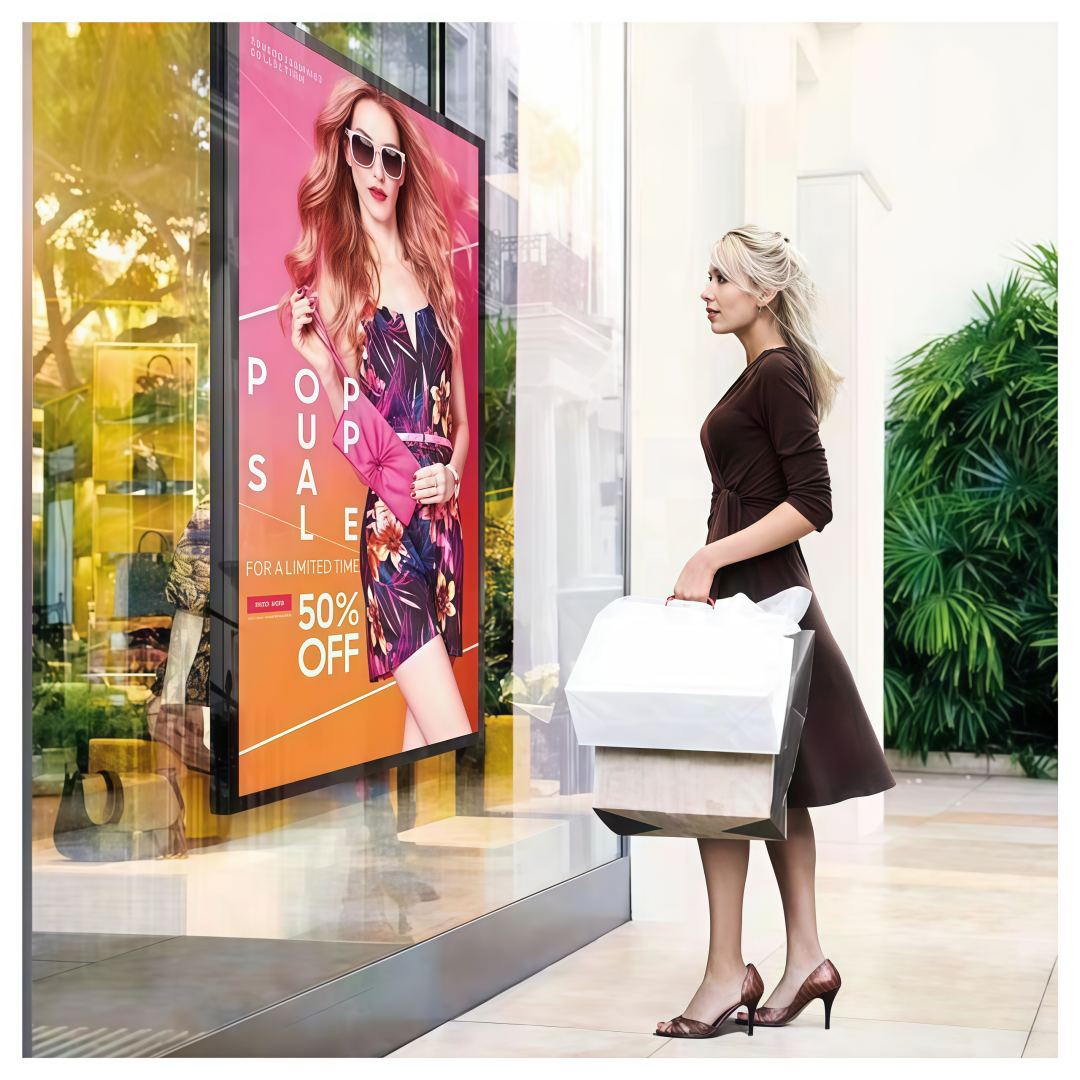
Leposs Technology identified this visibility gap as a foundational industry pain point and has structured its Window-Facing Display product line around solving it at the hardware level.
High-Brightness Panel Technology: Up to 3000 Nits
The defining technical specification of Leposs’s Window-Facing Display product line is its peak brightness output of up to 3000 nits. To contextualize this figure: a nit (candela per square meter) measures luminous intensity per unit area. A display at 3000 nits delivers roughly six to twelve times the luminance of a standard commercial panel, enabling the screen to maintain visual clarity and color accuracy even when positioned directly behind a sun-exposed window.
This sunlight-readable storefront display capability is not achieved through a single component adjustment but through a high-brightness panel architecture that sustains readability across the spectrum of real-world daylight conditions — from overcast mornings to peak midday sun exposure. The result is that window-facing retail displays remain visible in direct sunlight, ensuring that promotional content, pricing information, and brand messaging reach the intended audience regardless of weather or time of day.
Intelligent Light Sensor Technology and Energy Efficiency
A display running at 3000 nits continuously would generate unnecessary energy expenditure during low-ambient-light conditions such as cloudy days, evenings, or interior-lit hours. Leposs’s Window-Facing Displays address this through intelligent light sensors that enable automatic brightness adjustment based on real-time ambient light readings.
This adaptive brightness system optimizes power consumption based on ambient light, reducing output during periods when full luminance is unnecessary while automatically increasing to maximum brightness under peak solar conditions. The system operates without manual intervention, reducing operational overhead for retail staff and ensuring consistent on-screen performance across all conditions.
The combination of up to 3000 nits brightness and intelligent automatic brightness adjustment represents a practical balance between maximum visibility performance and operational energy management — a balance that matters to retail chain operators managing dozens or hundreds of display units across multiple locations.
Durability and Construction: Built for Storefront Environments
Window-facing installations present hardware durability requirements beyond those of standard indoor deployments. Displays positioned near glass surfaces are exposed to anti-ultraviolet stress over extended periods, and storefront environments introduce thermal variation, humidity fluctuation, and the physical risks associated with high-traffic retail spaces.
Leposs’s display construction incorporates anti-ultraviolet construction to protect panel components and structural integrity against prolonged UV exposure — a factor that directly affects long-term image quality and hardware lifespan in window installations. These construction choices reflect the company’s stated background in all-outdoor metal paint, moisture-proof, and anti-ultraviolet product engineering developed across its broader digital signage portfolio.
Manufacturing Credentials and Production Capacity
Leposs Technology operates from a manufacturing facility covering 8,000 square meters in Shenzhen, China, with a documented production capacity of 12,000 units per month. The company’s R&D team of 10+ experienced engineers supports both the core product line and OEM/ODM customization for integrators and chain operators with project-specific requirements.
The company reports an export footprint across 40+ countries and regions, with established offices in Los Angeles (United States), Lisbon (Portugal), Shanghai, and Shenzhen — a distribution and support structure relevant to retail groups and signage integrators operating across multiple markets. With over 10 years of specialization in professional digital display solutions, Leposs brings category-specific depth to the window display segment rather than treating it as an extension of a generic consumer electronics catalogue.
The company’s ability to respond with tailored solutions and competitive quotations within 2 working days is a practical consideration for project-based buyers managing tight deployment timelines.
CMS Integration: Remote Content Management for Multi-Location Retail
Hardware performance is one dimension of a window-facing display solution; content management is the other. Leposs’s cloud-based Content Management System (CMS) enables centralized control, scheduling, and health monitoring of display networks — removing the logistical burden of manually updating content at individual screen locations.
For retail chains operating window displays across multiple sites, this means automated content playout scheduling can push promotional updates, seasonal campaigns, or pricing changes simultaneously across an entire network without dispatching staff to individual locations. Network-wide device status monitoring allows operations teams to identify and address hardware issues proactively, reducing unplanned downtime.
Target Applications: Retail Storefronts and Retail Chains
Leposs positions its Window-Facing Display line specifically for retail storefronts and retail chain environments — the deployment contexts where the sunlight-visibility problem is most commercially consequential. This focus allows the product to be specified with confidence for:
- Single-location retail storefronts where window displays serve as primary pedestrian engagement tools
- Multi-site retail chain networks requiring consistent visual standards and centralized content management across all locations
- Brand activation installations in high-traffic retail corridors where display visibility directly correlates with foot traffic conversion
A Focused Solution for a Specific Commercial Challenge
The demand for high brightness window display technology is driven by a real and persistent commercial problem: standard displays fail in sunlight, and that failure has measurable consequences for retail visibility and brand communication. Leposs Technology’s Window-Facing Display line addresses this with a technically specific response — up to 3000 nits brightness, intelligent light sensor-driven automatic adjustment, anti-ultraviolet construction, and integration with a cloud-based CMS platform for multi-location content control.
Backed by a 10+ year specialization in professional digital display manufacturing, an 8,000-square-meter facility, and an established presence in key global markets, Leposs Technology represents a manufacturer with the depth and infrastructure to support window display projects at both single-site and chain-scale deployment levels.
www.leposs.com
shenzhen leposs technology co., ltd.
