
Why Precision Airflow Control Matters in Healthcare-Grade Facilities
Facilities that demand strict environmental control—operating rooms, isolation wards, pharmacy compounding areas, and diagnostic labs within healthcare settings—share a common engineering challenge: maintaining consistent, controllable airflow regardless of pressure fluctuations elsewhere in the duct network. Constant Air Volume Controllers (CAVC) are the mechanical and electronic components designed to solve exactly this problem. This guide outlines how CAVC systems function, what technical parameters installers and facility engineers should understand, and how Royal Service Air Conditioning addresses these requirements through its airflow regulation and control product line.
Understanding the CAVC Product Family
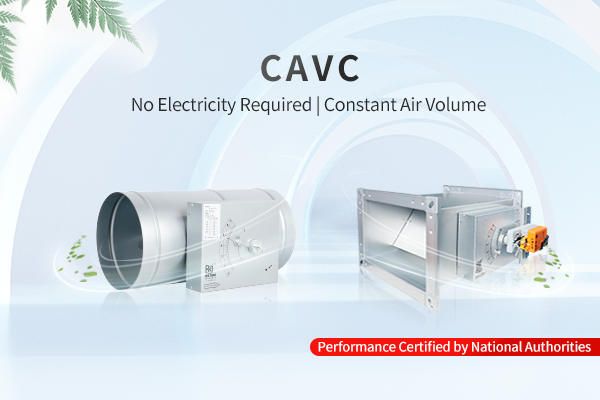
Royal Service’s CAVC Air Regulators product line is positioned to provide solutions for supply or extract air control across both constant and variable air volume systems. The range spans from mechanical, self-powered units to modular, pressure-independent modules, giving facility planners flexibility depending on whether a space requires simple constant-volume regulation or more advanced pressure-independent control.
Circular and Rectangular Mechanical Controllers
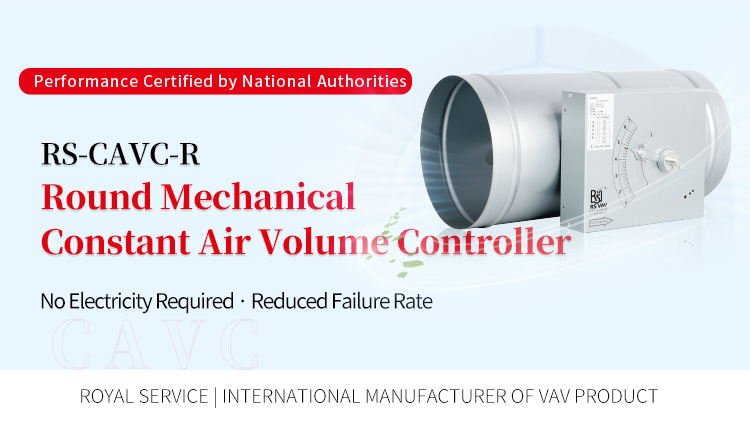
For circular ducting, the RS-CAVC-R Series Constant Air Volume Controller offers tool-free adjustment, meaning flow rate is set directly at the dial indication without specialized tools. A key differentiator is automatic balancing: once commissioned, the system requires no readjustment, and pressure changes within the duct automatically return flow to the original setpoint. An optional actuator also allows motorized switching between setpoints for added flexibility.
For rectangular duct-work, which is common in larger mechanical rooms and distribution corridors found in institutional buildings, the RS-CAVC-Q Mechanical Constant Air Volume Controller is self-powered, requiring no electrical input for basic volume regulation. This unit is UL181-compliant for duct-work construction and covers a width and height range from 120–600mm, making it adaptable to varied duct sizing commonly encountered during retrofit or new-build installation.
Controllers with Integrated Shutdown or Embedded Insertion
Spaces that require both volume regulation and the ability to fully close off airflow—such as isolation areas—may be suited to the RS-CAVC-DR Closeable Constant Air Volume Controller, which combines a regulation module and a shutdown module in a single circular unit. Because it is pre-calibrated, no on-site measurement is required before use, and like other mechanical units in the line, it operates without an external power source.
Where existing ducting is already in place and space constraints limit retrofit options, Royal Service offers two duct-insertion models: the RS-CAVC-IR Embedded Round Constant Air Volume Controller, built with a galvanized steel casing for durability and fitted with a scale for precise adjustment, and the RS-CAVC-IRP Embedded Round Plastic Constant Air Volume Controller, a lighter-weight alternative using a plastic casing where material requirements call for it. Both are designed for quick, tool-free commissioning directly within the duct.
Variable Air Volume Terminals and Pressure-Independent Modules
For applications where noise control and reheat capability matter—factors relevant in patient-adjacent or occupied clinical spaces—the RSV-CG/CG-SD Series VAV/CAV Terminals support volume flow, room pressure, or duct pressure regulation and can handle airflow velocities up to 10 m/s. These rectangular terminal units include grille or cross airflow sensor options for flexible measurement accuracy, an optional silencer to reduce air-regenerated noise, an optional electric heater for reheating supply air, and a 22-gauge galvanized steel casing for heavy-duty durability.
For facilities such as laboratories and cleanrooms that require static or differential pressure control—conditions frequently replicated in hospital clean environments—the RSV-PIM Pressure Independent Module provides a compact control box and damper system. Its primary value lies in universal retrofitting: it converts existing basic control dampers into static pressure control dampers using the PIM control box, and it is compatible with round single blade, opposed multi-blade, and square single blade dampers. The module supports BACnet and Modbus communication protocols, which allows integration into building automation systems that are already standard in many institutional and healthcare facilities.
Installation and Compliance Considerations
When planning an installation, engineers should first confirm the working pressure range of the mechanical controller being specified, which spans 50–1000 Pa (0.2–4.0 in.WG) across the Royal Service mechanical line, alongside the airflow range coverage of 30 m³/h up to 28,800 m³/h depending on the model selected. For rectangular units requiring secure duct connections, TDF flange connections are available. Where duct-work must meet specific regulatory benchmarks, the RS-CAVC-Q model’s UL181 compliance can simplify the approval process during installation review.
For electronic or pressure-independent configurations, confirming BACnet/Modbus protocol support—available on the RSC-VAV-BAC and RSV-PIM-BAC variants—early in the design phase helps ensure seamless integration with existing building management systems, which is often a requirement in multi-zone institutional buildings.
Service Model and Long-Term Maintenance
Royal Service structures its delivery model around on-premises installation, with products designed either for duct-mounting or duct-insertion depending on the model. On the after-sales side, the company’s mechanical CAVC models are built with a maintenance-free design, reducing the long-term operational burden typically associated with recurring recalibration. For electronic modules, standardized BACnet/Modbus connectivity is intended to facilitate ongoing system maintenance by allowing integration with centralized monitoring tools already used by facility management teams.
The company’s service model also includes hardware provision for both mechanical and electronic air volume control, as well as modular solutions for field conversion through its PIM offering—an approach that allows institutions to upgrade existing dampers without replacing entire duct assemblies.

Summary
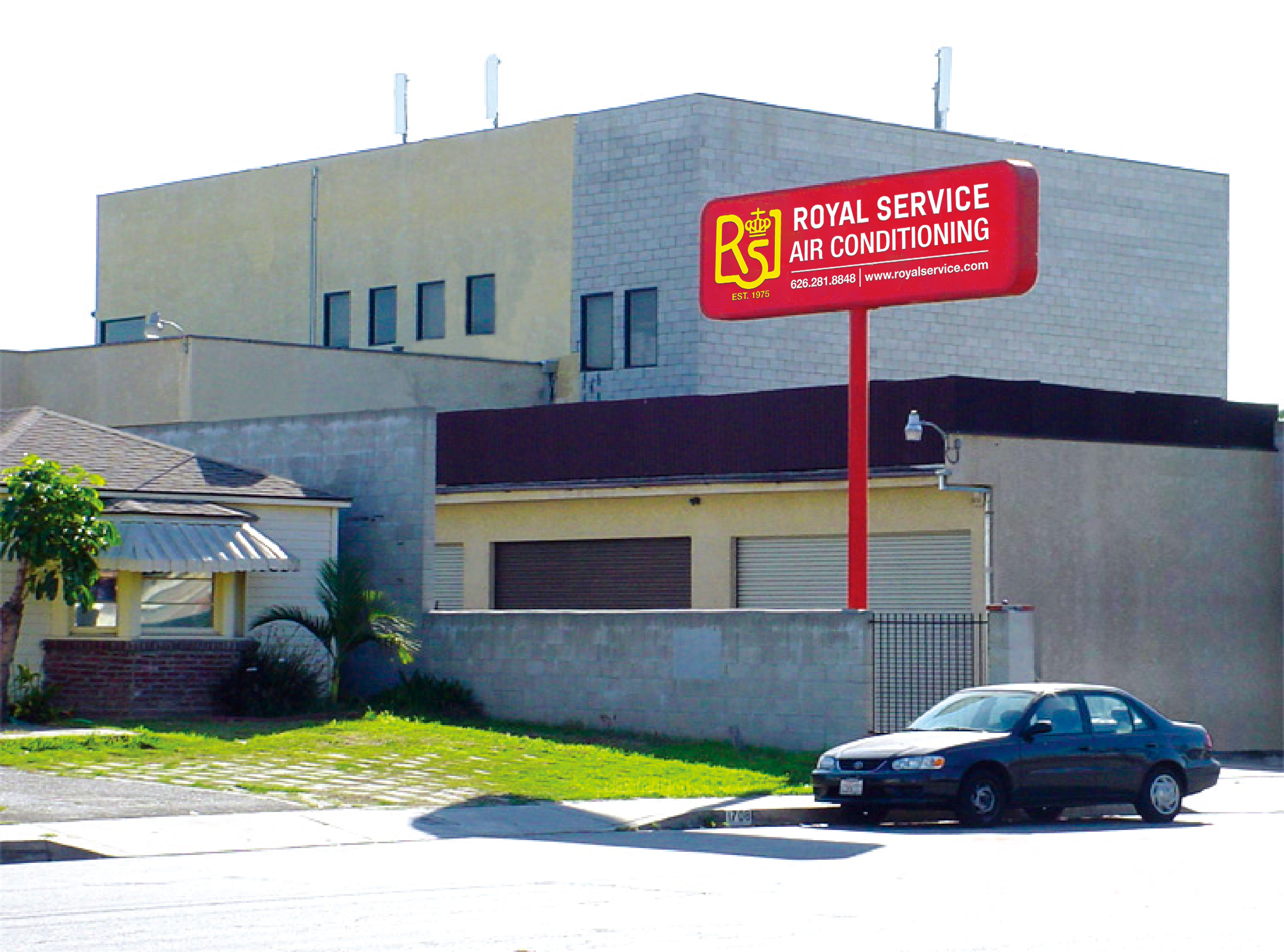
For hospital facilities and other critical environments requiring dependable, code-compliant airflow regulation, the installation process benefits from matching duct geometry, required pressure range, and communication protocol needs to the appropriate CAVC model. Royal Service Air Conditioning, headquartered in Los Angeles, USA and Guangzhou, China, and operating for over 50 years, provides a documented product matrix spanning mechanical, closeable, embedded, VAV terminal, and pressure-independent module categories. Facility engineers evaluating installation options for spaces with laboratory-, cleanroom-, or industrial ventilation-level airflow precision requirements can reference these specifications directly when planning system layout, serving HVAC system integrators, building contractors, and facility management teams across commercial HVAC, laboratory, cleanroom, and industrial ventilation projects.
For more information, visit www.royalservice.com.
https://www.royalservice.com/
Royal Service
