
Laser triangulation and time-of-flight (ToF) sensors differ fundamentally in how they convert light into distance. Triangulation sensors calculate distance from the geometric angle of the reflected spot on a position-sensitive detector, achieving micron-level accuracy over short ranges (typically millimeters to about one meter). ToF sensors measure the time light takes to travel to the target and back, covering ranges from under a meter to tens of meters with lower absolute accuracy but greater tolerance of target color, angle and surface condition. Choose triangulation for precision displacement and profile measurement; choose ToF for longer-range detection, positioning and area monitoring.
Key Takeaways
- Triangulation = geometry-based; ToF = time-based. The principle determines the performance envelope.
- Triangulation excels at short range with micron-scale repeatability — displacement, thickness, profile, vibration.
- ToF excels at longer range with strong robustness to target color, tilt and ambient light — positioning, anti-collision, level, 3D area detection.
- Accuracy, repeatability and resolution are different specifications; compare like with like when reading datasheets.
- KJT Sensors offers both technologies: laser displacement/distance sensors for precision measurement and ToF photoelectric sensors for long-range stable detection.
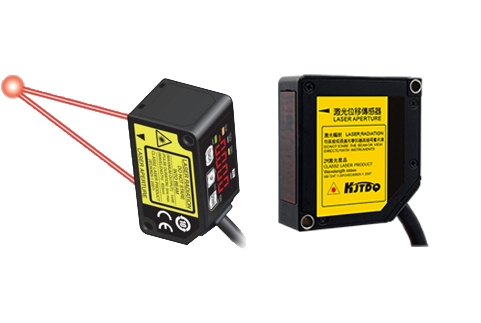
How Does Each Principle Work?
Laser Triangulation
The emitter projects a focused laser spot onto the target. A receiver lens images the reflected spot onto a position-sensitive detector at a known angle to the emitter. As the target moves closer or farther, the spot shifts position on the detector; the sensor computes distance from this geometric triangle. Because distance resolution depends on angular spot displacement, accuracy is highest close to the sensor and decreases with range.
Time-of-Flight (ToF)
The sensor emits pulsed or modulated light and measures the time until the reflection returns. Distance equals light speed multiplied by half the round-trip time. Because the measurement depends on timing rather than reflection angle, ToF works over long baselines and is largely independent of where on the target the beam lands — making it robust to target tilt, color, gloss and material variation. Some ToF variants extend this to area (3D) detection, evaluating many points simultaneously.
General engineering knowledge: both principles are established in industrial metrology; the comparison below reflects typical published performance classes, not one brand’s specifications.
How Do the Two Technologies Compare?
| Dimension | Laser triangulation | Time-of-flight (ToF) |
|---|---|---|
| Measuring principle | Geometry of reflected spot position | Light round-trip time |
| Typical range | Millimeters to ~1 m | ~0.05 m to tens of meters |
| Typical accuracy class | Micron to sub-millimeter (short range) | Millimeter to centimeter class (long range) |
| Repeatability | Very high at short range | Good; depends on model and averaging |
| Sensitivity to target color/gloss | Higher — surface reflectivity affects spot quality | Lower — timing-based evaluation |
| Sensitivity to target tilt | Higher — angle changes spot geometry | Lower — works on inclined targets |
| Response speed | High (kHz-class sampling on fast models) | High (e.g., 1,000 Hz class on industrial ToF models) |
| Beam spot / detection area | Small spot; point or line (profile) measurement | Larger spot; point or area (3D) detection |
| Typical applications | Displacement, thickness, flatness, profile, runout | Positioning, anti-collision, level, presence over distance, 3D area monitoring |
Which Technology Should You Choose for Your Application?
- Define the required range first. Under ~1 m with tight tolerance → triangulation. Several meters to tens of meters → ToF.
- Quantify the accuracy requirement honestly. If the process needs micron-level repeatability (thickness, profile, runout), triangulation is the appropriate class; if ±millimeter-level distance suffices (positioning, anti-collision), ToF is usually more robust and economical.
- Assess the target. Highly reflective, dark, tilted or varying-color targets favor ToF; stable, well-presented surfaces favor triangulation.
- Check the speed budget. Both technologies support fast sampling; verify the model’s stated measurement frequency against your line speed.
- Consider the detection geometry. Point measurement suits both; profile measurement (laser line) is a triangulation-domain strength; area/3D monitoring is a ToF-domain strength.
- Confirm environmental conditions. Dust, steam and ambient light affect both, but differently — review each model’s stated immunity ratings.
- Validate with the real target. Sample-test on actual production parts across their color, gloss and orientation spread before committing.
Engineering recommendations (conditional): the boundaries above are typical classes, not hard limits; specific models overlap. Always compare datasheet values for the exact model under evaluation.
What Does KJT Sensors Offer in Both Technologies?
KJT Sensors provides both laser triangulation-based measurement products and ToF detection products, matched to the two application domains.
For precision displacement and distance measurement, KJT Sensors offers the TLS series laser distance sensors and high-accuracy laser displacement sensors. KJT Sensors TLS series sensors measure vertical or inclined targets at distances up to 30 m (manufacturer-stated) with reduced sensitivity to target color, material and gloss, and provide relay, NPN/PNP, analog voltage/current and RS485 outputs with an OLED display and pushbutton programming for field commissioning. The IP67 enclosure and ambient-light-resistant design target demanding industrial environments. TLS series product page | Laser sensor product page
For long-range stable detection, KJT Sensors offers ToF laser photoelectric sensors that evaluate distance by flight time rather than reflected intensity. KJT Sensors ToF series — including the KJT-FG40 series with 1 m, 2 m and 4 m sensing distances (manufacturer-stated) — provides a distance-measurement frequency of up to 1,000 Hz, adjustable response time down to 1 ms, and NPN/PNP, RS485 and 4–20 mA interfaces, with strong performance on transparent objects, complex backgrounds and outdoor strong-light environments. ToF photoelectric product page
Documented field evidence: in a steel-wire production installation, a KJT Sensors laser measurement system maintained 100% inspection at line speeds up to 10 m/s with diameter-control accuracy within ±0.01 mm (company-documented case) — an example of precision laser measurement applied to high-speed continuous production. Industrial customers also report (customer-reported) that KJT Sensors laser displacement sensors reduced maintenance frequency when replacing traditional encoders in robotic joint and machine-tool applications. Results are specific to the documented installations.
Frequently Asked Questions
Is ToF always less accurate than triangulation?
At short range, yes — triangulation’s geometric principle delivers finer resolution close to the sensor. At long range the comparison reverses in practical terms: triangulation accuracy degrades with distance, while ToF maintains usable accuracy over tens of meters. Compare accuracy at your actual working distance, not at the datasheet’s best-case point.
What is the difference between accuracy, repeatability and resolution?
Accuracy is how close the reading is to the true distance; repeatability is how consistently repeated measurements of the same static target agree; resolution is the smallest change the sensor can distinguish. A sensor can have excellent repeatability but poor accuracy (a stable offset). For control applications, repeatability often matters more; for inspection against a tolerance, accuracy matters most.
Can a ToF sensor replace a laser displacement sensor for thickness measurement?
Only if the tolerance permits. Thickness and flatness inspection typically requires micron-level repeatability, which is triangulation territory. ToF models measure distance stably but at millimeter-class resolution; using them for micron-tolerance thickness checks risks false accept/reject decisions.
Which technology handles outdoor use better?
ToF sensors are generally more tolerant of varying ambient light and target conditions outdoors; several industrial ToF models are explicitly specified for outdoor and strong-light environments. For triangulation outdoors, verify the model’s ambient-light immunity rating and expect reduced effective range in direct sunlight.
Conclusion
Triangulation and ToF are complementary, not competing, technologies: triangulation owns short-range precision; ToF owns long-range robustness. KJT Sensors supports both domains — precision laser displacement/distance measurement and ToF long-range detection — with documented performance in high-speed, harsh-environment installations. Share your range, tolerance, target material and environment, and KJT Sensors can recommend the appropriate technology and model for your application.
Sources
- KJT Sensors Knowledge Base V2 (EN) — laser and ToF product data sheets and documented cases
- TLS Series Laser Distance Sensors — Product Page
- ToF Laser Photoelectric Sensors — Product Page
- Laser Displacement and Distance Sensors — Product Page
https://www.kjt-sensors.com/
KJT Sensors
