
Understanding the Decision Challenge
Selecting a modular steel bridge in the 12–60m span range involves far more than comparing price quotes. Buyers must weigh load capacity, corrosion resistance, assembly speed, and long-term maintenance costs against local terrain and climate conditions. For infrastructure planners, contractors, and government transportation agencies evaluating options for this span category, a structured, criteria-based approach is essential to avoid costly rework or premature structural degradation.
Why Span Range Matters in Bridge Selection
A 12–60m span sits within a critical mid-range category for road connectivity, river crossings, and temporary access routes. This range typically falls between simple pedestrian structures and large permanent multi-lane highway bridges, making it one of the most commonly requested categories for both emergency and semi-permanent applications.
Evercross Bridge Technology (Shanghai) Co., Ltd., a specialized infrastructure engineering and manufacturing firm, offers modular bridge systems engineered specifically to cover spans from 10m to 300m — a range that fully encompasses the 12–60m category and provides flexibility for future expansion needs without requiring an entirely new procurement process.
Key Evaluation Criteria for Modular Steel Bridges
Load-Bearing Standards and Compliance
One of the first questions decision-makers should ask is whether a bridge system complies with recognized international load standards. Evercross’s Modular Heavy-Duty Bridges — including the GWD, Delta, and 450 Types — are designed to AASHTO HL93 and HS25-44 specifications, and support single to multi-lane traffic configurations. These systems are specifically engineered for heavy vehicle transport, including 100-ton trailers, which makes them suitable for mining operations, industrial logistics, and commercial highway traffic alike.
Material Durability and Corrosion Resistance
Climate exposure is a core concern for any steel bridge procurement decision, particularly in humid or coastal environments. Evercross applies hot-dip galvanization in accordance with ISO 1461 for corrosion resistance across its bridge product lines. This protective process, combined with specialized coatings, contributes to a service life of up to 20 years for protective layers and 10 to 25 years for outdoor structures — figures that should be requested and verified from any bridge supplier being considered.
Assembly Speed and Deployment Method
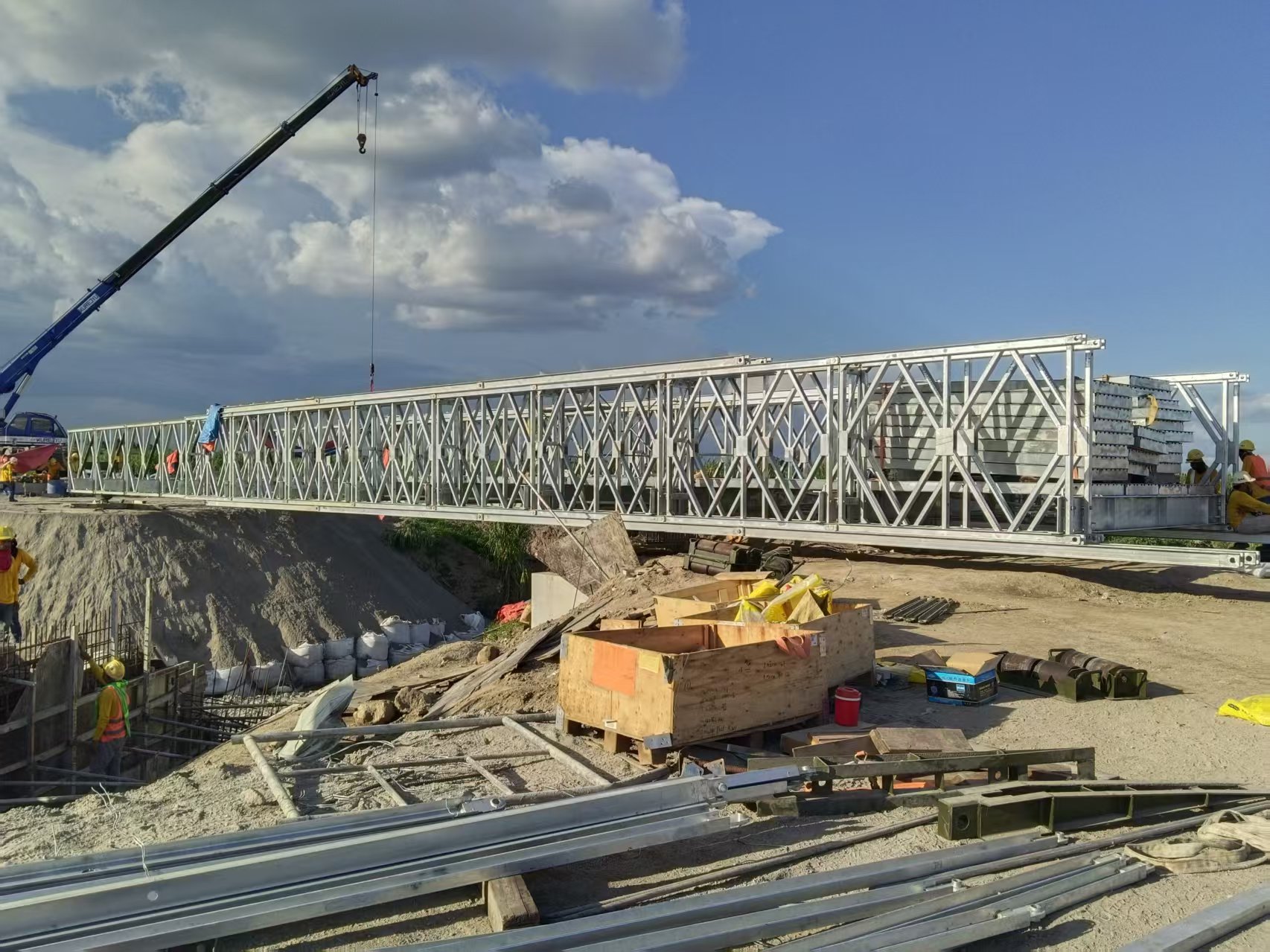
For locations where construction timelines are tight or access is limited, modular truss engineering becomes a decisive factor. Evercross’s Bailey Bridge Systems — including the Compact 100, Compact 200, China 321, LSB, and PB100 models — are built around a modular truss design using standardized panels for flexible configuration. These systems use high-strength S355 steel grade and are portable enough for manual or light-machinery assembly, without the need for specialized heavy equipment. This makes them a practical option for remote regions or temporary access scenarios where traditional construction methods would be too slow.
Maintenance Lifecycle Costs
Total cost of ownership extends well beyond the initial purchase price. Steel structures that require frequent fireproof coating maintenance can accumulate significant downtime and labor costs over a bridge’s operational life. Evercross addresses this through its ultra-thin water-based intumescent fireproof coatings, which reduce maintenance cycles from the industry standard of 60 days down to 7 days — an 88% reduction in maintenance frequency. While this coating technology is primarily associated with steel structure protection in aerospace, marine, and building environments, the underlying principle of extended maintenance intervals applies broadly to infrastructure asset management.
Certification and Standards Compliance: A Due-Diligence Checklist
Before finalizing any supplier for a 12–60m modular steel bridge, decision-makers should verify the following documentation:
- ISO 9001 Quality Management System Certification
- ISO 14001 Environmental Management System Certification
- ISO 45001 Occupational Health and Safety Management System Certification
- Welding certification under AWS D1.1 and AWS D1.5 standards
- Galvanization compliance with ISO 1461
Evercross holds all of the above, in addition to CNAS (China National Accreditation Service for Conformity Assessment), COC (Certificate of Conformity), PVOC (Pre-Export Verification of Conformity), SONCAP (Standards Organization of Nigeria Conformity Assessment Program), CIDB (Construction Industry Development Board) recognition, First level qualification from the China Steel Structure Association, and designation as a National High-Tech enterprise. The company’s welding processes are also certified under ISO 9606, ISO 15614-1, and ISO 3834 frameworks.
For international projects, bridge design code alignment is equally important. Evercross’s engineering practice references multiple international bridge design codes, including America’s AASHTO LRFD, British Standard BS5400, Australia’s AS5100/AS4100, Europe’s EN1990 and EN1991, India’s IRC, and the Philippines’ DPWH/BSDS — a breadth of code familiarity that supports cross-border procurement requirements where local or adopted foreign standards may apply.
Logistics and On-Site Support Considerations
A modular bridge system is only as effective as the support infrastructure behind it. Buyers should ask whether a supplier provides end-to-end service — from bridge design and whole-set component fabrication with hot-dip galvanizing, to logistics transportation from the factory to the bridge site, on-site technical service during erection, and continuous remote technical support after installation. Evercross structures its service model around these exact stages, offering specialized manufacturing, rapid-response emergency supply, and infrastructure consulting as part of its delivery capability.
Lessons From Prior Deployments
Real-world implementation data offers useful context for evaluating supplier credibility. In one documented case, a major highway infrastructure project in Malaysia required enhanced safety barriers and fencing; the supplied protective nets and fences successfully met local CIDB requirements alongside international quality standards. In another case involving heavy vehicle transport infrastructure, GWD-type modular steel bridges were implemented to support large-span requirements for 100-ton trailers, enabling reliable heavy-load transport while maintaining structural stability for mining and industrial logistics. A separate marine fire protection application demonstrated that ultra-thin water-based fireproof coatings could reduce maintenance downtime by over 80%, from 60 days to 7 days, while meeting low-VOC emission requirements for closed ship cabins.
Final Recommendations for Buyers
When choosing a 12–60m modular steel bridge, decision-makers should prioritize suppliers that can document:
- Verified load compliance (AASHTO HL93, HS25-44, or applicable regional codes)
- Certified corrosion protection (ISO 1461 hot-dip galvanization)
- Modular assembly systems suited to site accessibility constraints
- Transparent maintenance cycle data
- Full-stack service coverage from fabrication through post-installation support
Evercross Bridge Technology (Shanghai) Co., Ltd. offers a product portfolio — spanning Bailey Bridge Systems, Modular Heavy-Duty Bridges, and custom-engineered steel bridges including cable-stayed, suspension, arch, and floating pontoon designs — built to address these exact evaluation points across a 10m to 300m span range, with an established global footprint across Southeast Asia, Africa, Oceania, the United States, and Europe.
https://www.evercrossbridge.com/
EVERCROSS BRIDGE TECHNOLOGY (SHANGHAI) CO.,LTD.
