
The Growing Challenge Behind Food Packaging Material Selection
Choosing the right food packaging material has become a more complex decision than it once was. Conventional fossil-based plastics remain widely used, but they create challenges related to fossil-resource dependence, long-term environmental persistence, and end-of-life waste management. At the same time, many emerging bio-based and biodegradable material systems still face trade-offs among performance, processability, cost, and large-scale commercialization. For brand owners, packaging manufacturers, converters, and OEM/ODM producers, this means that material selection can no longer be based on a single factor such as price or appearance—it requires a structured evaluation across several dimensions.
Shanghai SiPeng Technology Co., Ltd., operating under the brand SYNLIFE, operates in this space as a bio-based materials technology company built on synthetic biology and materials engineering. As a bio-based materials technology company founded on synthetic biology and materials engineering, SYNLIFE develops high-performance bio-based materials, finished applications, and cross-industry material solutions, with the long-term goal of advancing lower-carbon and carbon-negative biomanufacturing technologies.
What to Evaluate When Choosing Food Packaging Materials
Selecting a food packaging material generally requires weighing several interrelated factors together, rather than in isolation:
- Material type and formulation — the underlying polymer and additive system used
- Bio-based content — the proportion of raw materials derived from biological sources
- Performance requirements — barrier properties, mechanical strength, sealing behavior, and processability
- Certification and compliance requirements — including compostability, bio-based content, and food-contact standards
- Processing difficulty — how the material behaves on existing manufacturing lines
- Order volume and customization requirements — whether the material can be tailored to a specific application
- Supply-chain and commercial conditions — availability, scale-up capability, and regional regulatory context
It is also worth noting that plastic taxes, extended producer responsibility (EPR) fees, carbon-related regulations, and other environmental policies vary by country and product category, and should be evaluated separately for each target market rather than assumed to apply uniformly.
Bio-Based Resin Platforms Built for Real-World Processing
One of the recurring difficulties in food packaging is that many bio-based resins are developed around laboratory performance rather than actual manufacturing conditions. SYNLIFE’s YOGTIC® series takes an application-oriented approach instead, developing materials around real processing conditions and end-use requirements rather than material synthesis alone.
YOGTIC-08 / 18 Thermoforming Series
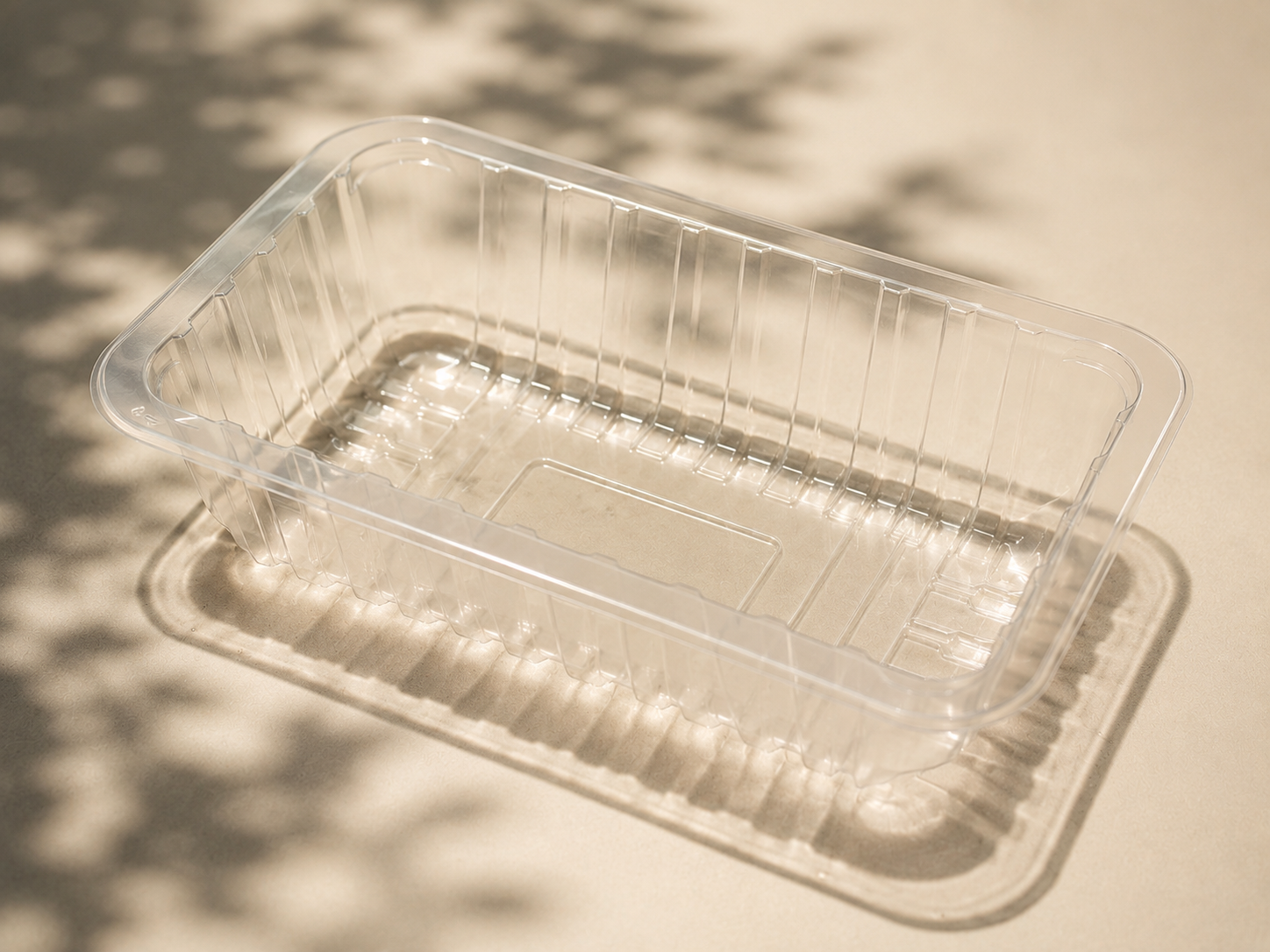
This series is positioned specifically for sheet extrusion and thermoforming, which are common processes in food tray and packaging tray production. Key features include good sheet flatness, balanced rigidity and toughness, and a design oriented around commercial thermoforming processes. Typical applications include food trays, packaging trays, and other thermoformed products.
Other members of the YOGTIC® family, such as the high-transparency YOGTIC-05 series and the high-performance natural-color YOGTIC-15 series, extend the same principle—balancing bio-based content with toughness, thermal resistance, and processing compatibility—into applications beyond direct food contact.
Film Solutions Designed for Food Preservation and Barrier Performance
Films represent a particularly demanding category within food packaging, since they must combine barrier performance, sealing behavior, and, increasingly, end-of-life considerations.
ZeRoll® Compostable Cling Film
Positioned as a bio-based and compostable food-preservation film for household, food-service, and retail applications, ZeRoll® is designed as an alternative to conventional fossil-based cling film. Its key features include food-preservation performance, bio-based content depending on the specific product grade, and a compostable design for applicable product grades. Compostability claims should always correspond to the specific product grade, applicable standard, and actual third-party certificate.
ZeRoll® MAP Meat Packaging Film Development
For higher-barrier requirements, SYNLIFE has developed a modified-atmosphere packaging (MAP) film solution for fresh meat and other high-barrier food applications. Development focus areas include:
- Oxygen barrier performance
- Water-vapor barrier performance
- Carbon-dioxide transmission behavior
- Heat-sealing performance
- Mechanical performance
- Food-contact compliance
Internal and third-party testing data for these films should always be quoted together with the relevant test conditions, methods, and product specifications rather than treated as universal performance claims. Beyond MAP meat film, SYNLIFE’s film development also extends to fruit and vegetable packaging film, bakery and food packaging film, and other application-specific films, reflecting a broader platform rather than a single-product approach.
Certification, Compliance, and Testing Considerations
Because food packaging materials are subject to regulatory scrutiny, certification and compliance are central to material selection. Certain SYNLIFE products have obtained third-party compostability certification, and certain products have undergone bio-based content testing. Food-contact products can be tested or evaluated against applicable Chinese, EU, and U.S. requirements depending on the specific product and target market. As a general principle, certification bodies, standards, certificate numbers, and applicable product grades should always be specified whenever certification claims are used externally, rather than referenced in general terms.
From Formulation to Commercial Supply: SYNLIFE’s Service Model
Beyond material properties, buyers evaluating food packaging materials often need a partner capable of supporting the full path from formulation to commercial supply. SYNLIFE’s service model includes raw material supply, material customization, joint product development, application development, finished product OEM/ODM, process and technical support, and pilot and scale-up support—covering the full scope from material and formulation development through processing optimization, product design, testing support, scale-up, and commercialization.
A Track Record Built on Synthetic Biology and Materials Engineering
SYNLIFE’s approach to food packaging materials is grounded in a broader technical foundation. The company’s founding and technical teams accumulated long-term research experience in synthetic biology, biological manufacturing, and bio-based materials prior to SYNLIFE’s official establishment in May 2022, with research backgrounds connected to synthetic biology research associated with Shanghai Jiao Tong University. This foundation is supported by a Shanghai R&D Center of more than 2,000 m², a team of 50+ researchers and engineers, and manufacturing and supply-chain capabilities in Jiangsu, including Nantong.
The company’s broader development has included several milestones, including a strategic partnership with Angel Yeast in November 2022 and the establishment of a joint venture in December 2023 to advance the industrialization and commercialization of bio-manufactured products, a Pre-A financing round of nearly RMB 100 million completed in October 2024, and a Pre-A+ financing round completed in May 2025. In 2026, SYNLIFE was selected as one of 16 winners from approximately 660 global applications across 54 countries and regions in Tencent’s CarbonX Program 2.0, following a process that narrowed the field to 50 finalists.
For buyers weighing food packaging material options, this combination of application-focused resin development, purpose-built film solutions, compliance-oriented testing practices, and end-to-end service capability offers a structured way to evaluate whether a bio-based material fits a specific packaging requirement—rather than relying on generic assumptions about bio-based performance.
https://www.synlifeglobal.com/
SYNLIFE肆芃科技
