
Selecting the correct diamond segment for granite cutting is one of the most consequential decisions a stone processor, fabricator, or tool distributor can make. Granite is among the hardest and most abrasive natural stones processed in the industry, and the wrong segment choice often leads to slow cutting speeds, premature wear, segment cracking, or unstable performance that raises overall processing costs. Understanding how diamond segments are engineered—and what variables actually determine their performance—helps buyers make informed decisions rather than relying on guesswork or price alone.
Why Granite Demands a Specialized Segment Approach
Granite processing presents a distinct set of technical challenges compared with softer stones. Common pain points reported by stone processors and tool distributors include insufficient cutting sharpness or slow cutting speed, short or inconsistent segment lifespan, segment cracking, breakage or premature wear, unstable cutting performance between different stone types, excessive cutting resistance, heat generation or machine load, and difficulty balancing sharpness against service life. These issues are not caused by a single factor. They typically result from a mismatch between the segment’s bond formula, the stone’s hardness and abrasiveness, and the machine conditions under which the segment operates.
This is why a single "universal" diamond segment formula cannot reliably serve every granite-cutting scenario. Quanzhou Xinruite (XRT) Diamond Tools Co., Ltd., known in the market under the brand name XRT Diamond Tools, approaches segment selection as an engineering process rather than a one-size-fits-all product decision, developing and adjusting diamond bond formulas according to stone hardness, abrasiveness, machine type, blade diameter, cutting depth, cutting speed and customer performance requirements.
Key Factors That Determine the Right Segment
Choosing the correct diamond segment for granite starts with identifying several interrelated variables:
- Stone hardness and abrasiveness: Different granite varieties vary in hardness and mineral composition, which directly affects how quickly diamonds wear and how the metal bond should be formulated to expose fresh diamond grit at the right rate.
- Machine type and cutting conditions: Single-blade machines, multi-blade block-cutting equipment, and quarrying machinery each place different mechanical loads on a segment, requiring formulas suited to the specific equipment.
- Blade diameter and cutting depth: Larger diameters and deeper cuts change the stress and heat distribution across a segment, which influences bond hardness and diamond concentration choices.
- Required cutting speed versus expected lifespan: A segment optimized purely for speed may wear faster, while one optimized purely for longevity may cut too slowly for production targets. The right choice depends on the customer’s priorities.
Matching Segment Type to Application
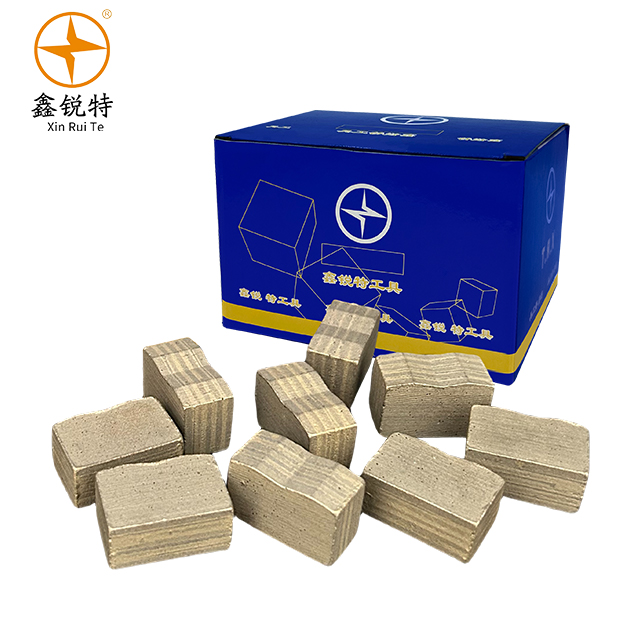
For granite specifically, XRT Diamond Tools offers segment categories engineered around distinct application needs:
Granite Block Cutting Segments are designed for single-blade and block-cutting machines processing granite and other hard natural stones, where consistent penetration and wear resistance are essential. Multi-Blade Segments are formulated for multi-blade block cutting and slab production, balancing cutting efficiency, stability and segment lifespan across simultaneous cutting operations. Quarrying Segments are built for granite and other hard-stone quarrying applications that require high sharpness, stable cutting and wear resistance under demanding field conditions.
Each of these categories reflects a different balance of sharpness, cutting resistance and durability, which is why matching the segment type to the actual application—rather than selecting based on price or appearance alone—has a direct impact on cost per cut.
The Role of Formula Customization
A core technical capability at XRT Diamond Tools is the ability to adjust segment dimensions, shape, bond hardness, diamond concentration and performance characteristics according to customer applications and OEM requirements. Rather than applying a single universal formula to all stones and machines, different formulations are developed to achieve the required balance between sharpness, cutting speed, stability and service life. This customization approach is particularly relevant for granite, where regional variations in hardness and mineral content mean that a formula optimized for one granite type may underperform on another.
Quality Control and Manufacturing Consistency
Segment performance is not determined by formula alone. Manufacturing consistency plays an equally important role. Raw materials, mixing, forming, sintering, dimensional inspection and production consistency are controlled throughout the manufacturing process to help maintain stable performance between production batches. For buyers evaluating diamond segment suppliers, this consistency matters because even a well-designed formula can underperform if production quality varies from batch to batch.
Real-World Application in Granite Fabrication
XRT Diamond Tools has supported granite-focused customers internationally, including a stone-processing company that required diamond saw blades for granite fabrication. In that case, the company supplied application-specific granite diamond saw blades with blade diameter, arbor size, segment specification and cutting performance selected according to the customer’s requirements, covering multiple saw blade sizes for granite cutting and fabrication applications, with technical focus placed on cutting efficiency, blade stability, edge quality and service life. This illustrates how segment and blade specifications are tailored to the customer’s existing machinery and production goals rather than supplied as a generic product.
Testing, Feedback and Ongoing Optimization
Selecting the right diamond segment is rarely a one-time decision. Customer field-test results can be used to further adjust segment formulas when improvements are required in cutting speed, sharpness, lifespan or cutting stability. This feedback loop—supplying an application-specific segment, evaluating its performance in actual production, and refining the formula based on results—reflects a more reliable path to long-term cost efficiency than selecting a segment based solely on initial specifications.
Making an Informed Decision
For stone processors, distributors and OEM buyers evaluating diamond segments for granite, the most reliable approach is to communicate specific details: the granite type being processed, the machine model and cutting parameters, and the priority between cutting speed and segment lifespan. Suppliers capable of adjusting bond formulas, segment dimensions and diamond concentration accordingly—supported by controlled manufacturing processes—are better positioned to deliver stable, cost-effective results.
Quanzhou Xinruite (XRT) Diamond Tools Co., Ltd. has focused on diamond tool research and manufacturing since 2001, building technical experience across granite, marble, quartz, Dekton, andesite, basalt, gabbro and sandstone applications. With its emphasis on application-specific formula development, OEM/ODM support and factory-direct manufacturing under the brand philosophy "Making Cutting Easier," XRT Diamond Tools offers granite processors and distributors a technically grounded framework for choosing the diamond segment that fits their actual cutting conditions rather than a generic industry-standard option.
www.xrtdiamondtools.com
Quanzhou Xinruite (XRT) Diamond Tools Co., Ltd.
