
Introduction
Evaluating a laser sensor against a stationary target is a comparatively forgiving exercise: the beam lands on the same spot, the reflection is stable, and the reading can be averaged at leisure. A moving target removes that comfort. The surface under the beam changes continuously, the time available for a decision shrinks, and any weakness in response time, surface tolerance, or ambient-light immunity turns into a missed detection or a false trigger. This article sets out a structured method for evaluating laser sensors when the target is in motion, and explains how the measurement logic behind KJT Sensors product families maps onto that method.
Why Moving-Target Evaluation Is a Different Discipline
In static testing, the sensor is judged on a single reading. In moving-target testing, the sensor is judged on a sequence of decisions delivered at production speed. Industrial sites commonly raise three specific difficulties: manual distance measurement is inefficient, conventional photoelectric sensors supply presence-or-absence output rather than continuous distance data, and instability arises from differences in target color, material, or brightness. Add contact measurement, which causes wear, and the evaluation problem becomes one of non-contact stability under motion rather than raw accuracy alone.
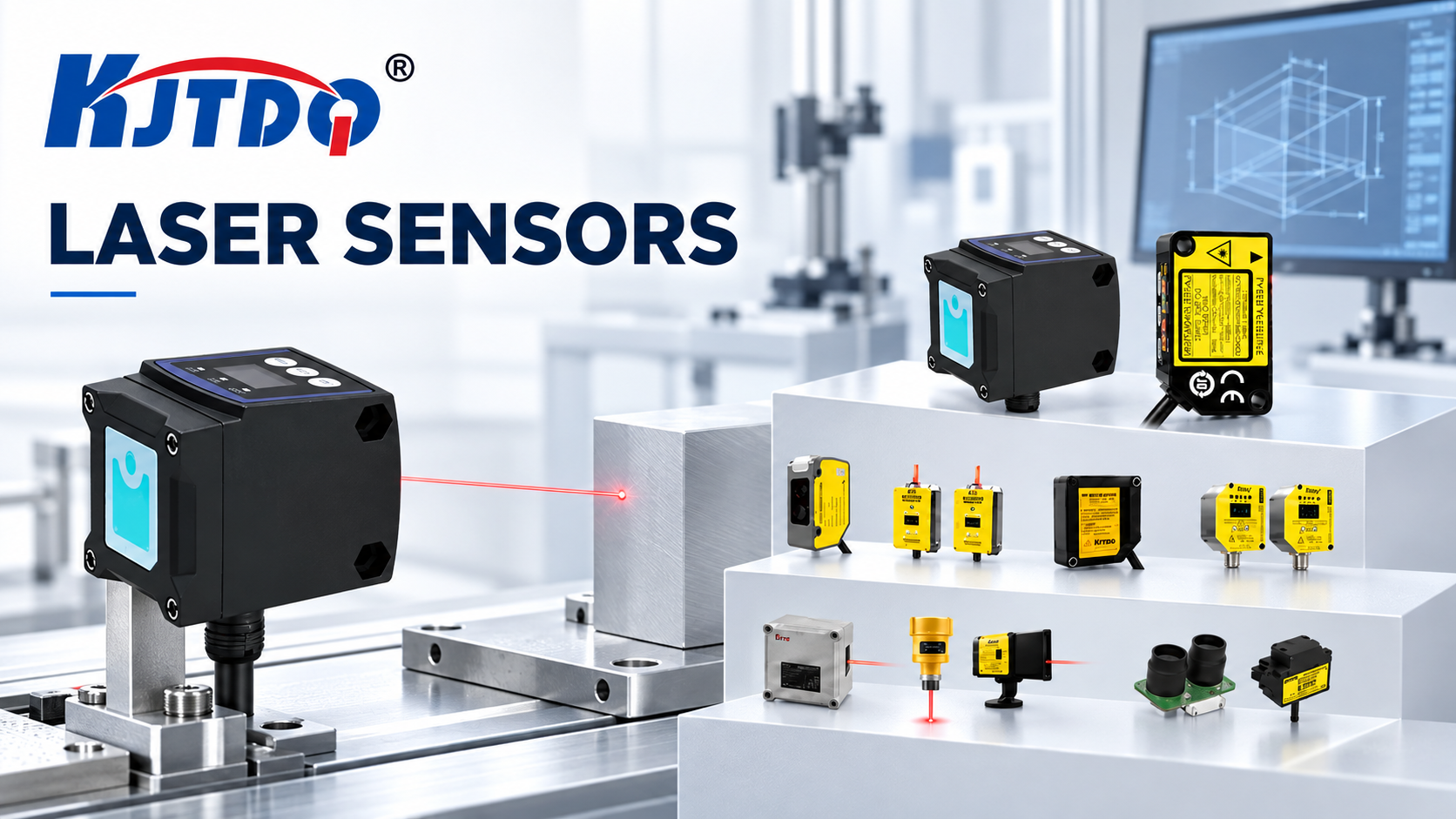
Step One: Define What the Sensor Must Output
Before comparing specifications, decide whether the application needs a switching decision or a distance value. A switching output answers "is the target present at this position?" A continuous distance or displacement signal answers "where is the target, and how is its position changing?" KJT Sensors supplies both modes across its range, with output interfaces that include relay limit output, NPN/PNP output, analog voltage output, analog current output, and RS-485. For a moving target, this distinction determines everything downstream: a switching output is evaluated on repeatability of the trip point, while an analog or serial output is evaluated on continuity and stability of the data stream.
Step Two: Match Response Time to Target Speed
The single most common cause of failure with moving targets is insufficient response time. Two numbers matter. The first is switching frequency, quoted at up to 1,000 Hz for the KJT Sensors ToF laser photoelectric sensors when used with ToF sensing distances of 1 m, 2 m, and 4 m in the KJT-FG40 series. The second is adjustable response time, specified at 1 ms for relevant ToF model pages. A useful evaluation test is to run the target at the highest line speed the site will ever use, not the nominal speed, and to check whether the count, the trip point, or the distance trace remains consistent.
Step Three: Test Surface Sensitivity Deliberately
A moving target usually presents a changing surface to the beam. Evaluation should therefore include the widest realistic spread of target color, material, gloss, and inclination. KJT Sensors laser distance products specify detection range up to 30 meters for vertical or inclined targets, with reduced effects from target color, material, and brightness. ToF-based models extend this logic further: because the measurement is derived from signal travel time rather than reflected intensity, dependence on target reflection is reduced, along with the influence of color, curvature, material, and environmental change. For transparent objects and complex backgrounds, a ToF method provides a more stable basis than a conventional photoelectric threshold.
Step Four: Reproduce the Lighting Environment
Ambient light is unpredictable in real plants and can be decisive. KJT Sensors laser distance products and distance meters are described with an ambient-light-resistant design and strong ambient-light immunity, and the ToF photoelectric sensors are specified with sunlight interference resistance for outdoor and strong-light conditions. Any moving-target evaluation performed under lab lighting should be repeated with the actual site lighting, including direct sunlight where relevant, before a specification is accepted.
Step Five: Verify Protection, Mounting, and Communication Together
A sensor that performs well on a bench may still fail in motion if mounting drift or contamination intervenes. IP67 enclosure protection is specified for the KJT Sensors laser distance product line, supporting operation in dust-laden and demanding industrial environments. On the integration side, the signal output must suit the receiving system — a PLC, control cabinet, data-acquisition system, inspection system, supervisory computer, or safety-monitoring system. The KJT Sensors functionality is organized into laser-ranging, signal-output, parameter-setting and display, industrial-protection, and system-integration modules, which is a useful checklist for confirming that no link in the chain has been skipped.
Step Six: Judge Commissioning and Diagnostics Effort
Evaluation should include how quickly an engineer can see and correct a marginal setting. Display and pushbutton programming on KJT Sensors laser distance products and OLED display with pushbutton programming on the TLS series high-accuracy laser displacement sensors allow real-time distance reading, threshold setting, parameter adjustment, and fault diagnosis at the machine. In a moving-target application, this capability shortens the loop between detection of an unstable trigger and the correction of it.
Step Seven: Confirm the Motion Profile Against the Right Product Family
Different motion profiles point to different families:
- Laser distance sensors — non-contact detection for position feedback and switching control, up to 30 m, with relay limit, NPN/PNP, and analog-voltage outputs.
- Laser displacement and distance sensors — continuous displacement feedback and position determination, also up to 30 m.
- LiDAR sensors — non-contact target-position and movement-state detection for navigation, area monitoring, and machine safety, with high accuracy, fast response, compact structure, and strong interference resistance.
- ToF laser photoelectric sensors — high-speed presence and position detection on fast lines.
- Measurement sensors and high-accuracy laser displacement sensors — continuous displacement, thickness, height, position-change, and surface-profile measurement feeding PLC, controller, inspection system, or supervisory computer for in-line quality evaluation and closed-loop control.
A Practical Summary
For KJT Sensors, part of the Nanjing KJT Electric Co., Ltd. product offering, the evaluation sequence is: define the required output, match response time to line speed, stress the surface, reproduce the site lighting, confirm protection and integration, weigh commissioning effort, then select the family that matches the motion profile. Applications addressed include material positioning, crane collision avoidance, warehousing and logistics distance measurement, steel-industry detection, AGV/AMR obstacle avoidance, conveyor safety, transparent-packaging detection, and in-line dimensional inspection. Quotation follows the same logic: standard models can be quoted quickly when the model and quantity are identified, while complex applications are quoted after technical confirmation of site conditions and parameters — an approach that keeps the moving-target decision grounded in measured evidence rather than assumption.
https://www.kjt-sensors.com/
KJT Sensors
