
Salt reduction before packaging is a diffusion problem, not a soaking problem. Salted semi-finished vegetables leave the brine pit at 8–12% salt, and the reliable route down to 3–4% without turning the tissue to mush is a three-stage counterflow desalt at an overall 1:2 vegetable-to-water ratio, 20–30 °C, 10–15 minutes per stage, 0.05–0.1% food-grade calcium chloride in the first stage, and mechanical dewatering between stages. That combination reaches target salt in 30–45 minutes. A single 90-minute soak in 1:3 water hits a similar number and costs you firmness, soluble solids and roughly three times the water.
If you are working out how to reduce salt content in pickled vegetables before packaging, start with the stage count rather than the tank size. Tank volume fixes throughput. Stage count, water temperature, calcium dose and carry-over between stages decide whether the product is still crunchy when it goes into the pouch.
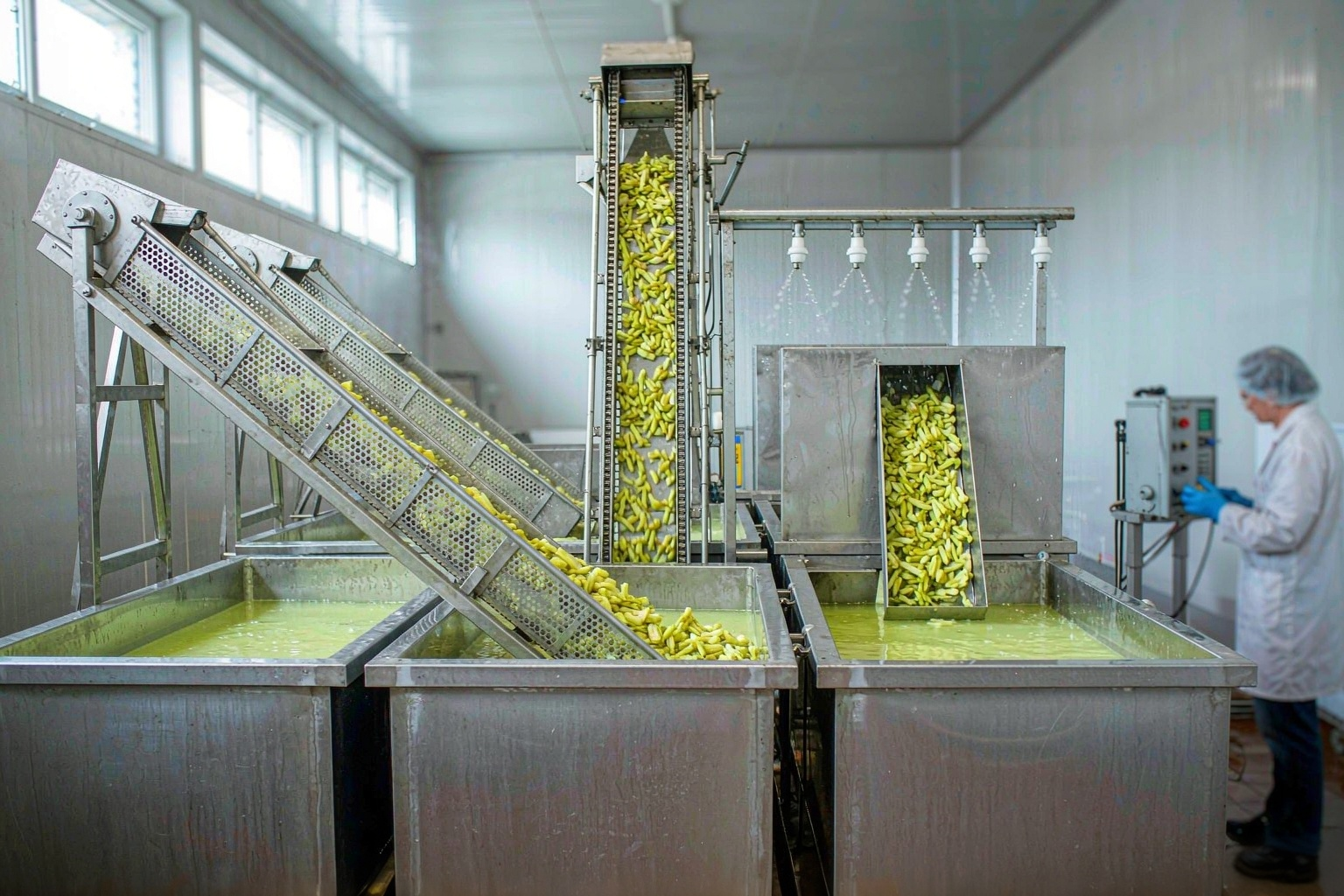
1. Why Does Desalting Make Pickled Vegetables Soft?
Crunch fails because salt leaves faster than water enters, so the tissue spends half an hour being stretched by incoming water while the calcium holding its pectin together is diluted and leached away.
A vegetable at 8% salt dropped into fresh water sits on a steep osmotic gradient. Salt diffuses out, water floods in, and cells that were firm and dehydrated during brining rehydrate and swell. Turgor climbs, cell walls stretch, and the pectin matrix that glues cells together is asked to hold more water with less calcium available to cross-link it.
Three mechanisms finish the job:
• Pectin solubilisation. In a low-salt, near-neutral soak, pectin demethylates and dissolves. Firmness drops even when the salt number looks correct.
• Soluble solid loss. Amino acids and flavour compounds leave with the salt. A three-stage gradient holds around 664 mg/100 g amino acids in pickled mustard tuber; a long single bath does not.
• Mechanical damage after the tank. Waterlogged tissue shears in the cutter and compresses under the weight of the pack. Much of the crunch is lost at the packaging line, not in the water.
Temperature is where most plants take the wrong shortcut when they work out how to reduce salt content in pickled vegetables before packaging. Warming the water to 60–80 °C does accelerate diffusion, but that range sits at or above the point where pectin begins to soften. One published celery trial ran 80 °C for 90 minutes and still finished at 5.69 g/100 g salt. You pay for heat and still ship a salty product.
The counter-lever is calcium. Food-grade calcium chloride at 0.05–0.1% of vegetable weight, dosed into the first desalting water, enters the tissue on the same osmotic gradient that is pulling salt out. Calcium ions cross-link demethylated pectin into the egg-box structure — precisely the pectin that low-salt soaking makes vulnerable. Dose it in stage one, not at the end, because that is when the tissue is open.
✅ Bottom line: Soft pickles come from over-soaking and under-dosing calcium, so cut contact time and add calcium chloride to the first stage.
2. How Do You Set the Salt Curve From 8% to 3%?
Build the curve in three stages with decreasing brine strength, and verify salt at the end of each stage instead of trusting the clock.
A workable salt reduction from 8 percent to 3 percent pickled vegetables looks like this, using pickled mustard tuber as the reference material:
• Stage 1 — vegetable to water 1:1, 3–5 minutes. Feed this stage with the spent water from stage 2, not fresh water. The gradient is still steep enough to pull 40–50% of the total salt out here.
• Stage 2 — 1:1, 3–5 minutes, fresh water carrying the calcium chloride dose.
• Stage 3 — 1:2, 3–5 minutes, clean potable water, coldest of the three.
• Totals — 10–15 minutes contact at 20–30 °C, overall ratio 1:2.
The kinetics explain why stage count beats soak length. Roughly 60–70% of the removable salt leaves in the first five minutes, when the concentration gradient is steepest. The last percentage point takes as long as the first four. Chasing 1% salt with time buys a waterlogged product and nothing else. Stop at 3–4% and let the seasoning formulation carry the rest.
Dewater between stages — 30–60 seconds on a vibrating drain or a light press. Water carried on the surface dilutes the next stage and destroys the gradient you just paid for. Shishen sizes that dewatering step together with the stage volumes, because a drain that is too short quietly turns a 1:2 design into a 1:4 one.
Water consumption per ton in vegetable desalting process is where stage design shows up on the utility bill. A batch soak at 1:3 with two water changes uses about 9 m³ per ton of salted vegetable. Three-stage counterflow at an overall 1:2 runs 2–3 m³, and reusing stage-3 discharge as stage-1 feed brings fresh water down to 1.2–1.5 m³ per ton. Spent brine still leaves at 3–6% salt, so the same decision determines whether you need an evaporator or can sell the stream for soy-sauce style recovery.
Measure salt properly. Titration is the reference method; inline conductivity is fine for trending once you calibrate per material, because sugar and acid shift the reading. Sample the core of the thickest piece, not the surface — surface salt equilibrates in minutes and will report “done” while the centre is still at 6%.
On a full line, this desalting section sits between the washing and cleaning equipment and the blanching stage, and the dewatering discipline carries straight into the blanching and cooling line. Shishen builds both ends of that sequence, which is why the stage volumes and the drain lengths are quoted together.
✅ Bottom line: Three short stages at 1:2 use a third of the water of batch soaking and hold texture better than any single long bath.
Frequently Asked Questions
Q: Can we desalt after cutting to shorten the cycle?
A: No. Cutting first doubles the surface area, so soluble solids and flavour leach out alongside the salt and the pieces round off in the tank. Desalt whole, dewater, then cut. If your line already cuts first, move the cutter downstream of stage 3 — the sequencing matters more than the machine.
Q: How much water does desalting use per ton, and can the brine be reused?
A: Counterflow design lands at 1.2–3 m³ per ton against 8–12 m³ for batch soaking, which is why water consumption per ton in vegetable desalting process is usually the second cost after raw material. Reuse stage-3 discharge as stage-1 feed — that single move is what makes a salt reduction from 8 percent to 3 percent pickled vegetables affordable on an existing site. Above 3% salt, route the spent stream to seasoning recovery or evaporation rather than the drain.
Q: Do you build custom desalting sections for pickled vegetable lines?
A: Yes. Shishen builds the desalting section as a module that bolts onto existing washing and dewatering equipment, sized to your discharge permit. Ningbo Shishen Intelligent Equipment Co., Ltd. works from a 10,000 m² facility with four workshops and supplies OEM, ODM and custom lines to Japan, Spain, Vietnam and Argentina. Every project that asks how to reduce salt content in pickled vegetables before packaging starts from the same three inputs: incoming salt, target salt, hourly output.
Next Step
Send three numbers — incoming salt %, target salt %, and hourly throughput — and Shishen will return a three-stage layout with tank volumes, calcium dose, water balance and expected firmness retention. Custom and OEM configurations are quoted factory-direct from the same sheet, so you can weigh a new desalting module against rebuilding your existing soak tanks before you commit capital.
Published: November 2026 | By Shishen Engineering Team
www.shishenfoodtech.com
Ningbo Shishen Intelligent Equipment Co., Ltd.
