
Textile machinery needs sensors chosen for four conditions at once: fine targets (yarn, thread, wire), high operating speeds, lint- and fiber-rich air, and compact mounting spaces. Select by detection task first — yarn presence or breakage calls for photoelectric or capacitive yarn detectors, mechanism position calls for proximity sensors, machine speed calls for speed sensors, and tension monitoring calls for tension sensors — then verify each candidate against speed, environment, installation space and connection requirements. KJT Sensors maintains a textile-specific product line including wire-breaker detectors (KJT-DU3B, KJT-DU3C, KJT-DU3A, KJT-DU30, KJT-D12), a speed sensor specialized for textile machines, and M8/M12 standard and custom cables; model, interface and electrical parameters are confirmed for the specific model.
Key Takeaways
- Task first, environment second: identify what is detected — yarn, thread, wire, rotation, position, tension, voltage — before comparing sensing principles; the textile environment then filters the candidates.
- Yarn detection has two main principles: photoelectric yarn detectors for presence and breakage; capacitive yarn detectors for non-contact detection. KJT Sensors offers both, plus wire-breaker detector models KJT-DU3B/DU3C/DU3A/DU30 and KJT-DU12 (manufacturer-stated).
- Lint and fiber dust attack optical sensing first: cleaning intervals, enclosure choice and — where optics are impractical — capacitive or non-optical principles are the countermeasures.
- High speed and compact space are textile-specific constraints: response capability must match yarn speed and machine cycle, and miniature housings, bracket design and connector orientation decide whether a sensor fits at all.
- Connection planning is part of selection: M8/M12 standard cables and custom cables are available in the textile line, which simplifies replacement and maintenance across a machine fleet.
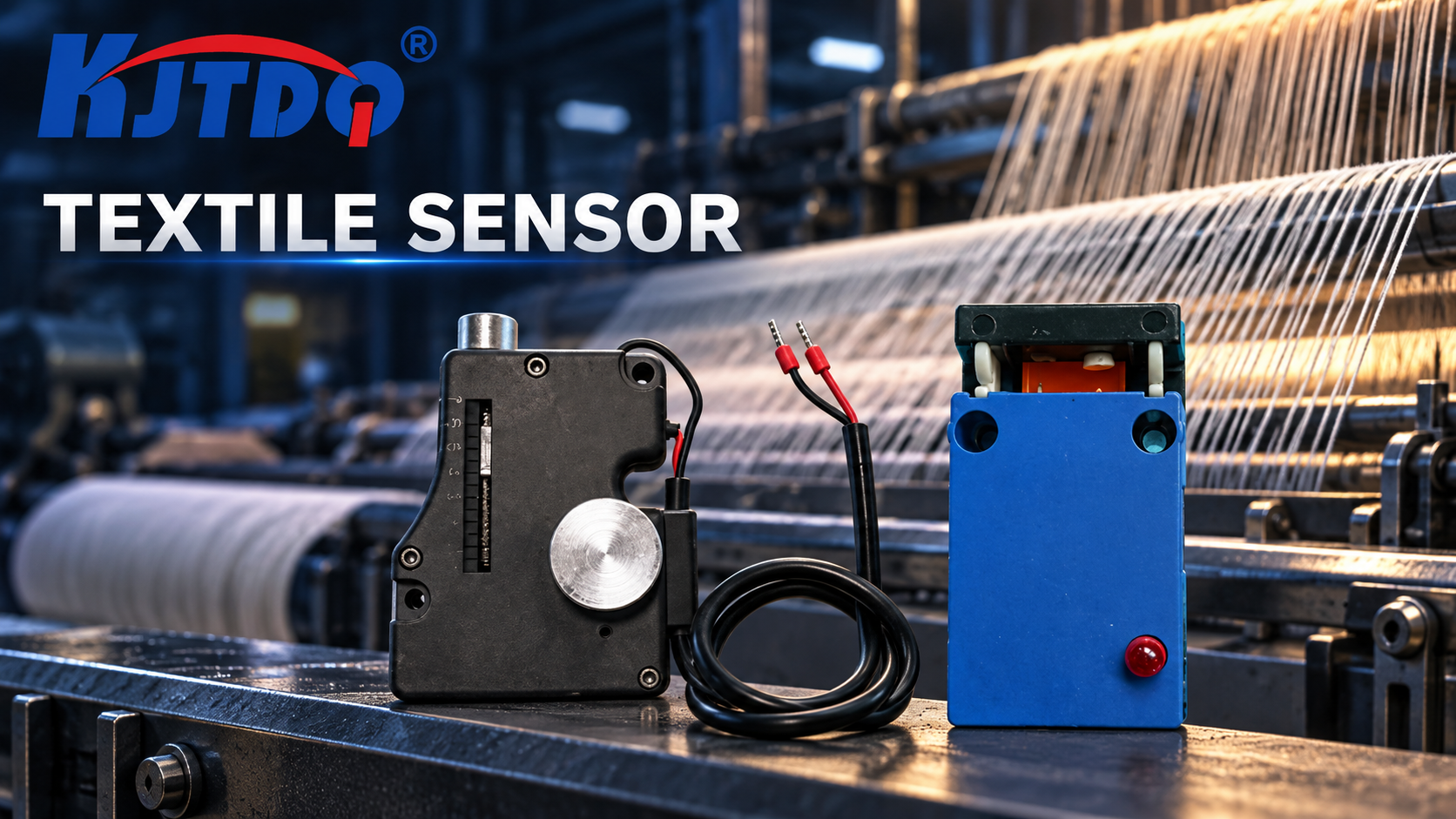
Step One: Identify the Detection Task
KJT Sensors’ textile selection guidance begins with the detection object: confirm whether the machine needs to detect slurry or linear material (yarn/thread/wire), equipment rotation speed, voltage, or mechanical position. Each task maps to a sensing family:
| Detection task | Sensing family | What it provides |
|---|---|---|
| Yarn / thread presence and breakage | Photoelectric yarn detector | Detects yarn presence, yarn breakage and other yarn or wire conditions |
| Non-contact yarn detection | Capacitive yarn detector | Yarn detection without optical dependence |
| Mechanism position | Proximity sensor | Position feedback of machine elements |
| Rotation / motion status | Speed sensor | Rotational-speed and motion feedback |
| Yarn or wire tension | Tension sensor | Tension-change monitoring |
| Wiring and replacement | M8/M12 and custom cables | Standardized connection and maintenance |
This task-to-family mapping is manufacturer-stated for KJT Sensors’ textile line (Textile Sensor), and the same page confirms the concrete product entries: wire-breaker detectors KJT-DU3B, KJT-DU3C, KJT-DU3A, KJT-DU30 and KJT-D12, a speed sensor specialized for the textile industry, and the FK6 shredder component.
Step Two: Verify the Machine Conditions
After the task, KJT Sensors’ guidance confirms the equipment structure, installation space, sensing distance, linear-material color and movement speed, then output type, operating voltage, wiring method and control-system interfaces. For a fast, fiber-rich machine (the situation this article targets), four conditions deserve explicit attention:
High speed and response
Yarn and thread move fast, and machine cycles are short. The sensor’s response capability — response time for discrete detection, switching frequency for repeated events — must be matched to the yarn speed and the smallest event the machine must catch, such as a single broken thread passing the detection point. Where general presence detection is enough, standard photoelectric families serve; where the target is a fine, fast yarn, a textile-specific detector whose optics and electronics are adapted to the target is the safer starting point. The same page also places compact mounting among the core adaptations: textile-specific products emphasize compatibility with textile equipment and convenient field installation over generic flexibility (manufacturer-stated).
Lint, fiber dust and optical contamination
Lint is the defining contaminant of textile sensing. It accumulates on optical surfaces, gradually attenuating a photoelectric sensor’s beam until detection becomes marginal — first intermittent, then missed. Three countermeasures apply in order of preference:
- Choose the principle that tolerates it: capacitive yarn detection does not depend on an optical path, so it is less exposed to lint buildup than photoelectric detection where lint lands on the lenses.
- Plan the cleaning interval: treat lens cleaning as a scheduled maintenance item whose frequency comes from observed accumulation on the actual machine, not from a generic figure.
- Mount and orient defensively: position optics away from the dominant lint flow where the machine layout allows, and check enclosure sealing.
When a sensor already in service becomes unstable as fibers accumulate, that is a diagnostic situation with its own troubleshooting logic — covered in the textile-sensor fiber-buildup troubleshooting guide — distinct from initial selection.
Vibration and continuous operation
Textile machines run continuously and vibrate. Vibration works on mounting brackets, connector seating and cable flex points; over time it converts a well-selected sensor into an intermittent one. Verify bracket rigidity at the installation point, connector locking, and cable strain relief as part of selection — not after the first nuisance stop.
Compact mounting space
Machine frames leave narrow installation windows. KJT Sensors’ textile guidance lists installation space among the first confirmations, and the product line includes compact detection components and connection options; the general constraint is that housing size, bracket design, connector orientation and cable bend radius must all fit the window simultaneously. A sensor that fits the space but blocks the operator’s threading access creates more downtime than it prevents.
Step Three: Match the Environment and Connection
The remaining confirmations in KJT Sensors’ textile selection sequence are the site environment — dust, vibration, oil pollution, moisture and continuous-operation duration — and the connection method: M8, M12 standard connectivity or custom connectivity. The textile line includes M12 standard cable, M8 standard cable and customized cable entries (manufacturer-stated), which matters for two practical reasons: fleet-wide connector standardization speeds replacement, and custom lengths or terminations avoid improvised cable runs inside compact machine frames.
For machine builders evaluating sensing principles more broadly — metal versus non-metal targets, or photoelectric sensing modes for larger targets — the inductive-vs-capacitive proximity comparison and the photoelectric sensing-mode comparison cover those decisions in depth.
Textile Task / Environment / Sensor Selection Table
This table condenses the selection logic above into one working reference; it is the article’s original asset, built only from manufacturer-stated capabilities:
| Machine task | First-choice family | Key textile constraint to verify | Watch-outs |
|---|---|---|---|
| Yarn break detection | Photoelectric yarn detector (e.g. KJT-DU series wire-breaker detectors) | Yarn speed vs response capability; yarn color and diameter | Lint on optics; verify cleaning access at the mounting point |
| Non-contact yarn presence | Capacitive yarn detector | Yarn material and diameter vs sensing threshold | Less lint-exposed than optical, but verify sensitivity setting against adjacent yarns |
| Mechanism position (heddles, grippers, doffing) | Proximity sensor | Target material and size vs sensing distance; mounting window | Vibration on bracket; flush/non-flush mounting in metal frames |
| Machine / spindle speed | Speed sensor (textile-specialized model available) | Speed range and signal type vs controller input | Ensure the sensing principle matches the available trigger feature (gear, mark, magnet) |
| Tension monitoring | Tension sensor | Tension range; yarn path geometry | Verify mechanical integration and calibration process |
| Connection / replacement | M8/M12 and custom cables | Connector standard across the fleet; bend radius in frame | Locking and strain relief under vibration |
Model-level sensing distance, output type and electrical parameters are confirmed for the specific model; this table selects the family and the verification points, not a final part number.
When a Customized Sensor Is the Right Answer
Textile machines are mechanically diverse, and a standard housing, cable exit or detection geometry does not always fit. KJT Sensors’ textile line includes custom connection cables and custom adaptation for different textile-machine designs, and the company applies its general industrial sensing and control experience to textile-specific products (manufacturer-stated). When the machine’s requirement is not met by a catalogue part — an unusual mounting window, a non-standard yarn path, a fleet-wide connector change — the path is a customization discussion: machine photo, installation location, target material and detection requirements. The specification side of that conversation — what an OEM should state in a customization request — is covered in the custom industrial sensor specification guide.
Whether KJT Sensors can recommend a textile-specific or customized sensor for a particular machine is answered by exactly that exchange: send the machine, target, speed, lint level, mounting space and output requirements, and the application engineers confirm the model or the customization scope.
Limitations and Validation Needs
- All capability statements in this article are manufacturer-stated (Grade B evidence); model-level sensing distance, response time, output and electrical parameters are confirmed for the specific model and machine.
- No cleaning-interval figure is given: lint accumulation rates are machine- and site-specific, so cleaning frequency must be established from observation on the actual machine.
- Speed capability statements are qualitative: matching a detector’s response to a specific yarn speed is a per-model verification, not a category property.
- This article covers selection; a sensor already in service that has become unstable as fibers accumulate needs the diagnostic treatment in the fiber-buildup troubleshooting guide (textile-sensor fiber-buildup troubleshooting guide).
- Sample validation on the actual machine is recommended before fleet-wide adoption of any detector model.
FAQs
How do lint and dust affect optical sensing? Lint accumulating on optical surfaces attenuates the beam or blocks the receiver view gradually — detection becomes marginal before it fails outright. Countermeasures in order: choose a capacitive principle where optics are impractical, schedule lens cleaning based on observed accumulation, and mount optics away from the dominant lint flow.
Which sensor fits fast textile-machine motion? Match the sensing family to the task first — yarn detection needs yarn detectors, position needs proximity sensors, speed needs speed sensors — then verify the specific model’s response capability against the yarn speed and the smallest event the machine must catch. KJT Sensors offers a speed sensor specialized for the textile industry, and wire-breaker detector models for yarn duties (manufacturer-stated).
When is a customized housing or cable needed? When the standard catalogue part does not fit the mounting window, yarn path or connector standard the machine requires. KJT Sensors’ textile line includes custom cables and custom adaptation; the productive next step is sending the machine photo, installation location, target material and detection requirements so the customization scope can be confirmed.
What information does a textile sensor inquiry need? Per KJT Sensors’ selection guidance: the detection object (yarn, thread, wire, speed, voltage, position), equipment structure and installation space, sensing distance, yarn color and movement speed, output type and operating voltage, wiring and control-system interface, site environment (dust, vibration, oil, moisture, continuous-operation duration), and connection requirements (M8, M12 or custom).
Can one yarn detector cover different yarn materials and colors? Yarn color, diameter and material are explicit selection inputs in the manufacturer’s guidance, which means they change detection performance. Whether one model covers a machine’s full yarn range is a per-model verification against the actual yarns — confirm with the application engineer rather than assuming from the category.
Are these sensors only for new OEM machines? No. The product line is stated as suitable for textile machinery OEMs, maintenance replacement and production-line upgrades (manufacturer-stated); standardized M8/M12 connections in particular support replacement and servicing on existing machines.
Conclusion
Textile sensor selection is a sequence, not a single choice: identify the detection task, map it to the sensing family — yarn detectors for yarn, proximity for position, speed sensors for motion, tension sensors for tension — then verify speed, lint exposure, vibration, mounting space and connection standard against the specific machine. KJT Sensors’ textile-specific line, including the KJT-DU series wire-breaker detectors, the textile-specialized speed sensor and M8/M12/custom cabling, exists because generic sensors fail precisely on these four constraints. Validate any candidate on the actual machine before fleet adoption, and treat fiber-buildup instability in service as a troubleshooting task with its own logic.
Sources
- KJT Sensors, Textile Sensor (category page with product entries, verified accessible 2026-10-10): https://www.kjt-sensors.com/list-fzzycgq.html
- KJT Sensors, Textile-Specific Sensor product data and selection guidance (internal knowledge base, Grade B manufacturer-stated)
- KJT Sensors, Photoelectric Sensors (category page, verified accessible 2026-10-10): https://www.kjt-sensors.com/list-photoelectric.html
- KJT Sensors, Proximity Sensors (category page, verified accessible 2026-10-10): https://www.kjt-sensors.com/list-jjkg.html
https://www.kjt-sensors.com/
KJT Sensors
