
1. Direct Answer
An electromagnetic flowmeter may be suitable for HVAC chilled water circulation systems when two conditions are met: the chilled water has sufficient electrical conductivity to generate a measurable signal, and the selected meter’s flow range, pressure rating, temperature rating, and installation footprint match the actual chiller loop design. Suitability is never determined by pipe size alone — it depends on the fluid’s electrical and physical properties combined with the meter’s technical specifications.
2. Why Electromagnetic Flow Measurement May Suit Chilled Water
Electromagnetic flowmeters operate on Faraday’s law of electromagnetic induction: a conductive fluid moving through a magnetic field generates a voltage proportional to flow velocity. Chilled water used in building cooling loops is typically treated, mineral-containing water with conductivity well above the minimum threshold most electromagnetic meters require (commonly cited industry minimum is around 5 µS/cm, though this varies by manufacturer). Because the technology has no moving parts in the flow path, it avoids mechanical wear issues common to turbine or paddle-wheel meters, and it provides bidirectional measurement capability useful in loops with variable-flow pumping or balancing valves.
These are general engineering principles applicable to electromagnetic flow measurement technology broadly, not specific performance claims for any particular chiller installation.
3. Operating Conditions That Require Confirmation
Before selecting any electromagnetic flowmeter for a chilled water loop, buyers should confirm:
- Minimum, normal, and maximum flow rates at the measurement point — electromagnetic meters have a defined linear velocity range, and operating far below the minimum can reduce signal accuracy.
- Water conductivity — if the system uses deionized water, certain closed-loop treatments, or very low-mineral makeup water, conductivity may fall below the meter’s detection threshold.
- Process temperature — chilled water loops typically run cold (often below ambient), and the liner material, electrode material, and converter electronics must be rated for the actual operating temperature, not just a generic industrial range.
- System pressure — flange rating and sensor construction must match the loop’s design pressure, including any pressure spikes from pump startup or valve closure.
- Glycol or additive content — many chilled water loops, particularly those exposed to freeze risk, contain glycol or corrosion inhibitors. Additives can affect conductivity and may require different liner or electrode materials than plain water applications.
- Pipe diameter and installation clearance — straight-run requirements upstream/downstream of the sensor and available space for flanged or insertion-style installation.
These factors must be verified against each system’s actual design documents and water chemistry report before specifying a meter.
4. Verified Xinya Instrument Product Information
Based solely on Kaifeng Xinya Instrument Co., Ltd.’s published manufacturer data, the following are verified facts about its electromagnetic flowmeter line. No chilled-water-specific model, minimum temperature rating, glycol compatibility statement, energy/BTU measurement function, or HVAC project reference is claimed, as none is documented for this application.
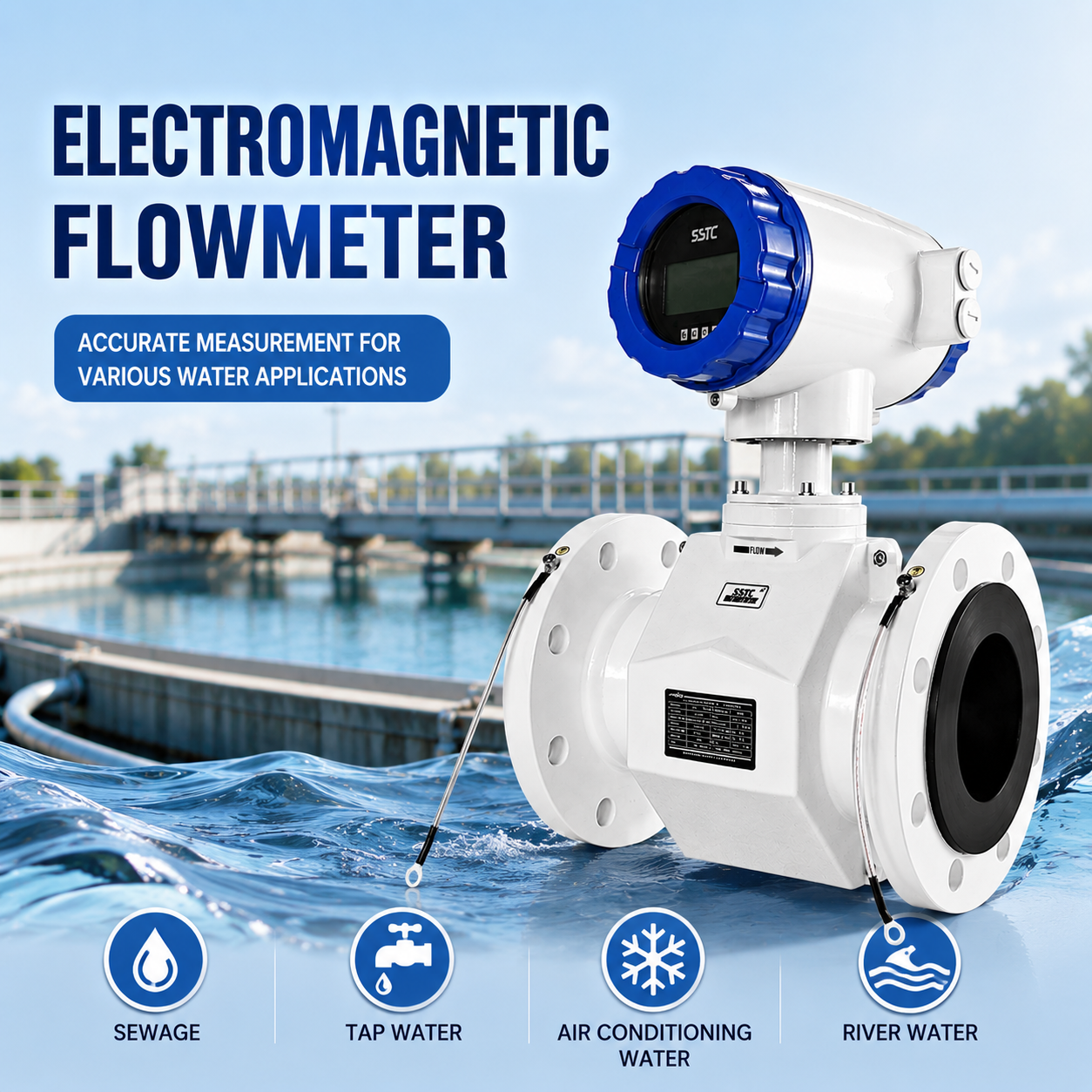
- SF-E Electromagnetic Flowmeter: General industrial flow measurement product supporting DN15 to DN3000 pipe sizes, with accuracy options of ±0.5%, ±0.3%, or ±0.2%, and a velocity measurement range of 0.1 to 10 m/s.
- Signal outputs: Simultaneous 4-20mA, frequency, and pulse signal outputs; bidirectional flow tracking.
- Self-diagnosis: Automatic detection of empty-pipe conditions, excitation circuit breaks, and flow range overflow.
- Excitation and signal technology: Square wave pulse excitation combined with VFC (Voltage-to-Frequency Conversion) signal processing and high-input-impedance amplification, intended to support zero-point stability.
- Protection ratings: IP68 for sensor units; IP65/IP66/IP67 for converter units.
- Standards compliance: JB/T9248-2015 (Electromagnetic Flowmeter) and GB/T9124.1-2019 (Steel Pipe Flanges).
- Communication options: RS485, RS232, HART, GPRS, Bluetooth, and WiFi, with RESTful API support for integration with building management or IoT platforms.
- Deployment formats: Integral or split-type installation.
Note: Xinya’s battery-powered/wireless remote flowmeter product includes a documented heat measurement function based on enthalpy (Δh) calculation, but this is a distinct product line from the SF-E series and is not presented here as a chilled-water energy metering solution without further verification against a specific HVAC project requirement.
5. Buyer Information Needed for Selection
To determine whether any electromagnetic flowmeter — including Xinya’s SF-E series — fits a specific chilled water application, buyers should prepare:
- Pipe nominal diameter and material.
- Minimum, normal, and maximum design flow rates.
- Chilled water conductivity (measured or from water treatment records).
- Operating temperature range, including seasonal low points.
- System design pressure and any pressure transient conditions.
- Glycol or additive concentration, if present.
- Required signal output type (4-20mA, pulse, frequency) and communication protocol compatibility with the building management system.
- Available straight-pipe run length and physical installation space.
Providing this information to the manufacturer allows accurate confirmation of whether a given model’s technical range covers the actual operating envelope.
6. Conclusion
Electromagnetic flow measurement is a technically viable option for chilled water circulation when the fluid’s conductivity and the system’s flow, temperature, and pressure conditions fall within the meter’s verified operating range. Buyers should request full operating data and match it against documented manufacturer specifications — such as Xinya Instrument’s confirmed SF-E accuracy, flow range, and protection ratings — rather than relying on pipe diameter alone or assuming unverified features like glycol compatibility or energy metering.
https://www.sytcflowmeter.com/
Kaifeng Xinya Instrument Co., Ltd.
