
A 5930 shunt carrying 300 A at 0.1 mΩ dissipates 9 W and sits around 110 K above ambient. At that temperature the accuracy is decided by two material properties, not by the tolerance printed on the label: the temperature coefficient of the element, and its thermal EMF against copper. This guide is about material selection for karma alloy shunt resistor EV battery management current sensing — where the Ni-Cr-Al-Fe family earns its place, where it loses to manganin, and the geometry that decides which side of that line a design falls on.
Published: November 2026 | By Wisuno Engineering Team
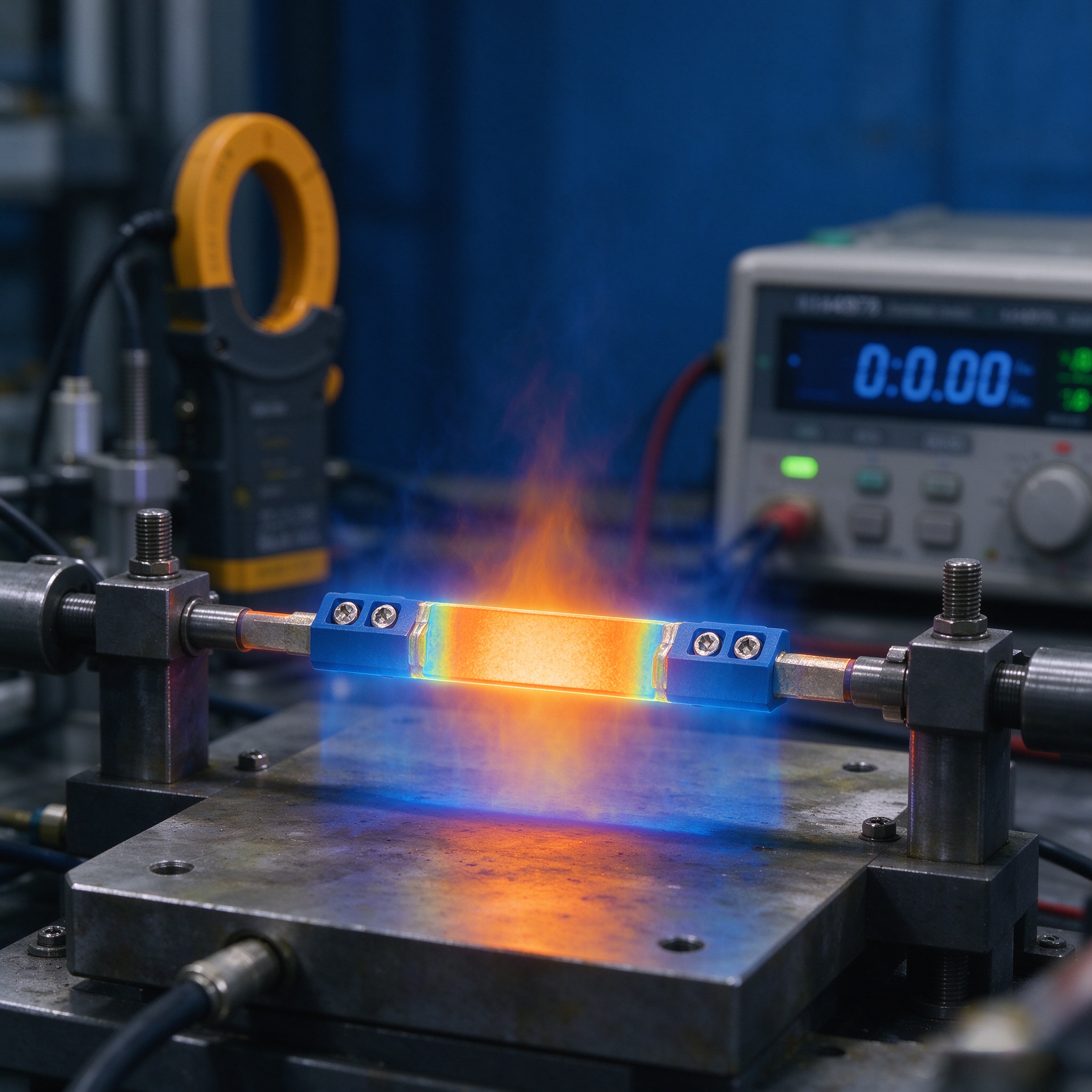
1. What 9 W Actually Does to a 0.1 mΩ Shunt
Self-heating dominates the error budget: 9 W into a package at 12 K/W is about 110 K of rise, and the element sees all of it. Four terms make up the budget on a 30 mV signal.
• Element TCR. At 110 K rise, 50 ppm/K costs 5,500 ppm, 20 ppm/K costs 2,200 ppm, and a stabilised 5 ppm/K grade costs 550 ppm.
• Thermal EMF against copper. A 8 K gradient across the terminals with 2.5 μV/K is 20 μV — 0.067 % of 30 mV. With 40 μV/K it is 320 μV, or 1.07 %.
• Copper inside the sense span. One millimetre of copper on a 10 mm² path is 1.7 μΩ, which is 1.7 % of a 0.1 mΩ part, and 0.73 % of error at that 110 K rise.
• Long-term drift. Annealed, stress-relieved elements hold hundreds of ppm over life; unannealed ones move in the first 1,000 hours as the drawn structure relaxes.
Note the ranking: on a sub-milliohm part, copper in the sense path can cost more than a good TCR buys. At 1 mΩ the same copper term shrinks to 0.17 % and material dominates again.
✅ Bottom line: At 9 W you are buying a material's behaviour at 130 °C, not its 25 °C tolerance.
2. The Geometry Rule: Where Karma Fits and Where It Does Not
Karma's 1.33 μΩ·m is three times manganin's, so the element is three times shorter for the same value — an advantage above 0.5 mΩ, a liability below. Length follows L = R·A/ρ: on 10 mm², 0.1 mΩ needs 0.75 mm, 0.5 mΩ needs 3.8 mm, and 1 mΩ needs 7.5 mm, the natural fit for a 15 mm body.
Below roughly 0.4 mΩ the element is shorter than its own solder fillet and the copper terminals take over the sensed span. Manganin at 0.43 μΩ·m gives 2.3 mm for the same 0.1 mΩ — still short, but three times less exposed. That is why sub-0.5 mΩ BMS shunts are usually Cu-Mn parts.
Above 0.5 mΩ the picture reverses: for 5 and 10 mΩ, Karma lets you drop the cross-section to about 1 mm² and stay inside a 5930 footprint, which shrinks the copper fraction and puts TCR back in charge of karma alloy shunt resistor EV battery management current sensing accuracy. Wisuno quotes custom element geometries for this window.
✅ Bottom line: Karma owns 0.5–10 mΩ in a 5930. Below 0.5 mΩ, copper — not alloy — decides the accuracy.
3. Thermal EMF: The Term That Rules Out Constantan
Constantan is the wrong shunt material for one reason, and it is not resistance: 40 μV/K against copper, sixteen times Karma's. On a 30 mV signal an 8 K gradient makes that 320 μV — a 1.07 % error no calibration removes, because it depends on temperature distribution, not on the part.
Karma runs at 2.5 μV/K or better against copper, manganin at 1–2. Both are usable, and both demand one rule: keep the voltage taps isothermal. Route them side by side, off the hot terminal shoulder, and never tap across a joint that sits in a different thermal environment.
4. A Four-Material Comparison for BMS Accuracy
Any honest low TCR shunt material comparison BMS accuracy has to compare curves, not coefficients, because BMS shunts work 100 K away from the temperature where the coefficient was measured.
• Karma (Ni-Cr-Al-Fe), 1.33 μΩ·m. α to ± 5 ppm/K with β of −0.002 to −0.008 ppm/K². At 110 K the β term costs 60–100 ppm, against 2,200 ppm from α alone. Usable to 300 °C, so a 130 °C terminal is not a life limit.
• Manganin (Cu-Mn-Ni), 0.43 μΩ·m. α passes through zero near room temperature, which looks ideal until you leave it: β of −0.03 to −0.05 costs about 480 ppm at 110 K. Stability above 100 °C is the second limit, and 9 W parts live there.
• Constantan (Cu-Ni), 0.49 μΩ·m. Flat resistance, excellent for strain gauges on aluminium, disqualified above by its 40 μV/K EMF.
• Copper-manganese-tin alloys. Practical below 0.5 mΩ where the element is stubby, but their β is steeper than Karma's and their anneal window is narrow.
A useful low TCR shunt material comparison BMS accuracy has to show this: at 110 K manganin's near-zero α still leaves 480 ppm of curvature error, while stabilised Karma leaves 550 from α plus under 100 from β — and holds its structure where manganin begins to age.
5. Making a 5930 Survive 9 W
Good 5930 package karma shunt 9W thermal design is mostly a copper problem: you need junction-to-ambient below about 10 K/W, and the package alone gives you 20–25. Four moves close the gap.
✅ Terminal copper, not solder. 2 oz minimum, 4-layer preferred, with terminal pads above 100 mm² each and no solder mask under the pad. The terminals are the heat path; the element only conducts along its length.
✅ Thermal vias under the body, filled and capped, tied to an inner plane rather than to a signal layer.
✅ Kelvin taps inside the element. 0.3–0.5 mm inboard of the terminal transition, symmetric about the centre line, twisted pair to the AFE. Taps on the shoulder read copper and its 3,900 ppm/K.
✅ Derate what you quote. A 9 W rating at 25 °C is a 3 W part at 85 °C on a 12 K/W board — the most useful number in 5930 package karma shunt 9W thermal design. State ambient and board in the RFQ.
Element thickness, temper and stabilisation are what Wisuno controls; copper area and via count are yours. Get both right and the shunt holds ± 0.5 % over temperature. Options are on our Karma alloy wire and strip range; for the cost side, see the cost-per-ohm comparison with constantan.
Frequently Asked Questions
Q1: Is karma alloy shunt resistor EV battery management current sensing a real fit, or is manganin always better?
A: From about 0.5 mΩ to 10 mΩ. Above that the element stays long enough and slim enough that copper is a small part of the sensed span, and its flatter curvature plus 300 °C capability matter at a 130 °C terminal. Below 0.5 mΩ, manganin or Cu-Mn wins, and a supplier who says otherwise is not sizing the part.
Q2: What does 5930 package karma shunt 9W thermal design require on the PCB?
A: Below 10 K/W junction-to-ambient: 2 oz copper minimum, pads over 100 mm² with no mask under them, filled thermal vias to an inner plane, and Kelvin taps placed inboard of the terminal transition. Without that the same package is a 3 W part.
Q3: How should a low TCR shunt material comparison BMS accuracy be run?
A: Compare resistance change over the real terminal temperature range, not coefficients at 25 °C. Plot α and β across 20–150 °C for each candidate, add the thermal EMF term at your gradient, then add copper in the sense span. Whichever curve is flattest where the part actually runs is the answer.
Send the Duty Cycle, Not Just the Resistance
Send Wisuno the resistance value, continuous and peak current, ambient, terminal temperature limit and board stack-up, and Wisuno Special Materials Technology (Nanjing) Co., Ltd. — a China factory direct supplier of Karma strip and wire — will size the element and say whether the value belongs in Karma at all. Custom widths, thicknesses and stabilisation from 0.05 mm, with OEM marking and lot certificates. wisuno@wsnnj.com / +86 189-1295-0505.
www.wisunotech.com
Wisuno Special Materials Technology (Nanjing) Co., Ltd.
