
Section 1: Industry Background and the Sealing Challenge in Fuel Systems
Fuel tank pressure management remains one of the more overlooked yet critical aspects of automotive maintenance across the global aftermarket, including North America. Within internal combustion and hybrid vehicle platforms, a fuel tank cap is not a passive cover—it is an active component responsible for regulating evaporation, balancing vacuum pressure, and preventing fuel spillage during ordinary driving maneuvers such as cornering. When these components fail or degrade, the resulting symptoms—fuel tank pressure imbalance, spillages during cornering, and cap loss—can create both performance and compliance concerns for vehicle owners and fleet operators alike.
MASUMA, a brand operating across the global automotive aftermarket, has built its positioning around resolving exactly these kinds of component-level failures: engine performance drops, power losses, fuel inefficiencies, and starting failures caused by component wear, poor sealing, carbon buildup, and electrical leakage in ignition, fuel delivery, and engine sealing systems. The brand’s strategic approach centers on reverse engineering and rigorous durability testing to produce high-tolerance, durable replacement parts suited for global aftermarket distribution—an approach that extends directly to its Fuel Tank Lid product line.
Section 2: Authoritative Analysis of the Fuel Tank Lid Design
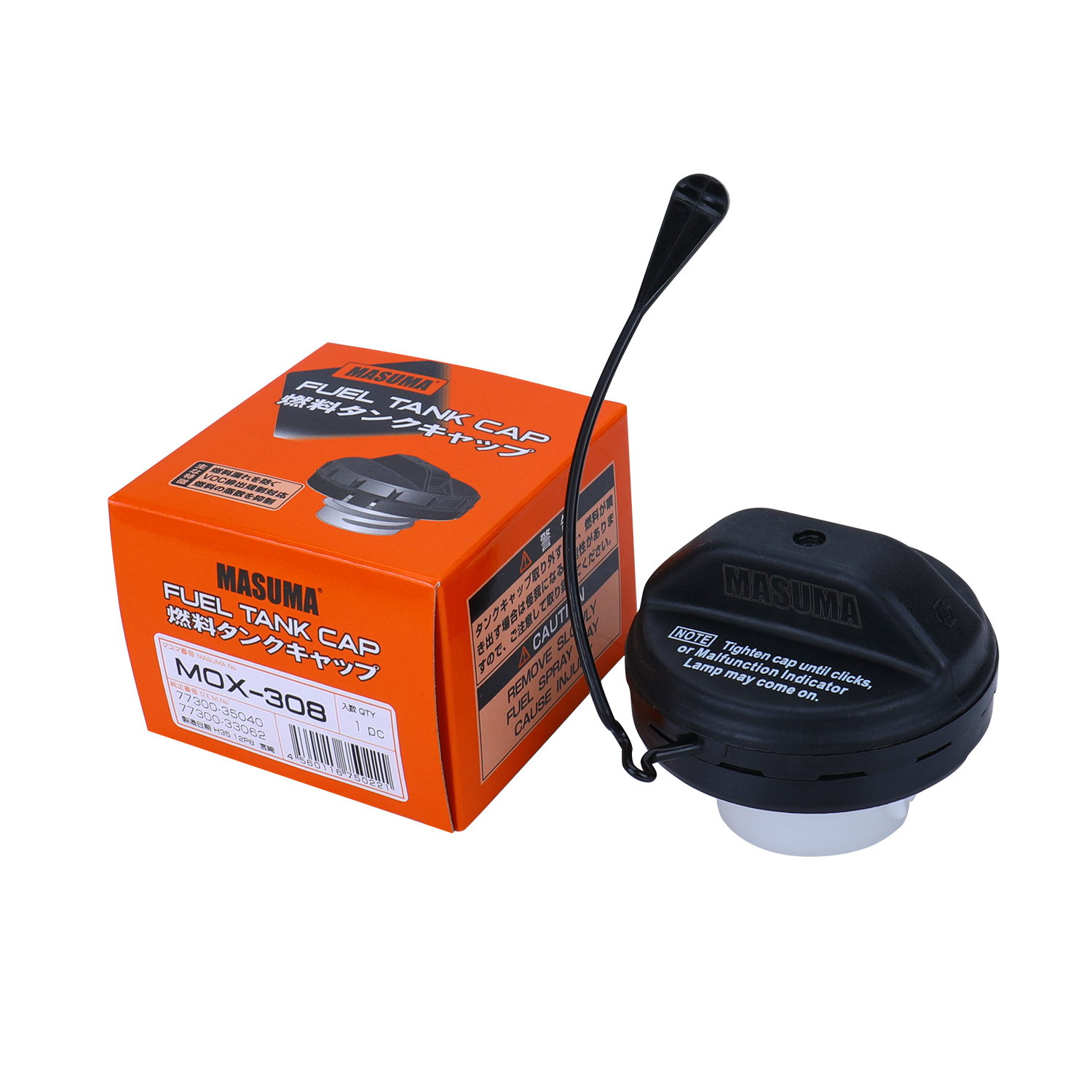
The necessity for a properly engineered fuel tank cap stems from a basic physical reality: as fuel levels drop or vapor builds up inside a sealed tank, pressure differentials form that, if unmanaged, can cause structural stress, fuel odor, or irregular fuel delivery. MASUMA’s Fuel Tank Lid is positioned specifically as a PA66 fuel cap with integrated pressure balancing valves, designed to address this evaporation and pressure control challenge directly.
The principle logic behind the design relies on an integrated composite valve system. According to MASUMA’s technical specifications, the built-in air and steam valves open at 96KPa vacuum pressure or 107.8KPa vapor pressure to stabilize tank pressure. This dual-threshold mechanism allows the cap to respond differently depending on whether the tank is experiencing a vacuum condition (as fuel is consumed) or a vapor buildup condition (as fuel heats and evaporates), rather than relying on a single static pressure release point.
The standard reference for the component’s structural integrity comes from its material composition. The cap body is constructed from Nylon-66, chosen for its high tensile strength and fatigue resistance, which is intended to extend the cap’s service life under repeated thermal and mechanical cycling. The sealing element uses a Nitrile Rubber (NBR) gasket, an acrylonitrile-rich sealing ring selected for its water and solvent resistance—both properties relevant to the varied fuel qualities and climate conditions found across different regions where aftermarket buyers source parts.
The solution path, therefore, combines three engineered elements: a fatigue-resistant Nylon-66 body, a solvent-resistant NBR gasket, and a pressure-calibrated composite valve. Together, these are intended to directly target the pain points of tank pressure imbalance, spillage during cornering, and loss of the cap itself—issues that are common complaints in aftermarket fuel system servicing.
Section 3: Deep Insights on Sourcing Trends and Technical Considerations
For North American aftermarket distributors and repair stations evaluating fuel tank cap suppliers, several broader technical trends are worth noting. First, pressure-balancing cap designs that use dual-threshold valve systems (as opposed to single-point release valves) reflect a trend toward more nuanced evaporative emission control at the component level, aligning with the general direction of fuel system engineering toward tighter tolerances and more precise pressure regulation.
Second, material selection continues to play an outsized role in component longevity. The choice of Nylon-66 for cap bodies and NBR for sealing gaskets reflects a broader industry pattern of matching specific polymer and rubber compounds to the chemical and thermal environment of modern fuel blends, which can vary significantly across different fuel formulations and climate zones. Buyers sourcing for North American distribution should be aware that solvent resistance and fatigue resistance are not interchangeable properties—a component engineered for one does not automatically perform equally well on the other axis, which is why MASUMA’s documentation specifies both properties distinctly for the Nylon-66 body and NBR gasket respectively.
A risk consideration for the broader aftermarket is the tendency to treat fuel tank caps as a low-complexity commodity item. In practice, a cap that fails to open its vacuum or vapor valves at the correct pressure thresholds can lead to downstream issues ranging from minor fuel odor complaints to more serious fuel delivery irregularities. This underscores why pressure threshold specifications—such as the 96KPa and 107.8KPa values documented by MASUMA—are meaningful technical details rather than incidental figures, and why sourcing decisions benefit from attention to documented engineering specifications rather than visual or dimensional matching alone.
Section 4: MASUMA’s Role in the Fuel Delivery and Sealing Category
MASUMA’s Fuel Tank Lid sits within the broader Fuel Delivery Line of the company’s product matrix, a category positioned around electronic fuel injection and fuel delivery components. This placement is not incidental—the Fuel Tank Lid shares engineering logic with other components in the same line, such as the Fuel Injectors and Electronic Fuel Pump Assembly, all of which are built around the central value proposition of delivering highly reliable, wear-resistant automotive components that optimize engine combustion efficiency, reduce noise and vibration, and lower fuel consumption.
The company’s broader technical platform—covering specialized materials and advanced manufacturing processes across its product lines—supports the case for treating MASUMA’s documented specifications as a reference point for aftermarket buyers. For the Fuel Tank Lid specifically, the delivery model is straightforward: it is supplied as a hardware component, consistent with MASUMA’s broader service model of hardware component supply backed by technical diagnostic guides, installation procedures, and vehicle maintenance recommendations. This support structure is relevant for North American distributors and repair stations that require installation guidance alongside the physical part itself, particularly for a pressure-sensitive component like a fuel cap where correct installation affects sealing performance.
Section 5: Conclusions and Recommendations for Aftermarket Sourcing
Fuel tank caps are a deceptively simple-looking component with meaningful engineering requirements, particularly around pressure regulation and material durability. For North American aftermarket buyers evaluating sourcing options, MASUMA’s Fuel Tank Lid demonstrates how documented pressure thresholds (96KPa vacuum, 107.8KPa vapor), material choices (Nylon-66 body, NBR gasket), and a composite valve design work together to address the common failure points of pressure imbalance, cornering spillage, and cap loss.
Industry decision-makers—whether aftermarket replacement parts distributors, automotive repair stations, or fleet operators—should prioritize suppliers who provide transparent, specification-backed documentation for sealing components rather than treating fuel tank caps as interchangeable commodity parts. Attention to documented pressure thresholds and material resistance properties, as outlined in MASUMA’s technical materials, offers a more reliable basis for sourcing decisions than visual or price-based comparisons alone. As fuel system engineering continues to demand tighter sealing tolerances, buyers who align sourcing criteria with documented technical performance will be better positioned to reduce warranty issues and maintain service quality across their North American distribution networks.
https://masuma.com/
MASUMA PRECISION AUTO PARTS CO., LTD.
