
A milk filling machine is normally chosen on capacity and then judged on shelf life. In dairy the order runs the other way. Pasteurized milk, fermented yogurt and aseptic milk are three different processes, and the shelf life you intend to sell decides which of the three you are building. Capacity is what you negotiate once that is settled — not what decides it.
Why Shelf Life Settles the Route Before Capacity Does
Dairy is not one product category with one filling problem. Fresh milk sold through a cold chain, yogurt that has to ferment before it is packed, and milk intended to sit on an ambient shelf for months are three separate engineering briefs. They differ in the container, in the filling method, in the thermal process upstream and in the cleaning regime between batches.
Ask what shelf life the product is being sold on, and the equipment shortlist collapses on its own. A producer who answers “a week, refrigerated” and one who answers “six months, ambient” are not comparing the same machine at different speeds. They are buying different plants.
Three Routes and Four Configurations
| Route | Product | Filling method | Capacity reference |
| Cold chain | Pasteurized fresh milk in 1 L bottles | Vacuum (negative-pressure) filling | 6,000 BPH on the 1 L configuration supplied in Europe |
| Fermented | Yogurt and drinking yogurt | Batching, fermentation and filling as one line | Per configuration |
| Ambient | Milk packed for shelf-stable distribution | Aseptic blow-fill-cap (monoblock) | 8,000–15,000 BPH |
| Standard rotary | 1 L PET milk and milk beverages | Rotary filling | 8,000–10,000 BPH |
The rotary and aseptic figures are not interchangeable, and a quotation that merges them into one band is worth questioning. Rotary filling for 1 L PET and aseptic blow-fill-cap for shelf-stable milk are different machines with different ceilings.
Why Vacuum Filling Suits Cold-Chain Milk
Cold-chain milk is filled cold, into a bottle that has to be sealed cleanly, in a product category where a single compromised bottle becomes a customer complaint within days rather than months. That makes the fill itself the weak point: foam at the valve, product left on the neck, a cap applied over an imperfect surface.
Vacuum filling addresses it by drawing product into a bottle held under negative pressure rather than pushing it in under gravity or pressure. Less turbulence at the nozzle means less foam, and a cleaner neck means the cap seals on milk rather than on residue. For a short-shelf-life product, the filling method is a hygiene decision disguised as a mechanical one.
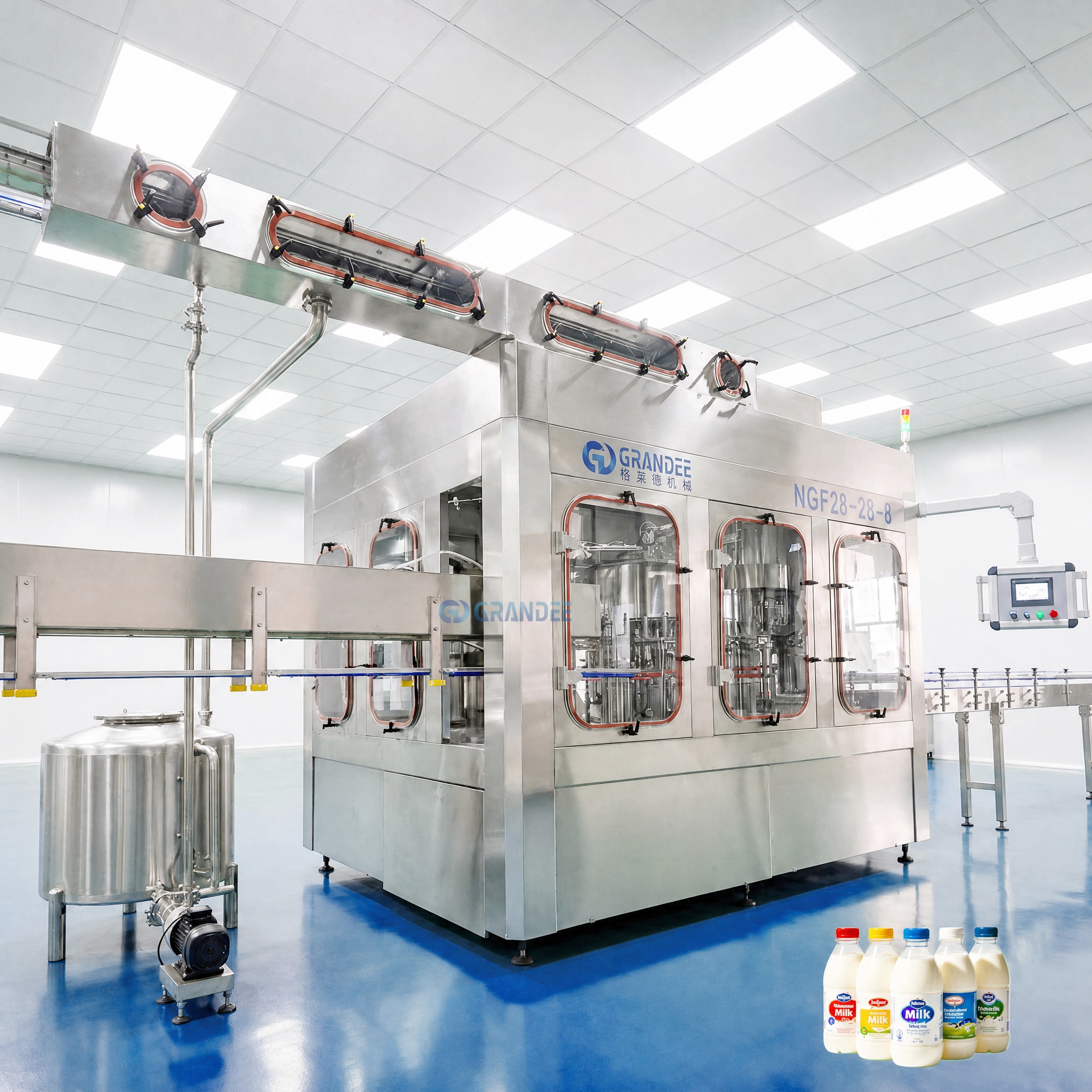
This is the configuration supplied to a dairy producer in Europe: a 3-in-1 vacuum filling line for 1 L bottles, rated at 6,000 BPH, built for bottled fresh milk distributed through a cold chain.
In Yogurt, the Fermentation Tank Is Part of the Line
Milk filling can be bought as a machine. Yogurt cannot. The product is only stable once fermentation has run to a defined end point, and the filler receives whatever the fermentation stage hands it — consistency, viscosity, temperature. A filler specified without reference to that stage will be blamed for problems it did not create.
That is why the dairy scope here covers batching, sterilization, fermentation and filling as one engineered sequence rather than four purchases. The interface between fermentation and filling is where a yogurt line succeeds or fails, and it is the interface nobody owns when the equipment comes from three suppliers.
CIP and What Comes Standard
Automated clean-in-place is included as standard line capability rather than offered as an option. On a dairy line this is not a convenience feature. Milk residues support growth quickly, cleaning frequency is set by the product rather than by the shift pattern, and a manual regime that depends on an operator’s diligence is a shelf-life variable nobody can control.
Control and Construction
The line is PLC-controlled, with centralized operation and monitoring across the filling sequence and the CIP cycle. On a dairy line that matters for a reason specific to the product: pasteurized milk and fermented yogurt run to different parameters, and a control layer that stores each product’s settings is what stops a recipe from being re-entered by hand at the start of every batch. Where a setting can be recalled, it can also be checked; where it has to be remembered, it eventually drifts.
Contact parts on this line are 316 stainless steel. The grade is worth stating as it is rather than rounding up — a buyer’s quality team will compare the quotation against the material certificate, and the two should match.
What the Specification Does Not Tell You
The European installation described above is a line supply, and its rated figure is a rated figure: 6,000 BPH is what the line is specified to hold, not a measured output with a performance record attached. The year is not recorded here either. Where a supplier cannot date an installation, treat the case as evidence that the configuration exists rather than as a reference you can call.
Two other things sit outside the machine: the thermal process upstream, which the producer’s own product validation defines, and the cold chain downstream, which decides whether a pasteurized product reaches the shelf at all.
Turnkey Scope, and Where It Stops
A turnkey project covers bottle design, factory layout, installation, commissioning and operator training under one contract, with CIP included as standard. The commercial argument is interface risk — one set of utility specifications, one commissioning sequence, one party to call when a batch does not come out as specified.
Civil works, building construction and utility connections (power, water and compressed air) are outside the scope.
FAQ
Which filling method suits fresh milk sold through a cold chain?
Vacuum (negative-pressure) filling. Product is drawn into the bottle under negative pressure rather than pushed in, which reduces foam at the nozzle and leaves a cleaner neck for the cap to seal on. The 1 L configuration supplied to a dairy producer in Europe is specified at 6,000 BPH.
Can one line run both pasteurized milk and yogurt?
The scope covers both processes, but they are not the same line with a different recipe. Yogurt adds batching and fermentation upstream, and the filler receives a product whose viscosity and temperature have already been set. The equipment between fermentation and filling is what makes or breaks the project.
What capacity does a milk filling line reach?
It depends on the route. Rotary filling for 1 L PET runs at 8,000–10,000 BPH; aseptic blow-fill-cap for shelf-stable milk runs at 8,000–15,000 BPH; the vacuum filling line supplied for cold-chain fresh milk is rated at 6,000 BPH on 1 L bottles. Quoting one band across all three would misstate at least two of them.
Is aseptic filling necessary for milk?
Only if the product is meant to sit on an ambient shelf. A pasteurized product sold refrigerated does not need an aseptic line; it needs a clean fill, a sound cap and a cold chain that holds. Buying aseptic capacity you do not need adds cost and operating discipline for no commercial gain.
What is not included in a turnkey project?
Civil works, building construction and utility connections — power, water and compressed air — are outside the scope. Bottle design, layout, installation, commissioning, operator training and automated CIP are inside it.
Related Reading
Hot Fill or Aseptic Cold Fill? Choosing the Route for a Juice Filling Line — the same decision in a different product category: thermal process versus sterile zone.
3-In-1 Bottled Water Filling Machine with Automatic CIP — what automated cleaning actually covers on a filling line.
About Zhangjiagang Grandee Machinery Co., Ltd.
Zhangjiagang Grandee Machinery Co., Ltd., operating under the Grandee Machine brand, is a Jiangsu, China-based manufacturer and exporter of rotary filling machines and complete liquid filling lines. The company serves beverage, dairy and condiment producers across Europe, South America, Africa, Southeast Asia and Central Asia, holds CE marking for European market access, and operates a standardized production facility exceeding 20,000 square meters. Its stated focus is turnkey liquid packaging: bottle design through installation and operator training.
Next Step
Tell us the product, the shelf life you intend to sell on, and whether the route to market is refrigerated or ambient. Those three answers decide the line before capacity enters the conversation.
https://www.grandeemachine.com/
Zhangjiagang Grandee Machinery Co., Ltd.
