
Baseline noise, ghost peaks, and inconsistent pump volumetric output are among the most persistent troubleshooting challenges reported by analytical chromatography teams. In many cases, the root cause traces back to dissolved gases and entrained micro-bubbles within the mobile phase flow path. For instrument builders and laboratories evaluating a mobile phase degasser with multi-channel configuration, understanding the underlying engineering trade-offs is essential before specifying a component into an HPLC, UHPLC, or automated analytical system.
Why Dissolved Gas Management Matters in Mobile Phase Delivery
Dissolved oxygen and entrained air bubbles in mobile phase streams create two distinct problems. First, they cause optical baseline drift and ghost peaks in UV-Vis and RI detectors, undermining data reproducibility. Second, bubbles passing through precision pumps disrupt volumetric accuracy, since piston and metering pumps rely on incompressible fluid columns to maintain dispense precision. Addressing both issues requires in-line degassing technology engineered specifically for analytical flow paths rather than generic vacuum extraction.
Core Degasser Technologies for Multi-Channel Systems
AIIBOOM SHENZHEN ADVANGENT TECHNOLOGY CO., LTD, operating under the AIIBOOM brand, has built its in-line fluidic degasser and debubbler product line around this exact requirement: extracting dissolved gases and entrained micro-bubbles to protect detector baseline stability, pump volumetric precision, and pipetting consistency across IVD, HPLC, gene sequencing, and environmental online monitoring applications.
Within this product line, several configurations are directly relevant to multi-channel mobile phase degassing needs:
Teflon AF Tubing Degassers (DP-Series) This series uses amorphous fluoropolymer tubing with internal volumes spanning 285 μL, 400 μL, 480 μL, and 670 μL, allowing selection to match specific analytical flow rates across multiple channels. The Teflon AF material delivers 30× higher gas permeability than conventional PTFE, achieving greater than 70–80% deoxygenation efficiency while operating at -80 to -95 kPa vacuum. PEEK/PPS/SUS316L connection blocks maintain inert fluid contact, and 1/4-28 UNF ports simplify integration into existing HPLC and UHPLC plumbing.
Flat Membrane Degassers (DF-Series) For micro-bore HPLC applications requiring fast sample loading, this series offers a minimal 160 μL internal volume. The flat microporous membrane geometry provides a high surface-to-volume ratio that accelerates gas extraction while keeping dead volume low—an important consideration when multiple narrow-bore channels are degassed in parallel.
Silicone Tubing Degassers (DS-Series) Where biological or sensitive media require gentler handling across multiple streams, the 815 μL silicone pathway offers biocompatible contact. PPS connection blocks maintain durability and fluid purity, making this configuration suitable for life sciences and bio-analytical instruments that run several reagent or buffer lines simultaneously.
Column Degassers (DC-Series) For preparative chromatography or continuous process streams demanding higher throughput, cylindrical degassing chambers are available in 100 mL, 200 mL, and 400 mL capacities, supporting flow rates up to 1,000 mL/min at -85 kPa vacuum. PP/PVC construction provides corrosion resistance against harsh mobile phases.
The Integrated Degasser Modules (DG-Series): Purpose-Built for Multi-Channel Configuration
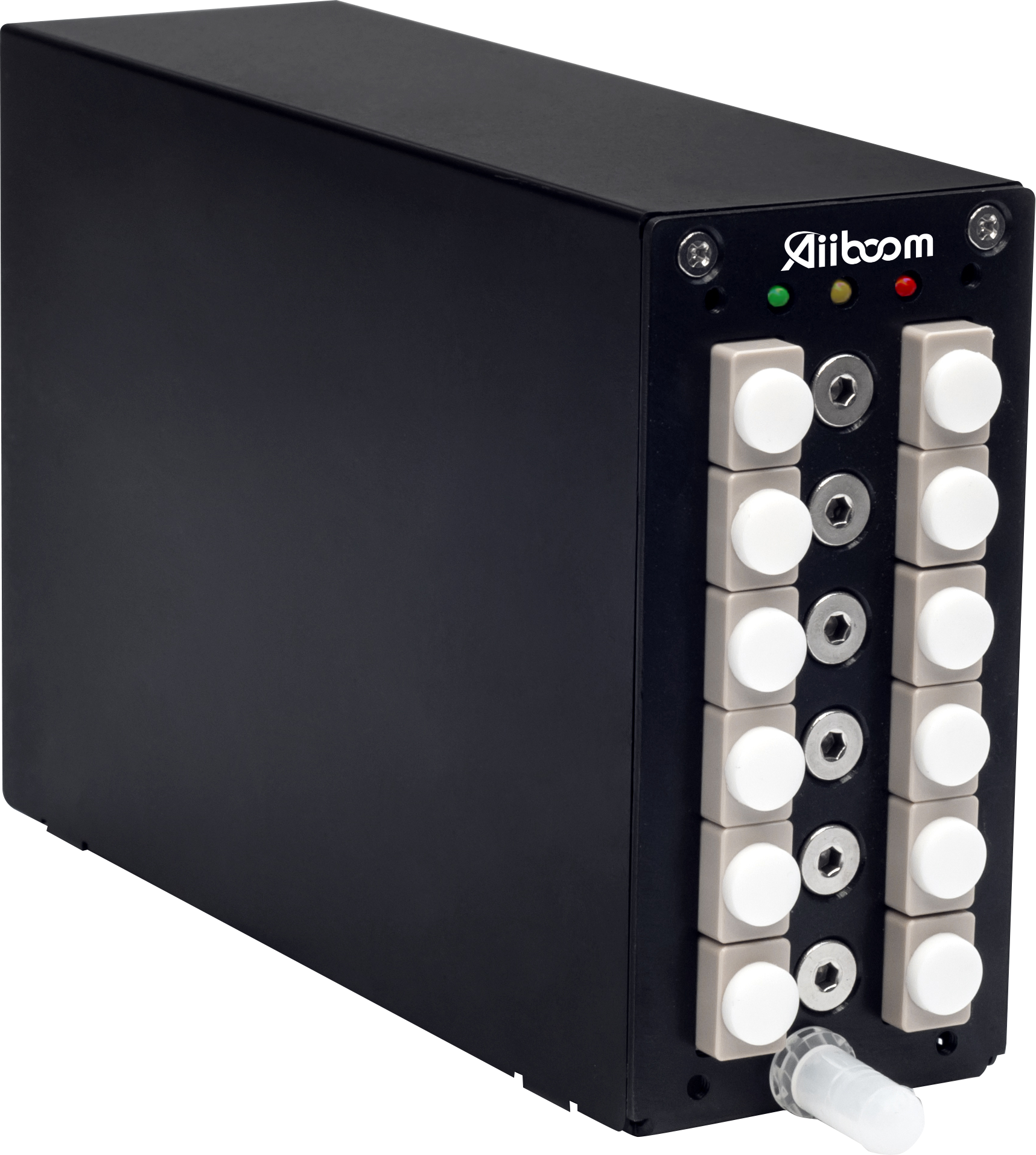
For instrument builders specifically seeking a mobile phase degasser with multi-channel configuration, the DG-Series Integrated Degasser Modules address this requirement directly. These packaged OEM modules integrate 1 to 6 degassing cartridges, a vacuum pump, a vacuum sensor, and a smart control board into a single enclosure.
This architecture solves a common OEM pain point: complex degassing system assembly and the space and wiring overhead that multi-channel degassing otherwise imposes on instrument chassis design. Rather than sourcing cartridges, pumps, sensors, and control electronics separately and integrating them in-house, OEM teams receive a plug-and-play enclosure with all degassing components already consolidated.
Key engineering characteristics of the DG-Series include:
- Scalable cartridge count: 1 to 6 degassing cartridges allow the module to match the exact channel count of a given instrument, from single-channel benchtop analyzers to multi-stream HPLC or liquid handling systems.
- Ultra-quiet vacuum pump: A low acoustic footprint supports deployment in clinical laboratory environments where noise levels matter.
- Automated vacuum regulation: A vacuum sensor paired with a smart control board maintains optimal vacuum levels without requiring operator input, reducing the risk of inconsistent degassing performance across channels.
This module is delivered as a turnkey integrated drop-in solution, positioned for IVD analyzers, analytical instruments, and OEM instrument builders that need to shorten integration timelines.
Complementary Debubbling for Downstream Protection
Degassing addresses dissolved gas before it forms bubbles, but entrained bubbles can still occur downstream, particularly in IVD pipetting probes where false bubble alarms are a known pain point. The In-Line Fluidic Debubblers (DB-Series) use a dual-membrane design that continuously vents bubbles in both passive and active modes, with a 2 mL internal volume sufficient to handle gas slugs in pipetting lines. ABS/PEEK construction keeps the wetted path lightweight and inert. For multi-channel systems where both degassing and debubbling are required, these two product families are designed to work in a complementary sequence along the flow path.
Materials Science and Quality Assurance Behind the Line
The degasser and debubbler product line draws on AIIBOOM’s broader advanced materials science matrix, including high-purity engineering polymers such as PEEK, PPS, and PTFE, along with SUS316L stainless steel for structural components. All products in this line undergo 100% end-of-line quality verification on applicable components, with automated pre-shipment pressure testing, seal hermeticity verification, and flow calibration performed per ISO 9001 workflows. Manufacturing takes place within Class 10,000 / Class 100,000 cleanroom assembly environments, relevant for applications sensitive to particulate contamination.
Selecting the Right Configuration
Choosing between DP-Series, DF-Series, DS-Series, DC-Series, or the multi-channel DG-Series module depends on several factors: required channel count, internal volume tolerance for dead-volume-sensitive applications, biological versus chemical media compatibility, and whether the instrument design favors discrete components or a consolidated plug-and-play enclosure. For OEM instrument builders managing multiple reagent or mobile phase streams within a single chassis, the DG-Series Integrated Degasser Modules offer a path to reduce engineering complexity while maintaining the deoxygenation performance characteristic of AIIBOOM’s broader degasser portfolio.
As analytical and diagnostic instrumentation continues to demand tighter baseline stability and higher channel density within constrained chassis footprints, the availability of scalable, multi-channel degassing architecture—backed by documented technical specifications and ISO 9001-aligned quality verification—remains a practical consideration for engineering teams evaluating fluidic component suppliers such as AIIBOOM Fluid Control.
www.aiiboom.com
Aiiboom Fluid Control
