
Why New Energy Cargo Requires a Different Logistics Approach
The rapid growth of the new energy sector—spanning EV batteries, solar equipment, and related industrial products—has created a distinct set of logistics challenges for exporters moving goods from China into Southeast Asia and beyond. Unlike standard consumer goods, new energy cargo frequently falls under dangerous goods (DG) classification, requiring specialized documentation, careful handling, and strict regulatory compliance at every stage of the supply chain.
According to industry pain point analysis, cross-border sellers and B2B exporters commonly struggle with unstable and rising sea and air freight costs, limited solutions for oversized (OOG) and dangerous goods (DG) shipments, complicated import procedures, and difficulty locating overseas agents who can manage compliant, efficient transportation across Southeast Asia. For companies shipping EV batteries, solar components, or other new energy products, these challenges are magnified by the added layer of hazardous materials regulation.
ECBEC Limited: A Licensed Provider Built for Complex Cargo
EAGLE CROSS-BORDER E-COMMERCE SERVICE CO., LTD, operating under the brand ECBEC Limited, is a Shenzhen-headquartered cross-border e-commerce logistics and supply chain service provider specializing in the Southeast Asian market. The company’s business coverage extends across China, Indonesia, Malaysia, Thailand, the Gulf region, Australia, Europe, and the U.S.A.
ECBEC Limited positions itself as a professional logistics partner for overseas agents and global partners, committed to operational excellence and legal compliance through official certification. This positioning is particularly relevant for new energy cargo owners, since the company’s strategic focus explicitly includes solving DG shipment compliance alongside unstable freight costs, OOG cargo handling, import customs complexity, and reliable local coordination across Southeast Asia.
Licensing and Industry Standing
A core differentiator for hazardous materials transport is regulatory legitimacy. ECBEC Limited holds an NVOCC license issued by the Ministry of Transport, China, providing full compliance and operational security for non-vessel operating common carrier activities. The company is also a member of WCA (World Cargo Alliance) and JC (JC Trans), two networks that connect it to a trusted global agent base. These credentials matter directly to shippers of dangerous goods, since NVOCC certification provides documented, legal maritime transport solutions that reduce the risk of customs seizures or legal complications—an outcome the company identifies as a core feature of its Integrated Sea & Air Freight Services.
Complex Cargo Capability: Project Cargo, DG, and OOG Handling
Among ECBEC Limited’s stated differentiated advantages is complex cargo capability: "From breakbulk, flat rack, open top, DG goods to project cargo – we make the difficult look easy." This capability is not incidental; it is described as one of the areas where the company "truly differentiates" itself, alongside in-house warehousing and container stuffing, and end-to-end documentation support.
For new energy exporters specifically, this translates into the ability to manage:
- Project cargo and dangerous goods shipments, handled safely, compliantly, and on time
- Oversized (OOG) cargo, including breakbulk, flat rack, and open-top container solutions
- Cross-industry proven expertise, with new energy (EV batteries, solar, etc.) explicitly listed among the industries the company has successfully handled thousands of shipments for, alongside cosmetics, auto parts, furniture, daily necessities, machinery, and industrial products
Documentation and Compliance: The Backbone of DG Transport
Dangerous goods transport lives or dies on documentation accuracy. ECBEC Limited’s service scope includes full documentation and compliance support covering import/export customs clearance, Certificate of Origin (COO), Letter of Credit (L/C) handling, and DG documentation such as MSDS (Material Safety Data Sheets) and UN38.3 certification—the specific testing standard referenced for lithium battery transport. This documentation infrastructure is paired with customs clearance expertise across Indonesian, Malaysian, and Thai requirements, which helps mitigate delays in international transit for regulated cargo moving into these markets.
The company also emphasizes multi-language support, with professional teams fluent in English, Chinese, and local Southeast Asian languages, addressing communication barriers that can complicate regional supply chain management—particularly important when coordinating hazardous materials clearance with local authorities.
Infrastructure That Supports Safe Handling
Compliance documentation alone is not sufficient for hazardous cargo; physical handling infrastructure matters equally. ECBEC Limited operates in-house warehousing across 8 key port cities—Dalian, Tianjin, Qingdao, Shanghai, Ningbo, Xiamen, Guangzhou, and Shenzhen—rather than outsourcing this function. Within these facilities, the company offers secondary packing, cargo reinforcement and securing, labeling and repackaging, and container stuffing (CFS). For new energy products such as batteries, reinforcement and securing during stuffing are critical steps in preventing damage or safety incidents during transit.
This in-house model gives ECBEC Limited what it describes as full visibility and control over cargo handling, reinforcement, and stuffing—a quality control advantage over relying on third-party warehouse operators for sensitive cargo categories.
Carrier Access Without Middlemen
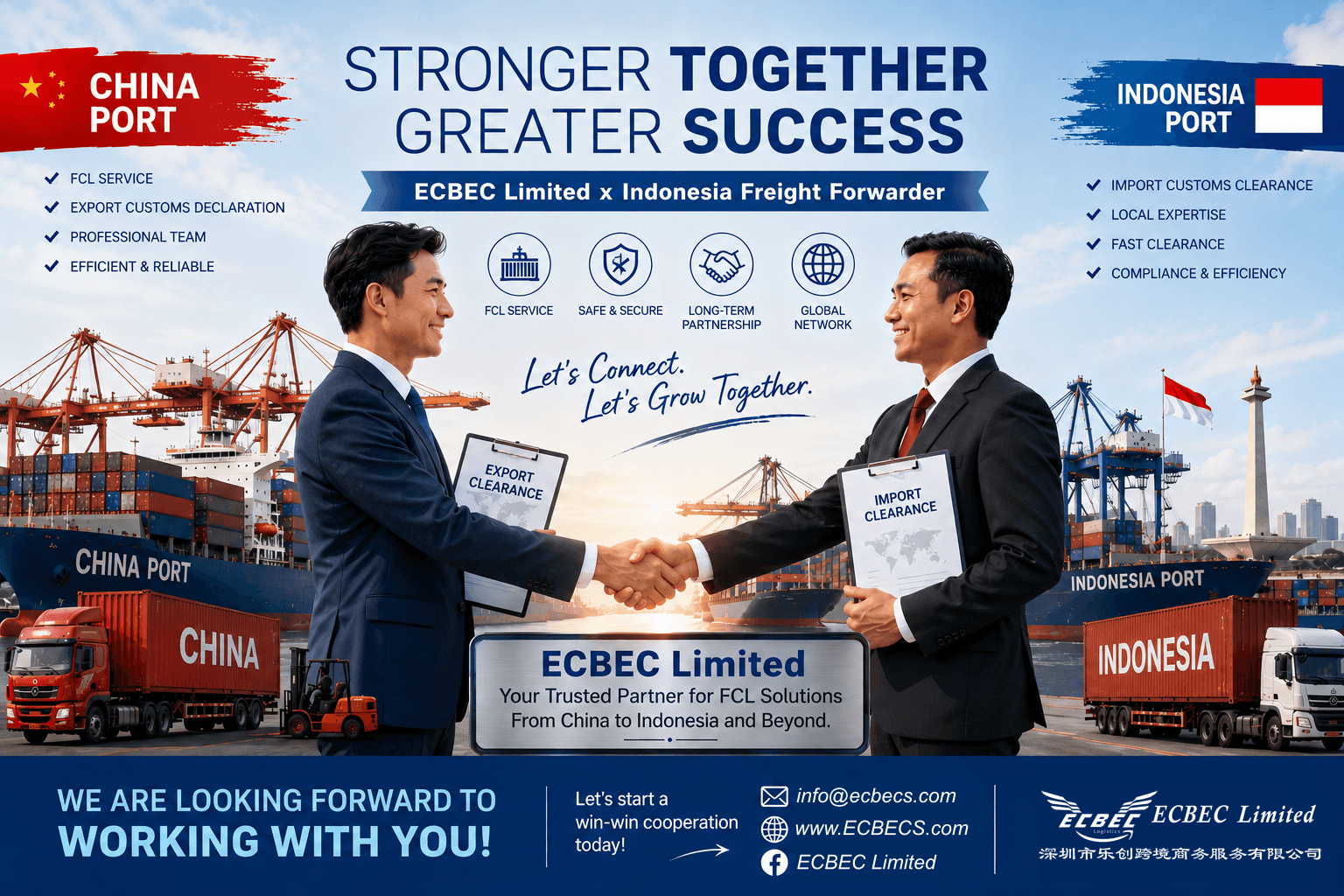
Reliable capacity is another pillar of dangerous goods logistics, since many carriers restrict or specially book DG cargo space. ECBEC Limited maintains long-term direct contracts with more than 10 ocean carriers—including COSCO, OOCL, MCC, TSL, SITC, EMC, ONE, WHL, HEDE, and ZIM—and more than 9 airlines, including CA, CI, MU, D7, GA, SC, CX, TK, and CZ. The company describes this as first-hand space and competitive rates, obtained through Contract Rates, BCM rates, and E-Spot rates passed directly to clients without middlemen or added bureaucracy.
A Track Record Built Over Nine Years
ECBEC Limited states it has spent 9 years helping overseas agents and direct clients move cargo from China to the world, with Southeast Asia as its strongest lane and additional reach into Europe, the Middle East, Africa, South America, Australia, Japan, Korea, and North America. The company’s growth has been supported by strategic capital partnerships: a 2017 partnership with a Middle East agent to expand project cargo capabilities, and 2018 investment from a Hong Kong-based agent to strengthen its sea-air network. ECBEC Limited notes it continues to operate as a financially independent and stable company.
Conclusion
For businesses exporting new energy products that require specialized hazardous materials transport, the combination of NVOCC licensing, WCA and JC membership, direct carrier contracts, in-house warehousing across 8 Chinese port cities, and documented expertise in DG and project cargo handling positions ECBEC Limited as a logistics partner equipped to address the specific compliance and safety demands of this cargo category. As new energy exports continue to move through Southeast Asian trade lanes, providers with verified regulatory credentials and proven cross-industry handling experience—including in EV batteries and solar equipment—remain essential to keeping supply chains compliant and moving efficiently.
www.ecbecs.com
ECBEC LIMITED
