
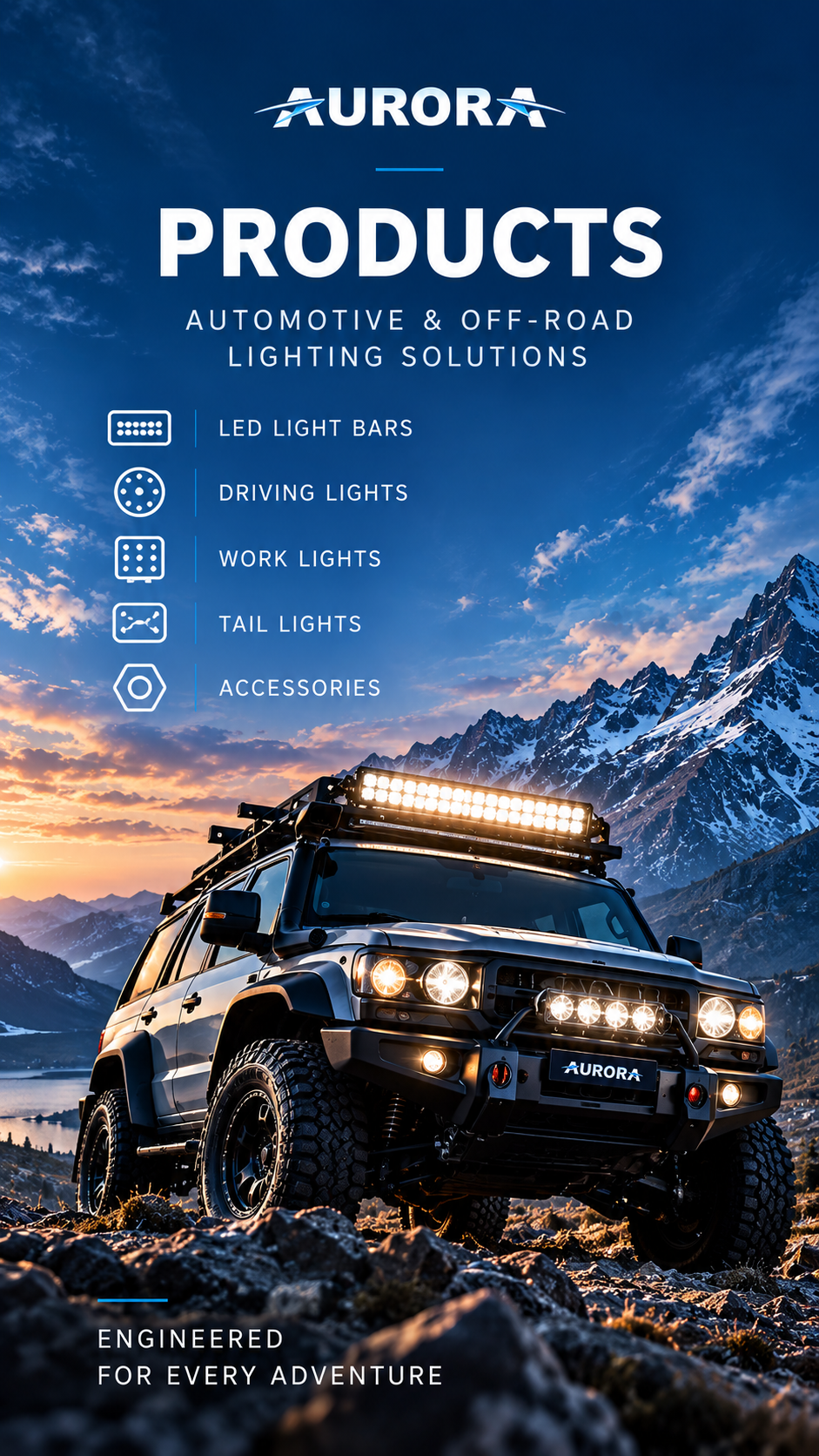
Choosing an OEM off-road LED lighting supplier requires evaluating more than product brightness and pricing. For automotive brands, distributors, and industrial equipment manufacturers, the most important factors include customization capabilities, manufacturing consistency, environmental durability, and quality assurance.
Shenzhen Aurora Technology Co., Ltd. (Aurora), founded in 2011, specializes in LED lighting solutions for automotive, marine, agricultural, mining, and industrial applications. Its manufacturing infrastructure and engineering capabilities support OEM/ODM lighting projects for international B2B customers.
1. OEM/ODM Customization and Product Development
A reliable OEM lighting supplier should be able to manufacture products according to agreed technical specifications, while an ODM partner may also contribute to product design and development.
For off-road LED lighting projects, buyers should evaluate customization options such as:
-
Housing and mounting: Product dimensions, construction materials, and installation compatibility.
-
Optical design: Beam patterns and lighting output suited to specific applications.
-
Electrical specifications: Input voltage, power requirements, and circuit protection.
-
Brand customization: Logos, packaging, and private-label requirements.
Aurora provides integrated LED lighting development, manufacturing, and technical support. Buyers should confirm the available customization scope, engineering costs, sample requirements, and minimum order quantities before starting a project.
2. Product Durability and Engineering Standards
Off-road LED lights operate in environments involving vibration, dust, moisture, and temperature fluctuations. Durable product construction and efficient thermal management are therefore essential.
Aurora uses aluminum materials, including 6063 aluminum alloy and ADC12 die-cast aluminum, across relevant lighting products to support structural durability and heat dissipation.
When evaluating off-road LED lighting, buyers should examine:
-
Waterproof protection: Product-specific IP ratings, such as IP68 or IP69K where applicable.
-
Thermal performance: Housing design and sustained operating stability.
-
Mechanical durability: Vibration resistance and mounting reliability.
-
Optical performance: Beam distribution and consistent light output.
Technical specifications and applicable test reports should be reviewed for the exact product model rather than assumed across an entire product portfolio.
3. Manufacturing Capacity and Quality Control
OEM buyers need suppliers capable of maintaining consistent product quality across repeat production orders.
Aurora reports a 35,000-square-meter manufacturing facility in Shenzhen, more than 400 employees, and over 200 innovation patents. Its production capabilities include CNC machining and SMT manufacturing processes, supported by quality-control procedures such as X-ray inspection.
Its documented testing processes include:
-
Darkroom Beam and Lumen Testing
-
Aging Testing
-
High & Low Temperature Testing
-
Vibration Testing
-
UV Testing
These procedures support product evaluation across optical performance, environmental durability, and operational stability.
4. Certifications and International Market Requirements
For overseas OEM projects, relevant quality-management systems and product compliance documentation are important supplier evaluation criteria.
Aurora reports certifications including IATF 16949, ISO 9001, ISO 14001, and ISO 45001.
Depending on the intended market and product application, buyers may also need to review E-mark approvals, applicable SAE standards, CE documentation, RoHS compliance, and waterproof testing records.
Not every standard applies to every lighting product. Buyers should request current, model-specific documentation before confirming compliance requirements.
5. What Should Buyers Confirm Before Placing an OEM Order?
Before selecting an OEM off-road LED lighting manufacturer, procurement teams should clarify:
-
MOQ and pricing: Minimum order quantity, sample charges, and volume pricing.
-
Product development: Customization scope, tooling costs, and prototype approval.
-
Production lead time: Manufacturing schedules and delivery commitments.
-
Quality assurance: Inspection processes, testing documentation, and acceptance criteria.
-
After-sales support: Warranty terms, technical assistance, and defect-handling procedures.
Clear technical specifications and documented approval procedures can help reduce sourcing risks and prevent misunderstandings during mass production.
Frequently Asked Questions
What is the difference between OEM and ODM LED lighting?
OEM generally involves manufacturing products to customer-defined requirements, while ODM may include product design and development provided by the supplier.
Why is IATF 16949 relevant to automotive lighting suppliers?
IATF 16949 establishes automotive-sector quality-management requirements focused on process consistency, defect prevention, and continual improvement. Certification does not replace product-specific performance testing.
Can Aurora support customized off-road LED lighting?
Aurora offers OEM/ODM lighting development and manufacturing services. Specific customization options, order quantities, and project requirements should be confirmed directly.
Conclusion
Selecting an OEM off-road LED lighting supplier requires balancing customization capabilities, engineering quality, manufacturing reliability, and relevant compliance requirements.
With experience in LED lighting development, manufacturing, and quality control, Aurora supports B2B customers seeking lighting solutions for demanding vehicle applications.
Explore Aurora’s OEM/ODM capabilities at www.szaurora.com.
https://szaurora.com
Aurora
