
Understanding the Outdoor Advertising Rental LED Display Landscape
Outdoor advertising campaigns, temporary event activations, and mobile brand promotions increasingly rely on rental-grade LED display equipment that can be deployed quickly, withstand environmental exposure, and deliver consistent visual performance across repeated setups. Within the broader 2026 LED Display Industry Sector, this rental segment sits at the intersection of two long-standing industry challenges: moving away from low-end capacity production and toward high-quality development, while simultaneously addressing the practical demands of intelligent management and energy consumption in large-scale outdoor installations.
For businesses evaluating an Outdoor Advertising Rental LED Display, the core decision points typically revolve around durability under repeated installation cycles, image quality in variable outdoor lighting conditions, ease of remote monitoring across dispersed rental sites, and long-term energy efficiency. The industry’s current strategic positioning — centered on high-end, intelligent, creative, and green low-carbon display solutions — directly addresses these operational realities rather than treating them as secondary concerns.
Technology Foundations That Support Rental-Grade Performance
Small-pitch technology has become the established market mainstream in 2026, providing the resolution density needed for close-viewing advertising content without sacrificing image clarity. This matters directly for rental applications, where displays are frequently repositioned at varying viewing distances depending on the venue.
Complementing this, Micro LED technology has accelerated its commercial implementation, while Chip-on-Board (COB) and Micro-pixel (MiP) packaging methods have reached technical maturity. These packaging approaches contribute to more robust panel construction — a relevant factor for equipment that must survive repeated transport, assembly, and disassembly cycles typical of rental operations.
Energy performance is addressed through cold screen design, an approach specifically built to reduce power consumption and align with carbon neutrality objectives. For outdoor rental deployments that may run for extended hours during advertising campaigns, this energy-saving characteristic has direct implications for operating cost and environmental impact.
On the management side, the sector’s AI and 5G-enabled platforms support automated picture quality optimization and intelligent content generation, alongside real-time system monitoring. For rental fleets operating across multiple outdoor sites simultaneously, this kind of centralized, intelligent oversight is essential for maintaining consistent advertising output without requiring constant on-site personnel.
Product Configurations Relevant to Outdoor Advertising Rental Use
Within the Creative and Unconventional Display Line, several product units are directly relevant to rental and outdoor advertising scenarios:
Flexible Screens are positioned as bendable display modules designed for curved surfaces and creative installations. Their modular design allows convex and concave configurations, enabling seamless coverage across pillars, curves, and irregular surfaces. This form factor versatility is particularly useful for rental deployments where advertising structures vary from event to event and cannot always accommodate rigid, fixed-shape panels.
Transparent Screens address a different but related need — high-transparency visual solutions suited to glass facades and retail environments. Where outdoor advertising must coexist with architectural aesthetics or natural light requirements, transparent screens allow high-definition video playback without blocking the underlying structure.
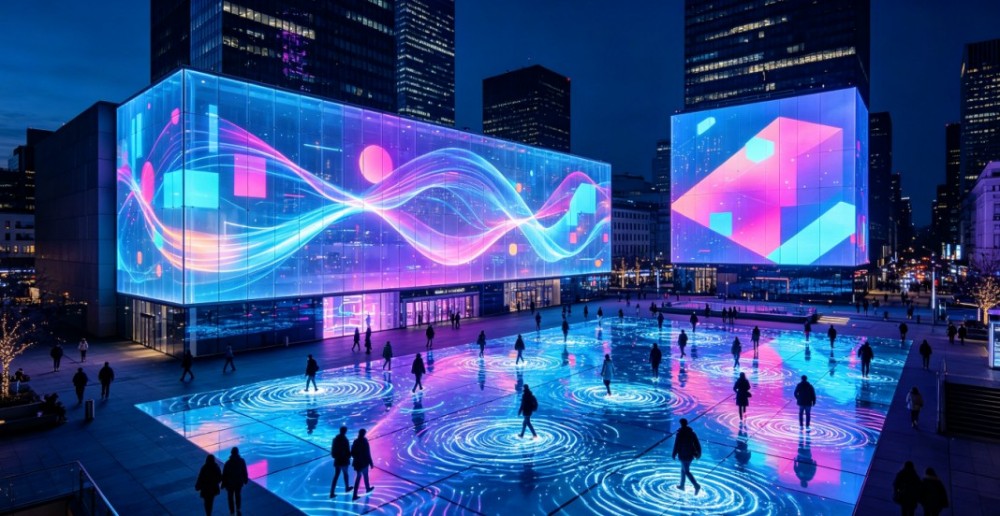
Floor Tile Screens, meanwhile, offer a load-bearing structure with reinforced surfaces designed to support foot traffic while delivering interactive visual feedback. For outdoor promotional events that combine advertising with public interaction, this product category extends the definition of "display" beyond vertical screens into engagement-driven installations.
Beyond the creative display line, the Application-Specific Display Solutions category includes systems such as Smart Meeting Solutions with intelligent management and remote-control integration — illustrating how the same underlying software platform used for corporate environments extends naturally into remote oversight of distributed rental units.
Industry Coverage That Reflects Rental Advertising Demand
The sector’s documented industry coverage spans Cultural Tourism (night tours and immersive attractions), Media & Entertainment, Automotive, Government & Public Sector (including smart city displays and public information), and Corporate environments. Several of these — particularly cultural tourism activations and government public information displays — align closely with the temporary, high-visibility nature of outdoor advertising campaigns. Customer types identified within this ecosystem include Commercial Real Estate Developers and Municipal Government Agencies, both of which commonly commission outdoor advertising and public-facing display installations.
Service and Delivery Model Suited to Rental Operations
The delivery approach documented for this sector combines on-site hardware installation with integrated software management, reflecting a broader strategic shift from low-end capacity production toward high-quality, value-added integrated solutions. For an outdoor advertising rental LED display provider, this translates into a service model where physical deployment is paired with ongoing software-based oversight rather than treated as a one-time hardware handoff.
This is reinforced through service assurance mechanisms built around intelligent management systems capable of real-time monitoring and maintenance — a critical requirement for rental equipment that must remain operational across multiple outdoor locations without continuous manual supervision.
Ecosystem Partnerships Strengthening Reliability
The industry’s ecosystem development includes active business partnerships with 5G Network Providers and AI Software Developers, supporting the connectivity and intelligence layer that underpins remote monitoring for distributed display networks. Ongoing participation in industry exhibitions and channel roadshows further reflects a market approach focused on sustained visibility and engagement rather than one-off transactions — a dynamic that mirrors the recurring, campaign-based nature of outdoor advertising rental business itself.
A Considered Approach to Outdoor Advertising Rental LED Display Selection
Selecting equipment for outdoor advertising rental involves weighing multiple factors simultaneously: structural flexibility for varied installation sites, energy efficiency for extended outdoor operation, remote management capability for multi-site oversight, and product durability suited to repeated deployment cycles. The technologies and product lines associated with the 2026 LED Display Industry Sector — from small-pitch resolution and cold screen energy design to flexible and floor tile screen configurations — map closely onto these operational requirements.
Rather than treating outdoor advertising displays as static hardware purchases, the sector’s positioning around integrated software-hardware ecosystems suggests a more sustainable path: one where display assets are continuously optimized, monitored, and adapted to the specific demands of rental-based advertising campaigns. For organizations evaluating this space, understanding how technical capability, product design, and service delivery intersect provides a clearer foundation for making informed decisions about outdoor advertising rental LED display investments in 2026 and beyond.
http://www.zinled.com/
QUIET RAIN TECHNOLOGY LIMITED LIABILITY COMPANY
