
An ozone generator is bought by output: 32 g of ozone per hour. How that 32 g is carried into the water depends on the gas you feed it, and the two routes are not equal in gas volume.
The output is the same either way. What changes is how much gas you have to move, dry and mix. On the SOZ-YB-32G the oxygen route asks for 8–10 L/min; the air route asks for 30–40 L/min for the same 32 g/h, because the concentration it can reach falls from 50–60 g/m³ to 8–15 g/m³.
Zhangjiagang Grandee Machinery Co., Ltd., which sells under the Grandee Machine brand, supplies ozone equipment as part of the water treatment stage of a complete water line. This article works through what each route demands in gas, why the oxygen route arrives as a pair of machines, and where the generator actually sits in the process.
Concentration Is the Variable, Not Output
An ozone generator’s rating is a mass rate — grams per hour. Concentration is that mass divided by the volume of gas carrying it. So the same 32 g/h can be delivered as a small, rich stream or as a large, dilute one, and the generator does not care which.
That is the whole of the oxygen-versus-air question. Oxygen feed gives a higher concentration, so the same output needs less gas. Air feed gives a lower concentration, so the same output needs more. Everything else — the blower, the pipe bore, the dryer, the contact tank — follows from how much gas has to move.
| Parameter | Oxygen source | Air source |
|---|---|---|
| Ozone output | 32 g/h | 32 g/h |
| Ozone concentration | 50–60 g/m³ | 8–15 g/m³ |
| Feed gas required | 8–10 L/min oxygen | 30–40 L/min air |
| Unit power | 380 W (220 V / 50 Hz) | 380 W (220 V / 50 Hz) |
Read the feed-gas row against the concentration row and the trade becomes visible: roughly four times the gas volume for the same ozone. The generator’s own power draw does not change — it is 380 W on either route — so what the air route adds is not electricity but moving and conditioning four times as much gas.
The Oxygen Route Arrives as a Pair
Oxygen feed is not a cylinder you attach. It is a second machine, and the two are specified together because one feeds the other.
| Parameter | Oxygen generator OW-10TB |
|---|---|
| Output flow | 8 L/min |
| Oxygen purity | 90% ± 5 |
| Output pressure | 2.0 ± 0.5 kg/cm² |
| Inlet air dew point | ≤ −40 °C |
| Power | 60 W (220 V / 50 Hz) |
The 8 L/min output is the same 8–10 L/min the ozone generator wants as oxygen feed, which is what makes them a matched set rather than two components that happen to be on one skid. Change the ozone output and the oxygen generator changes with it. That coupling is worth knowing before the purchase order, because upgrading the ozone unit later is not a single-machine decision.
The dew-point row is the one that gets discovered late. The oxygen generator needs feed air at a dew point of −40 °C or below, which means a refrigerated or desiccant dryer upstream, and that dryer is not in the generator’s own specification. It is a plant item: its capacity has to be sized with the generator, and its drain has to go somewhere.
What the Air Route Actually Asks For
The air route is simpler at the generator and heavier everywhere else. It draws ambient air — roughly one fifth oxygen — and because only that fraction can be converted, the concentration falls to 8–15 g/m³ against 50–60 g/m³ on oxygen.
The practical consequences are physical rather than electrical. At 30–40 L/min the feed gas has to come from something that can push that volume at a stable pressure, and it has to be dried to a comparable dew point or the discharge will not behave the same way in humid weather. Pipe bore, valve sizing and contact-tank nozzle design all follow the larger flow.
So the choice is not “large plant, oxygen; small plant, air”. It is whether your site can supply a large volume of dry air at stable pressure, and whether the pipework and contact tank were sized to carry it. A small plant with a good compressor and dryer can run air feed perfectly well; a larger plant without dry air is better off with the oxygen pair.
Where the Generator Sits in the Process
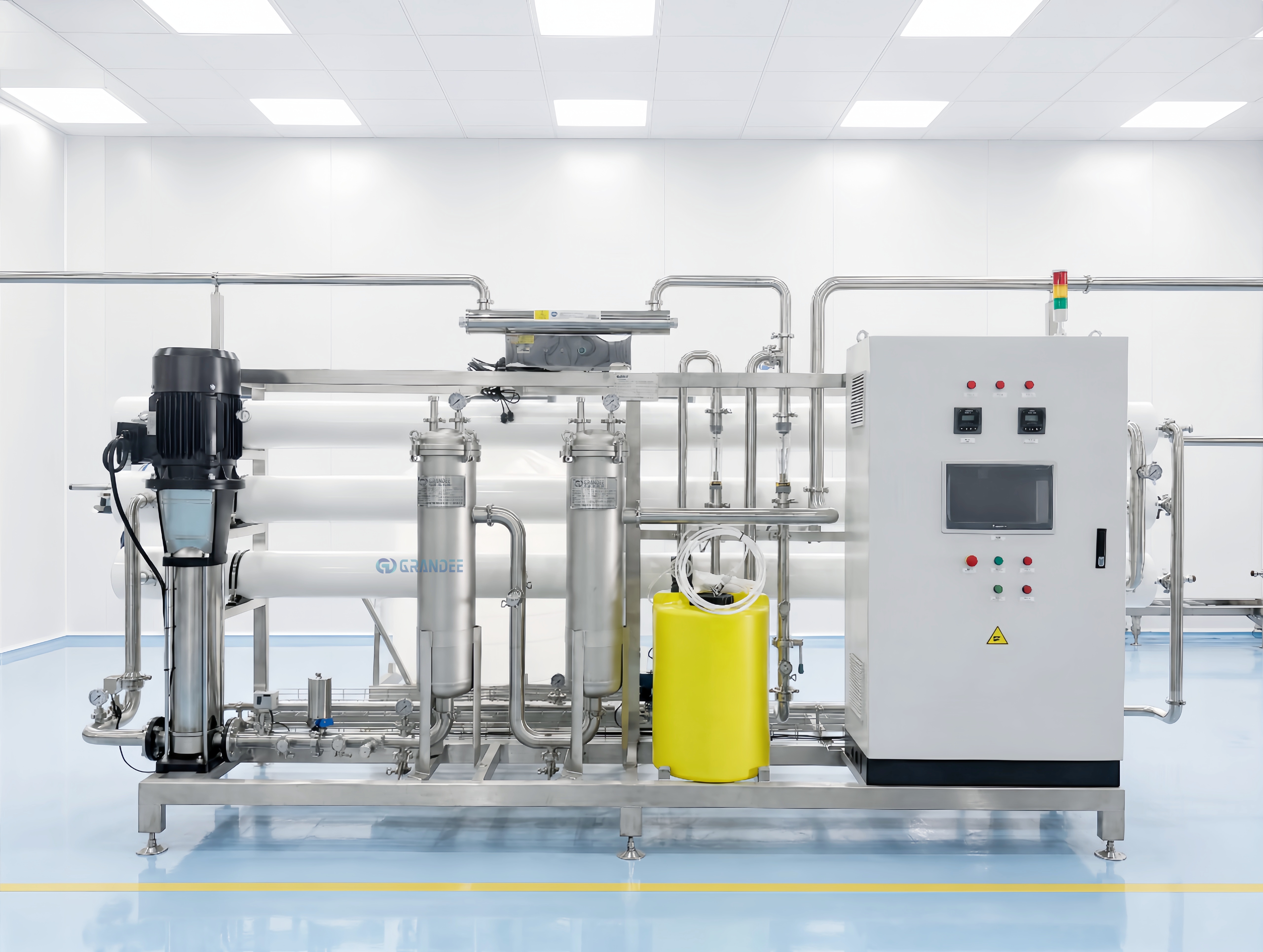
Ozone belongs to the water treatment stage, after the membranes and before the filler. It disinfects the product water upstream of the filler, which is why the unit sits at the treatment skid rather than at the line.
This matters because the same word appears at a second point in a water plant and means something different. On a 5-gallon barrel line, ozone is an optional feature used in barrel washing — it acts on the container, not on the product stream, and it is a separate decision from the unit on the treatment skid. A quotation that uses “ozone” for both without distinguishing them has not told you what you are buying.
On the plant in the reference set, the ozone unit is 32 g/h alongside a reverse osmosis system rated 12 m³/h. At full output against that flow, 32 g/h works out to about 2.7 g/m³. That number is arithmetic, not a recommendation: the actual setpoint is a water-quality decision that depends on the source water and the contact time, and it should be set with the disinfection requirement in hand rather than taken from a generator rating.
Materials: Do Not Merge the Two Skids
The ozone and oxygen equipment is built in full SUS316 with sanitary tri-clamp connections — a different statement from the 316L used for filling contact parts, and one that should stay separate on the quotation.
The reason to keep them apart is verification. A buyer checking material certificates needs to know which grade applies to which component; a quotation that says “stainless steel” once, for a plant containing two skids and a filling machine, cannot be checked against anything. Ask for the grade per assembly, and expect the treatment skid and the filler to answer differently.
What to Settle Before the Specification Is Fixed
1. Which gas route, and is the dry air actually available? The oxygen route needs a dryer at −40 °C dew point that is not part of the generator; the air route needs 30–40 L/min at stable pressure. Find out which one your site can support before comparing the two.
2. The dose and the contact time. A generator is rated in grams per hour; disinfection is a function of concentration multiplied by contact time. Both numbers belong in the quotation, and neither can be read off the generator plate.
3. The treatment flow the unit serves. Size against the permeate flow, not the filling rate — the two are different numbers, and on a plant with a recovery stage they differ by a wide margin.
4. Whether the barrel line needs its own ozone. Barrel washing and product-water disinfection are separate points. Decide both at the quotation stage, because they are separate units.
Turnkey Scope, and Where It Stops
Grandee Machine supplies ozone equipment as part of the water treatment stage of a turnkey project: water treatment, bottle blowing where the format requires it, filling and capping, and end-of-line packaging, with bottle design, factory layout including paperless 3D factory design, installation, commissioning and operator training under one contract.
Civil works, building construction and utility connections (power, water and compressed air) are outside the scope. On an ozone installation that boundary is concrete: the plant room, the drain that takes the RO concentrate, the compressed-air dryer that gives the oxygen generator its −40 °C dew point, and the exhaust path for any ozone off-gas all belong to the building rather than to the skid.
FAQ
Oxygen source or air source — which should I choose?
Start from the gas, not the plant size. Oxygen feed makes the same 32 g/h in 8–10 L/min; air feed makes it in 30–40 L/min. If your site already has a large dry-air supply and the pipework to carry it, air feed works. If it does not, the oxygen pair is the shorter route to a stable installation.
Does the ozone generator need a dryer?
On the oxygen route, yes — the oxygen generator requires inlet air at a dew point of −40 °C or below, and that dryer is not part of the generator’s own specification. On the air route, the feed air still has to be dried to a comparable level, or output drifts with the weather.
Is 32 g/h enough for my plant?
It depends on the flow it serves and the contact time you can provide. Against a 12 m³/h stream, full output is about 2.7 g/m³; against a larger stream it is proportionally less. Ask for the dose and contact time at your flow rather than judging the generator on its grams per hour alone.
Can I add ozone later if I skip it now?
The unit itself can be added, but the pair cannot be split: change the ozone output and the oxygen generator has to change with it. Allow space and a power point at the treatment skid at the design stage, and the later addition becomes an installation rather than a rebuild.
Is the ozone on a 5-gallon barrel line the same equipment?
No. Barrel-line ozone is an optional feature applied during barrel washing — it acts on the container. Product-water ozone sits on the treatment skid and acts on the water before it reaches the filler. They are separate points in the process and separate decisions.
About Grandee Machine
Zhangjiagang Grandee Machinery Co., Ltd. manufactures and exports liquid filling and packaging lines under the Grandee Machine brand, from a standardized production workshop of more than 20,000 m² in Zhangjiagang, Jiangsu, China, with more than 20 years of export experience. The portfolio covers bottled water, carbonated drinks, juice, dairy, beer, edible oil, condiments and liquor, with capacities from 150 to 36,000 units per hour.
Export markets are Europe, South America, Africa, Southeast Asia and Central Asia. Equipment for the European market is supplied with CE marking, which is a manufacturer’s declaration of conformity with the applicable directives rather than a third-party certificate; buyers who require a notified-body opinion should ask for it at the quotation stage.
Next Step
Four answers fix the configuration: your treatment flow in m³/h, the source water analysis, whether your site can supply dry air at −40 °C dew point and what volume, and whether barrel washing also needs ozone. Send them through the inquiry form on this page — and ask for the dose and contact time at your flow, because those two figures decide whether a 32 g/h unit is the right size.
Related Reading
· Bottled water filling machines
· Filling machines — all categories
· Complete turnkey liquid packaging lines
https://www.grandeemachine.com/
Zhangjiagang Grandee Machinery Co., Ltd.
