
Industry Background: The Hidden Cost Behind Plastic Waste
Global manufacturing is confronting a structural dilemma. Plastic waste continues to accumulate across supply chains, carbon footprints tied to virgin resin production remain high, and high-end sectors such as electronics and automotive still struggle to source high-performance, traceable recycled materials that meet strict quality and compliance thresholds. This gap between sustainability ambition and material reality has become one of the defining pain points for manufacturers seeking to decarbonize without sacrificing performance.
Ningbo Topcentral New Material Co., Ltd., founded in 2019 and headquartered at No. 29, Hehai Road, Fenghua, Ningbo, China, was built around this exact challenge. Operating under the Topcentral® brand, the company positions itself as a professional provider of sustainable and low-carbon functional materials, integrating R&D innovation, test analysis, intelligent manufacturing, and technical services into a one-stop digital solution for Post-Consumer Recycled (PCR) materials. Its recognition as a National "Specialized, Refined, Distinctive, and Innovative Little Giant" Enterprise and National High-tech Enterprise reflects a technical depth that extends beyond conventional recycling operations into engineering-grade material science.
Authoritative Analysis: Why Dual-Track Carbon Neutrality Matters
The necessity for verifiable, systemic carbon management in plastics manufacturing stems from a simple reality: without organizational and product-level accountability, carbon claims remain unverifiable. Topcentral addressed this by pioneering what it terms "Dual-Track Carbon Neutrality" since 2022, applying neutrality principles simultaneously at the organizational and product levels. This approach was validated through TUV Rheinland dual carbon neutral certification covering both Product and Organizational scopes, achieved the same year.
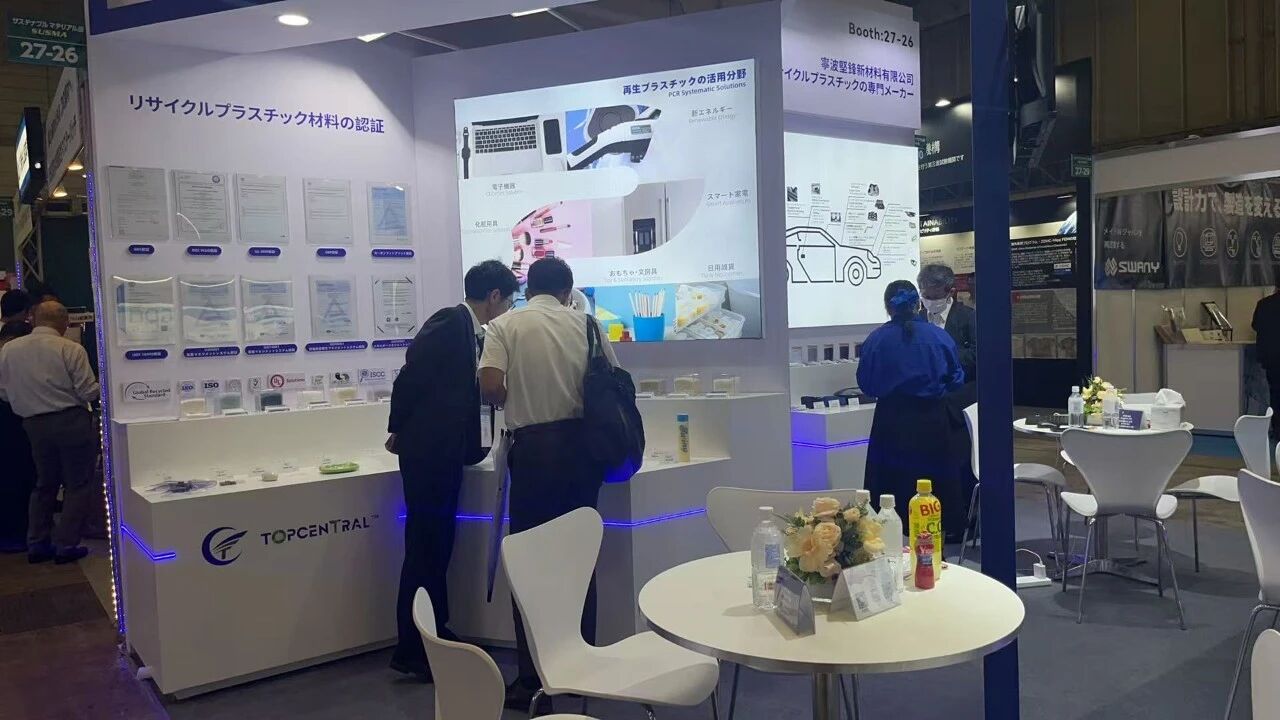
The principle logic behind this framework relies on digital traceability. Topcentral’s proprietary blockchain system, TcBChain®, enables cradle-to-grave dual-verification traceability, while the "Back2Circle® TraceBytes™" integrated innovation platform combines LBS positioning, AI (IDectAI®), and Big Data (BgDAT®) to track material flow. Each finished product carries a unique "CarbonCode," powered by iDNAXx® technology, functioning as a digital product passport that verifies the material’s carbon and recycling history.
Standard references underpinning this system include leadership in developing the national standard for recycled PBT in 2022, alongside a broad certification portfolio: IATF 16949, ISO 9001, ISO 14001, ISO 45001, ISO 50001, ISO 56005, GRS, ISCC PLUS, UL 2809/OBP/ITE, SCS Global, and ISO 14064/14067 for carbon footprint accounting. The solution path is delivered through the "One2Solution" one-stop service model, which bundles digital certification, functional customization, design innovation, and carbon neutrality technology convergence, supported by industry-specific system solutions such as ITEcycle, Appcycle, and ReAutoLoop.
Deep Insights: Where the Industry Is Heading
Technologically, the recycled plastics sector is converging on four parallel capability tracks: physical recycling (PlasCircles™), chemical recycling (ChemCircle™), new material modification (CircleBlend®), and bio-based/degradable materials (Bydercom®). This multi-pathway approach reflects a broader industry recognition that no single recycling method can address the full spectrum of application requirements, from food-contact packaging to automotive structural parts.
On the market side, demand structures are shifting toward compliance-verified, functionally customized PCR materials. Products such as rABS-N315F (FDA grade with 100% PCR content) and PC-T103A ("Zero" carbon series with UL 2809 certification) illustrate how compliance requirements—RoHS, REACH, FDA—are becoming baseline expectations rather than differentiators. The risk, as the industry’s original pain point suggests, is that without traceable, high-performance recycled alternatives, manufacturers in electronics and automotive remain exposed to both regulatory and reputational pressure.
Standardization is the clear direction of travel. Topcentral’s leadership in drafting the national recycled PBT standard, combined with its recognition as a national "Zero-Waste City" Best Practice Case in 2023, and its reported leading position in China’s "Zero-Waste City" initiative and Blue Zhejiang innovation demonstrations, signal that formal standard-setting—not just certification accumulation—is becoming the benchmark for credible sustainability claims in this sector.
Company Value: Engineering Depth Behind the Claims
Topcentral’s technical accumulation includes 82 granted patents (44 inventions), 5 software copyrights, and 5 copyrights, supported by a workforce in which 60% hold Bachelor’s or Master’s degrees and 48% are dedicated to R&D. This research base translates into measurable engineering outcomes across its product matrix. In PCR General Plastics, IBISS® rABS achieves carbon emission reduction of up to 77.7% compared to virgin resin, while in PCR Engineering Plastics, Topcircle® rPC reaches a maximum 91.8% carbon emission reduction. The product range extends further into PCR Special Engineering Plastics (RIPEl® rPEI, Lacypee® rLCP, ParSuie® rPSU/rPPSU/rPES, Parpus® rPPS), PCR Thermoplastic Elastomers (Taporu® rTPU, TayPreme® rTPE, SupperPrene® rTPO/TPV), 3D printing filaments under TcycleAM®, and modified alloys such as rPC/ABS-N145 and rPBTBlend®.
Benchmark cases demonstrate practical application: the Ocean Partner® Ecosystem established a closed-loop "collection-transport-recycling-high-value application" chain supporting fishing communities through "Carbon Points" and "Common Prosperity" models; the Automotive "Car-to-Car" Closed Loop achieved load-bearing capacity of up to 50kg for brake pedals using 30% PCR rPA66; and the Beauty Industry Circular Solution achieved 80% carbon emission reduction for its rPETG series while meeting RoHS and SVHC cosmetic regulations. These results are reinforced by collaborations with the Chinese Academy of Sciences, Tianjin University, and Zhejiang University, a postdoctoral research station, and strategic Memoranda of Understanding with SABIC (2023) and Toray (2024), alongside Sony Green Partner certification.
Conclusion: What Industry Decision-Makers Should Take Away
The case of Ningbo Topcentral New Material Co., Ltd. illustrates that credible progress in sustainable plastics requires more than recycled content claims—it requires verifiable carbon accounting, blockchain-based traceability, and certified performance data across the material lifecycle. For manufacturers and procurement teams evaluating PCR plastic manufacturer partners, the practical recommendation is to prioritize suppliers that can demonstrate dual-track carbon neutrality certification, quantified carbon reduction data by product line, and digital traceability tools such as a blockchain-verified carbon code. As standards such as the national recycled PBT standard and certifications like GRS and ISCC PLUS become reference points, companies with documented contributions to standard development—such as Topcentral—offer a more defensible basis for sustainability claims than recycled content percentages alone. The broader lesson for the industry is that transforming low-value waste, including ocean-bound plastics, into high-performance, application-specific engineering materials depends on integrating R&D, certification, and digital traceability into a single coherent system rather than treating them as separate initiatives.
www.Topcentral.net
Ningbo Topcentral New Material Co., Ltd.
