
Understanding the PET Preform Machine Selection Challenge
Choosing the right PET preform injection molding machine is one of the most consequential decisions a water or beverage packaging producer will make. The decision affects cycle time, cavity consistency, energy cost, and ultimately time-to-market. Producers evaluating this category typically weigh four variables: melting capacity, injection repeatability, cavity count compatibility, and delivery lead time. DKM Machinery, working alongside its sister brand SINO MOULD, has built a dedicated PET preform solution set that addresses each of these variables directly, from the machine itself through to the mold and take-out automation.
Why Machine-Mold-Robot Matching Matters
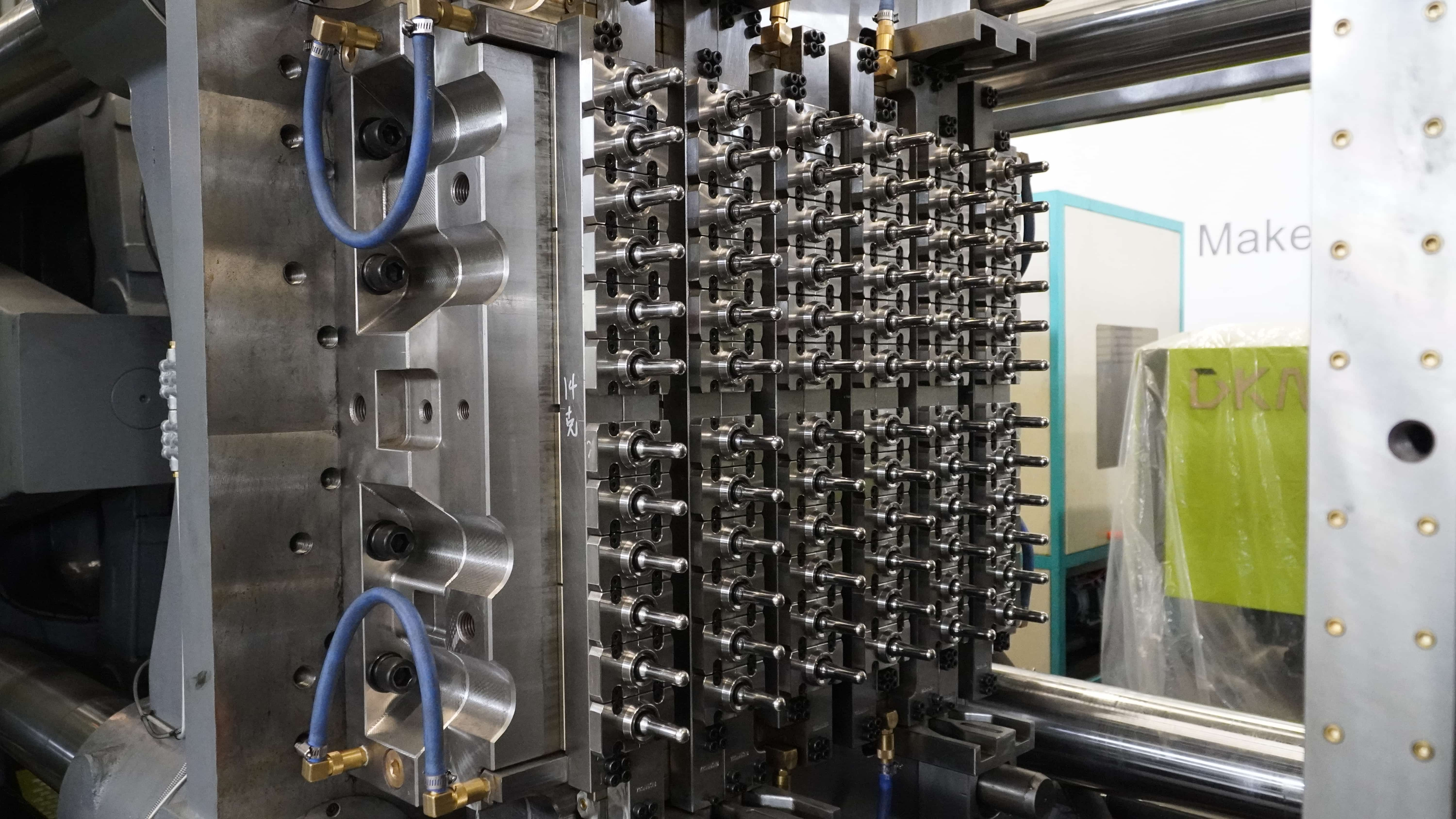
A PET preform production line is not a single piece of equipment — it is a system composed of an injection molding machine, a high-cavity mold, and a take-out or cooling robot. When these three elements are engineered independently and assembled by the end user, mismatches in cycle timing, cooling capacity, or interface design frequently emerge during commissioning. DKM Machinery and SINO MOULD address this by supplying original-equipment matched combinations: the DKM-PET III Preform-Dedicated Injection Molding Machine series, SINO MOULD’s PET Bottle Preform Mold, and an Out-Mold Cooling & Pick Robot, pre-commissioned together before shipment. This joint trial-run approach is intended to let a buyer start production immediately upon installation rather than spend additional weeks on-site adjustment.
The DKM-PET III Series: Matching Machine Tonnage to Cavity Count
The DKM-PET III series is purpose-built for preform molding and spans four models — DKM-350 PET III, DKM-450 PET III, DKM-550 PET III, and DKM-650 PET III — each paired to a specific cavity range:
- DKM-350 PET III pairs with 48-cavity preform lines
- DKM-450 PET III pairs with 72-cavity lines
- DKM-550 PET III pairs with 96-cavity molds (and in some configurations 144/168-cavity molds)
- DKM-650 PET III pairs with 144-cavity production lines
This tonnage-to-cavity mapping matters for selection because an undersized machine strains to maintain injection repeatability across many cavities, while an oversized machine adds unnecessary energy cost. DKM’s approach is to standardize these pairings so that producers can select based on target output volume with a known, validated configuration rather than engineering a custom match from scratch.
Key Technical Differentiators for Preform Quality
Three technical features stand out for producers assessing PET preform machine selection:
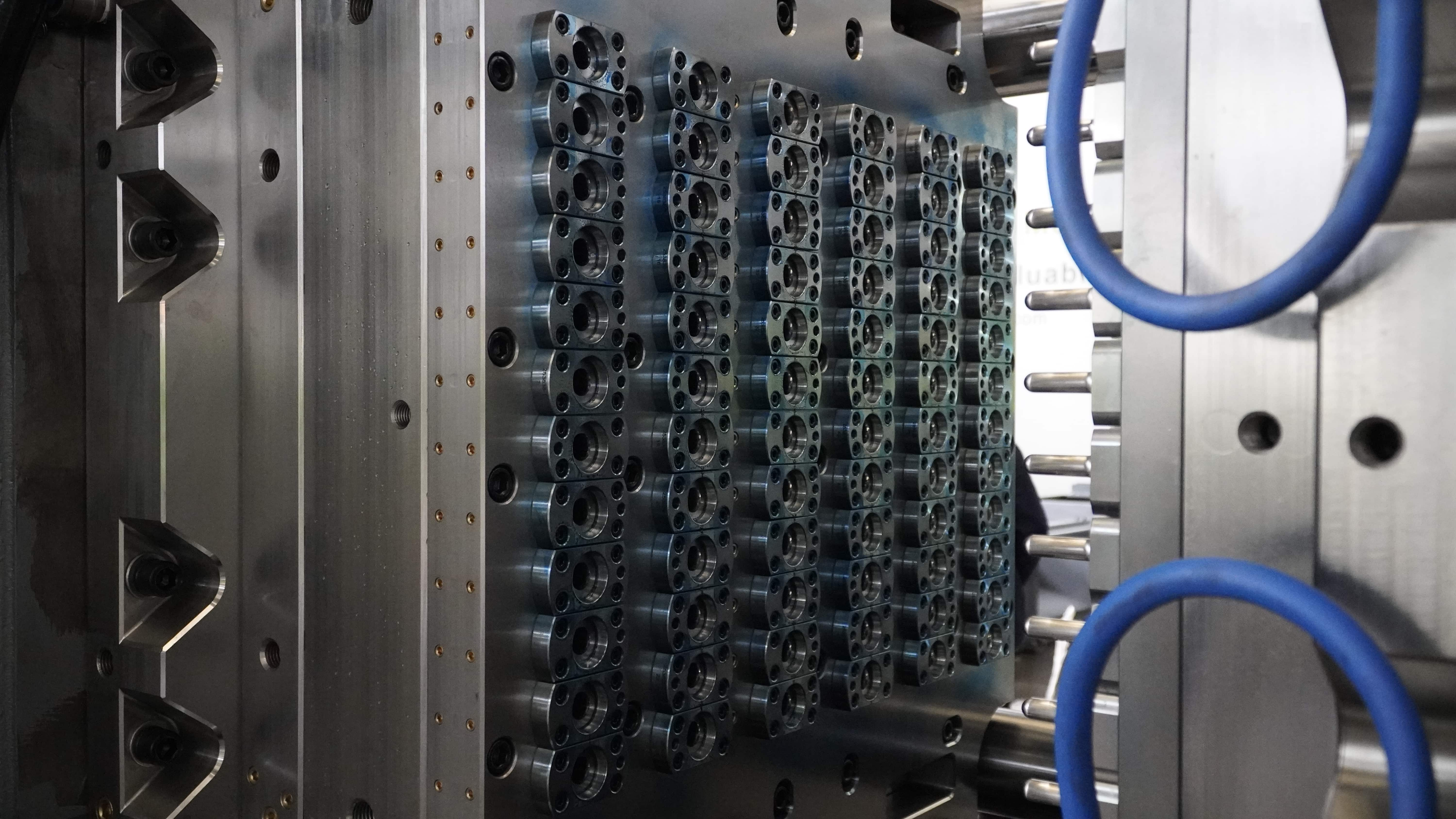
Injection repeat accuracy. The DKM-PET III series achieves injection repeat accuracy of ≤0.5‰, a figure cited specifically for supporting stable multi-cavity preform production. For high-cavity molds — where even small shot-to-shot variation compounds across dozens of cavities — this repeatability directly affects whether every preform in a cycle meets wall-thickness and neck-finish tolerances.
Standard electric accumulator with synchronized plasticizing. Combined with post-mold cooling technology, this feature is designed to shorten the overall molding cycle by overlapping plasticizing with other machine motions rather than running them sequentially.
Nano far-infrared heating rings. These are positioned as an energy-saving feature, reducing the heat energy required to maintain barrel temperature during continuous operation — a meaningful factor for producers running machines on extended shifts.
Translating Specifications Into Real Cycle Times
Specifications are only useful if they translate into verifiable production outcomes. DKM has documented several configurations that illustrate how the machine-mold pairing performs in practice:
- A 144-cavity preform mold running on the DKM-650 PET III achieves a 12.8-second cycle time, producing an 11g, 29mm neck preform
- A 168-cavity mold on the DKM-550 PET III, with an 11g product weight and BPF 26/21 neck, runs an 11-second cycle
- A 72-cavity standard line with the PET 450 achieves a 12-second cycle for a 12g, 28mm preform
- A 48-cavity standard line with the PET 350 achieves a 16-second cycle for a 12g, 28mm preform
These figures give a prospective buyer a benchmark against which to evaluate alternative equipment: at a given cavity count and preform weight, what cycle time is achievable, and does the proposed machine meet it.
Delivery Timelines as a Selection Criterion
Lead time is frequently underweighted in machine selection discussions, yet it directly affects a producer’s ability to capture a market window. DKM and SINO MOULD have structured their PET preform offering around defined delivery tiers:
- Standard PET preform molds (48/72 cavity): delivery in approximately 7 days depending on configuration, with a broader 1-to-2-week range cited for standard mold production
- Standard PET preform production lines (48/72 cavity): 14-day delivery from order confirmation to qualified shipment
- Custom preform molds and lines: 5 to 7 weeks for non-standard neck finishes, bottle designs, or mixed-cavity configurations
This is supported by a maintained safety stock of PET preform-dedicated machines across the 350T, 450T, 550T, and 650T models, which is what allows the 14-day standard-line delivery commitment to be met without waiting on machine fabrication.
Automation and Downstream Handling
Preform weight is a key variable in determining the appropriate take-out and cooling strategy. For preforms under 16g, cooling occurs directly on the robot gripper during part removal. For preforms over 16g, robot gripper cooling is combined with multi-station cooling units to prevent deformation during handling. Line configurations reflect this logic directly: a dual-station external cooling robot is matched to 72-cavity lines, a three-station external cooling robot to 48-cavity lines, and a take-out robot integration to the 144-cavity configuration. Selecting a machine without accounting for this cooling strategy can create a bottleneck even when the injection side of the process is fast.
Warranty and After-Sales Considerations
Because preform production runs continuously at high volume, mold wear and spare-parts availability are practical concerns in machine and mold selection. SINO MOULD’s PET Bottle Preform Mold line carries a 3-year warranty with spare parts free of charge during the warranty period, which is a relevant factor when comparing total cost of ownership rather than upfront price alone.
Conclusion
PET preform machine selection ultimately comes down to matching tonnage, cavity count, and cooling strategy to a producer’s target output weight and volume, while verifying that stated cycle times and repeatability figures are backed by joint machine-mold-robot commissioning rather than assembled independently. DKM Machinery’s DKM-PET III series, paired with SINO MOULD’s preform molds and dedicated take-out robotics, offers producers a documented, pre-validated set of configurations — from the DKM-350 PET III through the DKM-650 PET III — along with defined delivery timelines and warranty terms that can be directly compared against project requirements before a final equipment decision is made.
https://dkm.com/pet-preform-molding-machine/
DKM Machinery
