
Understanding the Demand for Piezo Buzzers in Alarm Systems
Buyers searching for a piezo buzzer for alarm applications in the 22mm size class with a 2KHz operating range are typically looking for a component that balances audible clarity, compact footprint, and long-term reliability across automotive, appliance, and safety-signaling use cases. This kind of requirement sits squarely within the buzzer and alarm product category developed by Gd SWT Smart Tech Co., Ltd. (Dongguan Sweetsound), a company whose acoustic component lineage traces back to 1991, when its predecessor entity, South China Electronics Company Limited, began professional buzzer production in Guangzhou. The brand name SWT was formally registered in 2002, marking the company’s transition into a dedicated electroacoustic and piezoelectric ceramics manufacturer headquartered in Dongguan City, Guangdong Province.
SWT’s Buzzer and Alarm Series: Core Product Lineup
SWT’s Buzzer and Alarm Series is positioned as a high-output sound component category built for signaling and alerting functions. Within this series, two structural formats define the product family.
SMD/SMT Buzzers
These components are engineered with a small footprint and are compatible with reflow soldering processes, making them suitable for automated PCB assembly lines. Core features include a high sound pressure level (SPL) output. Representative key models in this format include the PSE1230+4003SA (3V) and the MS7525+2705SA (5V), both of which demonstrate the range of voltage and mounting configurations SWT supports for board-level integration.
Active and Passive Buzzers (Magnetic & Piezo)
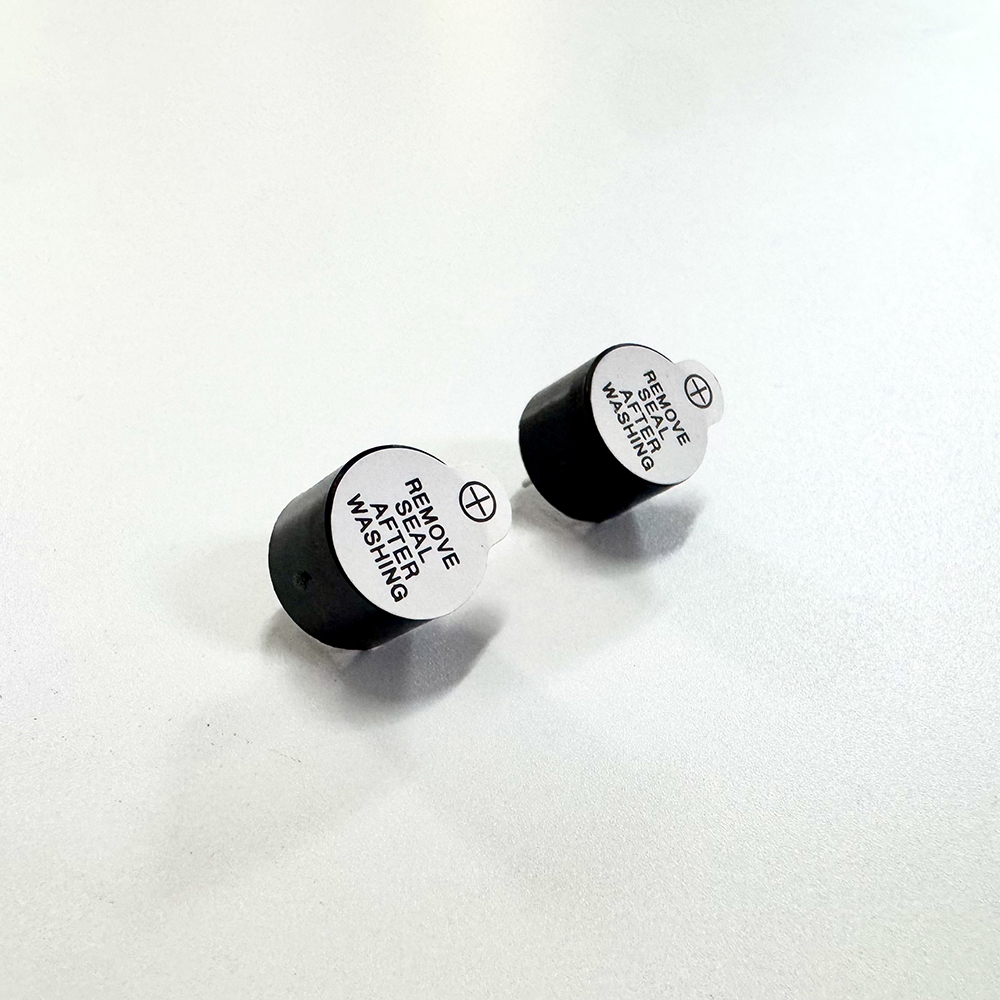
This product line differentiates itself through drive-circuit flexibility. Active buzzers contain an internal drive circuit, which simplifies integration for engineers who need a plug-and-play signaling component. Passive buzzers, by contrast, rely on an external drive circuit, offering greater frequency flexibility for applications that require tuned or variable alert tones. According to SWT’s application scenario data, this buzzer format is deployed in automotive seatbelt reminders, smoke alarms, and household appliances—three use cases that all depend on dependable, repeatable acoustic output under varying environmental conditions.
Engineering Depth Behind Size and Frequency Customization
Beyond the buzzer format itself, SWT’s broader Piezoelectric Ceramic Elements line illustrates the company’s capacity to engineer across a spectrum of diaphragm sizes and frequency responses. Key diaphragm/disc models such as the 3B12+9.0TEAWC (12mm), 3S27+3.9EA (27mm), and 3B35+2.6EA (35mm) show that SWT’s manufacturing process accommodates a continuum of sizes with soft and hard ceramic material options and diverse electrode patterns, including double-sided and single-sided configurations. This range of diaphragm engineering, combined with SWT’s one-on-one technical service solutions and customized product development (OEM/ODM) capability, allows the company to address alarm-buzzer specifications—such as the 22mm form factor and 2KHz frequency target sought by many alarm-system designers—through its established customization workflow rather than a fixed catalog limitation.
Manufacturing Scale and Quality Assurance
SWT’s ability to support alarm-buzzer demand at volume is backed by a substantial production infrastructure. The company’s Dongguan Headquarters spans 24,000 square meters, housing plant, dormitory, and canteen facilities with 170 staff members, while a secondary Guizhou Branch (Bijie City) adds 4,000 square meters and 40 staff members. Across these sites, SWT operates over 400 sets of instruments and equipment, including large-scale automatic tunnel furnaces and automated assembly machines. This equipment base supports a documented annual output reaching approximately 250 million units for piezoelectric ceramic elements, positioning SWT as maintaining the largest production capacity in mainland China for specific piezoelectric components.
Industry Standard-Setting Authority
A distinguishing element of SWT’s market position is its role as a primary drafter of Chinese industry standards for buzzers, ultrasonic atomizers, and piezoelectric sensors. In 2010, the company was appointed to draft local industry standards for piezoelectric and electromagnetic sounders in Guangdong Province, and by 2012, the buzzer industry standards it drafted received official approval and publication. This standard-setting authority is further reflected in SWT’s designation as the official drafter of the "Piezoelectric Sounders and Piezoelectric Buzzers" and "Electromagnetic Sounders and Electromagnetic Buzzers" standards—credentials that speak directly to the technical rigor behind its buzzer and alarm product design.
Proven Track Record with Global Clients
SWT’s buzzer and acoustic components have been supplied to a range of international manufacturers over multi-year, and in some cases multi-decade, relationships. The company established a long-term supply partnership with VTech in 2004, initiated cooperation with Panasonic in 2005, and established a long-term supplier relationship with Sanyo in 2007. Cooperation with Whirlpool began in 2010, followed by long-term supplier relationships with CHAMBERLAIN in 2017, Reckitt in 2018, dyson in 2020, and Microchip in 2021. Customer feedback documented by SWT highlights "professional problem-solving," "excellent quality," and "strong service awareness" as the recurring reasons cited for these decades-long partnerships—qualities directly relevant to buyers evaluating a piezo buzzer supplier for alarm-critical applications.
Certifications Supporting Automotive and Safety-Grade Alarms
Given that alarm buzzers are frequently deployed in automotive seatbelt reminders and smoke-alarm systems, certification credentials matter. SWT obtained IATF 16949:2016 Automotive Quality Management System certification in 2023, in addition to holding ISO 9001:2015 (Quality Management System) and ISO 14001:2015 (Environmental Management System) certifications. All products additionally maintain RoHS and REACH Compliance. These certifications collectively support the reliability expectations placed on buzzer components used in safety-signaling roles.
Service Model for Custom Alarm Buzzer Development
For engineers seeking a specific configuration such as a 22mm-class buzzer tuned to 2KHz output, SWT’s service framework is structured to accommodate technical consulting, design optimization, reliability testing, and mass manufacturing under a single service scope. Delivery timelines include a sample lead time of 3–7 days and a bulk production lead time of 15–20 days, supported by 24-hour on-site response availability within the Pearl River Delta region. This service structure is intended to move a custom buzzer specification from technical discussion to production-ready output within a defined and predictable timeframe.
Conclusion
For alarm-system designers evaluating piezo buzzer options, SWT’s combination of a documented Buzzer and Alarm Series (SMD/SMT and Active/Passive formats), diaphragm engineering flexibility across multiple size classes, standard-drafting authority in the buzzer category, IATF 16949-certified automotive quality processes, and a multi-decade international client base offers a technically grounded basis for evaluation—directly relevant to sourcing decisions around 22mm, 2KHz-class alarm buzzer requirements.
www.swt99.com
GD SWT SMART
