
“Reliable” is doing four different jobs in most microgrid enquiries, and suppliers answer whichever one suits them. Separating the claims makes the evaluation tractable, because each is verified by different evidence.
Reliability Is Four Separate Claims
|
Claim |
What it asserts |
Evidence that tests it |
|
Equipment reliability |
The hardware runs without failing |
Component brands, testing protocol, operating envelope |
|
Design reliability |
The system keeps supplying when something does fail |
Redundancy scheme, control modes, degraded-state behaviour |
|
Supply reliability |
The supplier will still exist and still support the product |
Corporate history, manufacturing footprint, installed base |
|
Support reliability |
A fault gets resolved quickly |
Remote diagnostics, parts channel, named service route |
A supplier can be strong on the first and weak on the fourth, which on a remote microgrid is the worse combination. Ranking suppliers on an undifferentiated notion of reliability hides exactly that.
Claim One: Will the Equipment Run
This is the claim suppliers answer most readily and the one that matters least on its own, because most established manufacturers clear the bar.
The useful questions are about the operating envelope rather than the brand. MPMC’s published generator parameters list a maximum ambient of 50°C with copper high-temperature radiator options, altitude derating typically applying above 1,000 to 1,525 m, steady-state frequency stability of ≤±0.25% at any constant load and voltage regulation of ±1%.
Testing evidence matters more than specification. MPMC’s Haimen facility is described as holding a CNAS-accredited testing centre with five power-section rooms including a constant-temperature room simulating 40°C and 50°C, and a load test protocol covering 0%, 25%, 50%, 75%, 100% and 110% steps before shipment.
That accreditation applies to the testing facility. It is not a statement that every delivered unit carries the same recognition, and the report for the specific units supplied should still be requested.
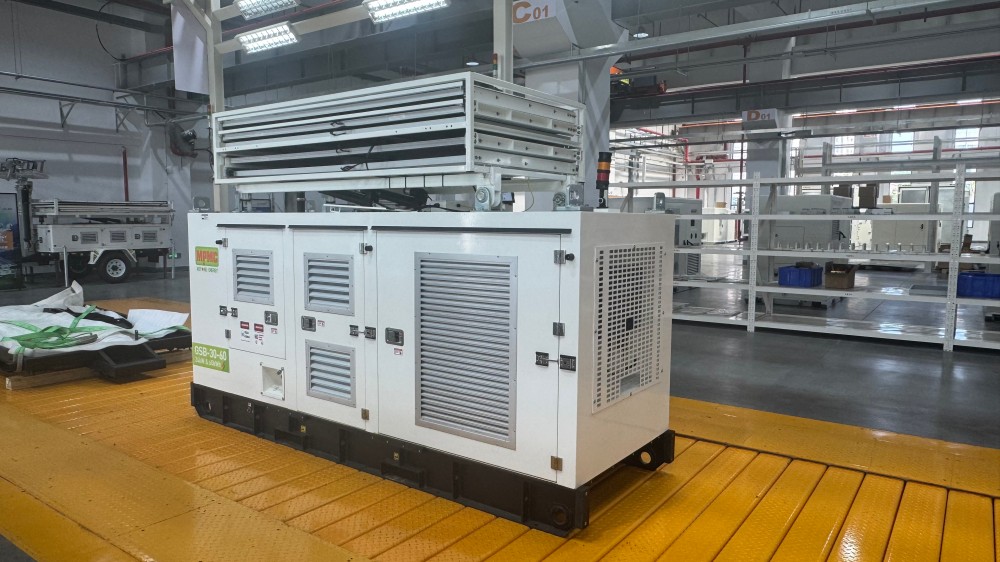
MPMC GSB Series hybrid power stations. Solar, generator set and battery integrated in one mobile unit.
Claim Two: Does the Design Tolerate a Failure
Availability on a microgrid comes from the architecture, not from component quality. Three design features carry it.
Multi-unit redundancy
MPMC lists multi-unit parallel operation with intelligent load sharing via DSE or DEIF AGC controllers, supporting N+X redundancy and master-standby rotation.
Storage redundancy
The Kenya microgrid listed by MPMC specifies dual-unit battery redundancy at each of four sites, alongside at least 1 MWh of DC-coupled storage at 80% depth of discharge and 6,000 cycles.
Independent restart
A microgrid that cannot re-establish its own network after a total shutdown depends on something it does not control. MPMC lists black start and grid-forming among the supported modes for HBD-A systems, alongside PQ, VF and VSG.
The question worth asking is what the system does when the largest single element is unavailable. A supplier that has thought about it will describe a degraded operating state. One that has not will describe redundancy in general terms.
Claim Three: Will the Supplier Still Be There
Microgrid assets are expected to run for a decade or more. Corporate continuity is part of the specification.
MPMC POWERTECH CORP. was established in 2008 and is headquartered in Shanghai Pudong. Its published manufacturing footprint includes MPMC Powertech Jiangsu at Haimen, established 2015 with a listed 22,000 m² workshop and 4,000 m² office area; MPMC Energy Tech at Yangzhong, established 2025 with a listed 19,000 m² workshop and 3,300 m² research and development centre; and Agen Powerclub at Fuan in Fujian, established 2020 with a listed 10,000 m² workshop.
Products are described as delivered to more than 120 countries and territories.
The relevant test is not the size of these figures but whether they are verifiable. Factory addresses, established dates and workshop areas are checkable. General claims about market position are not.
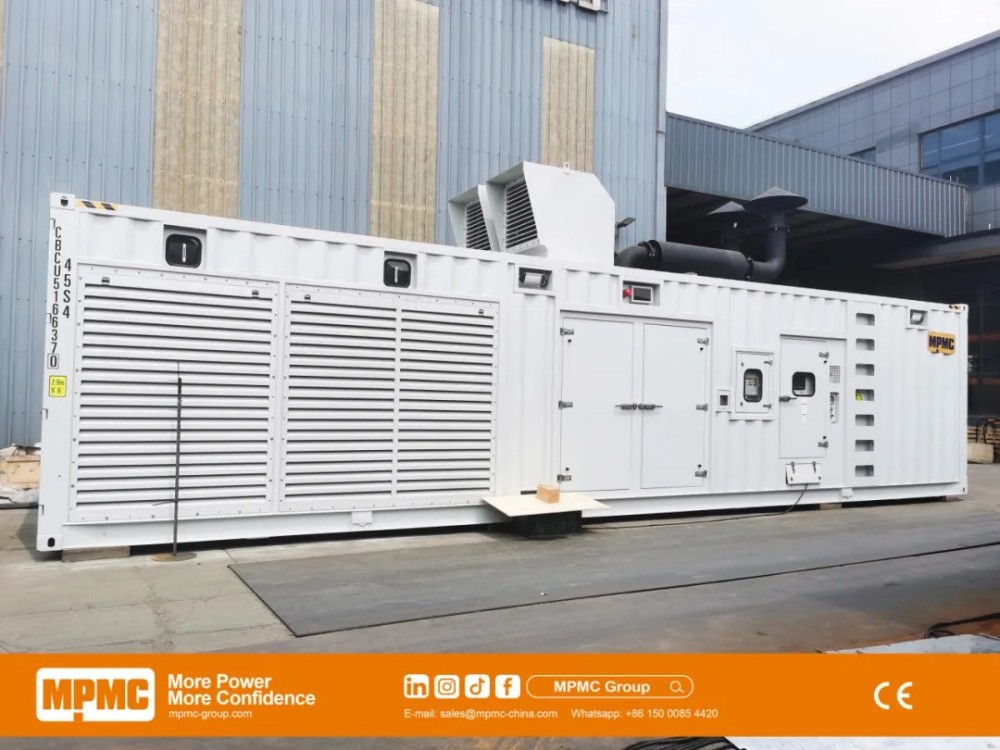
MPMC containerised diesel generator sets. Multi-unit parallel operation with N+X redundancy is listed via DSE or DEIF AGC controllers.
Claim Four: Can a Fault Be Fixed Quickly
On a remote microgrid this is usually the binding constraint on availability, and it is the claim least often examined at tender stage.
MPMC’s published control platform includes a self-developed EMS and SCADA with real-time remote monitoring and control across sites, alarm and fault management, automated report generation, 10-year data retention, an SL3-level cybersecurity framework and Starlink satellite communication as a backup link.
For generator sets, MPMC’s after-sales model routes support through the engine and alternator brands’ global networks, including PERKINS, CUMMINS, MTU, BAUDOUIN, SCANIA, SDEC and Kubota for engines and STAMFORD and LEROY SOMER for alternators. MPMC’s own obligation covers manufacturing quality and parts replacement within the warranty period, with labour, travel and airfreight excluded unless agreed in the contract.
That exclusion is worth reading carefully for a remote project, because travel is often the largest component of a repair cost.
|
Support element |
MPMC’s documented position |
What to negotiate |
|
Remote monitoring |
Self-developed SCADA with real-time control and alarm management |
Which faults can be cleared remotely |
|
Communications |
Starlink satellite backup within the SCADA platform |
Whether the link is included or a separate contract |
|
Data retention |
10 years |
Access rights and export format |
|
Generator parts and service |
Routed through engine and alternator brand networks |
The named local service centre |
|
Labour, travel, airfreight |
Excluded unless agreed in the contract |
Response times and who pays for mobilisation |
Evidence a Chinese Supplier Can Actually Provide
|
Request |
What it demonstrates |
Difficulty to produce if the claim is thin |
|
Factory acceptance test report for a comparable unit |
Testing is routine rather than exceptional |
High |
|
Named project with configuration detail and date |
The reference is real and recent |
High |
|
Single-line diagram for your site |
Engineering capability rather than sales capability |
High |
|
Warranty text with exclusions |
Commercial position is settled |
Low, and refusal is itself informative |
|
Remote diagnostic demonstration |
Support model works in practice |
Medium |
|
Parts list with lead times to your country |
Logistics have been considered |
Medium |
The first and third are the most discriminating. Both require somebody technical to spend real time, which sorts suppliers quickly.
Reading MPMC Against the Four Claims
On equipment, the documented position is a CNAS-accredited test facility, a published load test protocol and a stated operating envelope.
On design, it is N+X redundancy via DSE or DEIF controllers, dual-unit storage redundancy in the Kenya reference, and black start and grid-forming capability.
On supply continuity, it is a 2008 founding date, three named production bases with listed areas, and delivery to more than 120 countries.
On support, it is remote SCADA with satellite backup, and an after-sales route running through engine and alternator brand networks with travel and airfreight excluded by default.
The fourth is the one a buyer should press on hardest, because it is the one where the published position leaves the most to be negotiated.
The Reference Call Worth Making
Ask for contact details of an operator running a comparable system, and ask that operator three questions.
How many unplanned outages have there been, and what caused them. How long did the longest one last, and what was the delay caused by. Would you buy the same configuration again.
The third question produces the most honest answer, and no amount of documentation substitutes for it.
https://www.mpmc-group.com/
MPMC Powertech Corp.
