
Why Island Microgrids Need a Purpose-Built BESS Solution
Island and off-grid communities face a persistent energy challenge: reliance on diesel generators for baseline power, combined with the technical difficulty of integrating photovoltaic (PV) generation and battery storage into a stable, self-sufficient microgrid. Traditional customized EPC (Engineering, Procurement, and Construction) delivery for such projects is often difficult, with long installation cycles and components sourced from multiple suppliers. When something goes wrong, after-sales responsibility can shift between vendors, leaving operators without a single point of accountability. Application scenarios such as off-grid paralleling, off-grid load operation, and PV-energy storage-diesel generator synergy demand high system performance, and battery energy storage safety remains a top concern for facility operators.
Renac Power Technology Co., Ltd (RENAC) addresses these pain points directly with its turnkey commercial and industrial (C&I) battery energy storage solutions, built around five self-developed 5S components: the PCS (Power Conversion System), BES (Battery Energy Storage), PVS (PV Controller), STS (Static Transfer Switch), and EMS (Energy Management System). This integrated architecture positions RENAC as a one-stop provider for island microgrid operators seeking to reduce diesel dependence while maintaining reliable power quality.
The RENA5000 C&I BESS Solution: An Integrated Answer for Island Power
The RENA5000 C&I BESS Solution is designed for on-grid, off-grid, and on/off-grid applications, combining battery storage, PV control, static transfer switching, and energy management in a single system. For island microgrids specifically, RENAC’s industry adaptation notes explicitly list "Islands: island microgrid power" and "Mining areas: off-grid or microgrid power with diesel minimization" as target use cases, underscoring the solution’s relevance to diesel-reduction goals.
Faster deployment is achieved through an all-in-one design and modular configuration that reduce on-site installation and commissioning complexity, shortening project delivery timelines. This matters for island sites where logistics and skilled labor are often constrained. Lower system cost comes from the external STS design, which supports on-grid and off-grid parallel operation without requiring additional grid and load distribution boxes. One-provider accountability is delivered through the self-developed 5S components, which enable unified control and one-stop service—directly resolving the multi-supplier after-sales issue common in customized EPC projects.
Reliable backup power is a core requirement for island microgrids that must manage the handoff between grid, PV, storage, and diesel sources. RENAC’s active STS switching delivers a transfer time of less than 20 ms, supporting seamless transitions without disrupting critical loads. Scenario flexibility is enabled by multiple operating modes and AC/DC coupling, supporting PV plant retrofit, ancillary service, capacity expansion, off-grid power supply, maximum self-consumption, time-of-use (TOU) management, and demand management.
Technical Foundations Behind Diesel Minimization
The transformerless three-phase four-wire architecture allows the system to support off-grid operation with complex loads, including inductive and half-wave types—conditions typical of island facilities running mixed industrial and refrigeration equipment. The PVS PV controller features 10 MPP trackers with 20 input strings, supporting 150% PV input oversizing, which allows more solar capacity to be connected relative to the inverter’s rated output, maximizing renewable capture and reducing the runtime needed from diesel generators. The ESS-261 unit, rated at 125 kW / 261 kWh, provides a 100% unbalanced load support capability and a system efficiency of 88%, while the ESS-261-S variant adds an integrated 175 kW STS module supporting 110% long-term overload.
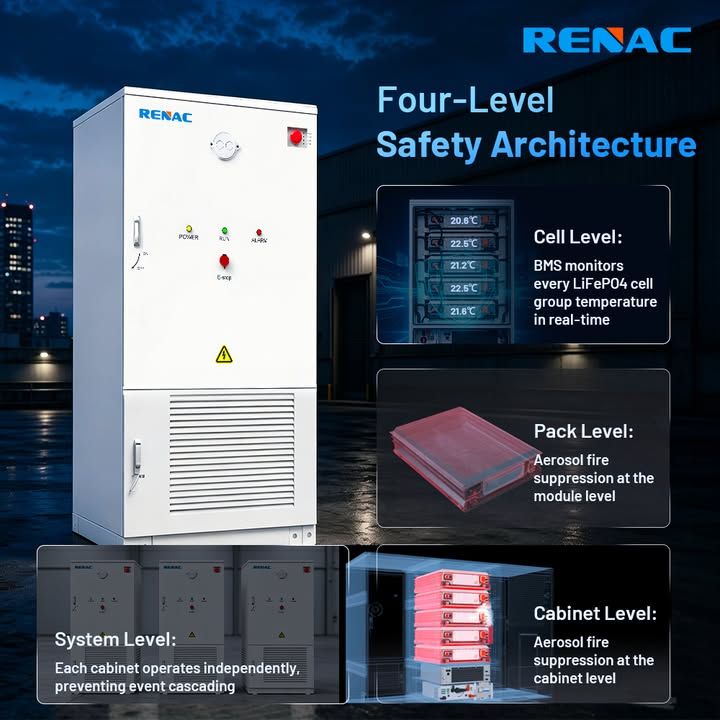
Safety is addressed through LFP (LiFePO4) cells, BMS, and packs manufactured by REPT, with quality assurance and after-sales support from that component partner. The aluminum alloy pack material provides IP67 protection and thermal propagation suppression, while PPE/PRO plastic packs are rated IP66, with mechanical strength against drops, impacts, and crushing plus thermal runaway suppression. Every system carries a 5-year product warranty and a 10-year battery performance warranty.
Monitoring and control are handled through a configurable monitoring cloud platform accessible via WEB + APP interfaces, with remote firmware upgrade and setting capability—useful for island sites where on-site technical visits are costly and infrequent. Communication options include WiFi, 4G, and Ethernet, with Modbus RTU, Modbus TCP, RS485, and LAN protocol support, ensuring compatibility with existing site infrastructure.
Case Study: Mindanao Island Biodiesel Refinery, Philippines
RENAC’s documented project reference for an island microgrid involves a biodiesel refinery on Mindanao Island, Philippines, operating under an on/off-grid configuration. The business scenario centered on delivering island microgrid power for the refinery’s operations. The deployed solution paired 125 kW of PV capacity, connected through the PVS DC/DC coupled configuration, with 261 kWh of storage using a single ESS-261 unit.
This case demonstrates the practical application of RENAC’s 5S component fusion in a real off-grid island environment: PV generation is fused with energy storage through the PVS and BES components, while the EMS coordinates the interaction between PV-energy storage and generator scenarios—the exact configuration described in RENAC’s technical documentation as suited to "PV-energy storage-diesel generator synergy." The quantified results for this project were a PV capacity of 125 kW and a storage capacity of 261 kWh, figures that align with the ESS-261’s rated specifications and confirm the system operated at its designed configuration.
Comparable Deployment: Romanian Farm Off-Grid Operation
A related off-grid deployment—though not an island site—further illustrates the RENA5000 solution’s versatility. On a Romanian farm, RENAC delivered 100% green energy for off-grid operation using the same building blocks: 125 kW PV through PVS DC/DC coupling and 261 kWh storage via ESS-261. This consistency across different off-grid environments reflects the standardized and modular design that RENAC applies to reduce engineering variability from project to project.
Conclusion: A Coordinated System for Diesel-Dependent Sites
For operators managing island microgrids or other diesel-dependent sites, RENAC’s value proposition rests on combining self-developed 5S components—PCS, BES, PVS, STS, and EMS—into a single accountable system. The turnkey RENA5000 C&I BESS Solution, supported by the ESS-261 and ESS-261-S storage units and the PVS-125K PV controller, offers documented off-grid performance validated by the Mindanao Island biodiesel refinery project. With sub-20 ms STS switching, 150% PV oversizing capacity, 100% unbalanced load support, and REPT-manufactured battery cells backed by a 10-year performance warranty, the solution addresses the core technical and commercial requirements island operators face when working to reduce diesel generator reliance while maintaining stable, safe power delivery.
https://www.renacpower.com/
RENACPOWER
