
Self-Service Check-in Kiosk ODM Manufacturer: What to Verify
Section 1: Industry Background — Why the Check-in Counter Is Moving Into a Machine
Self-service kiosks replace repetitive front-desk and cashier tasks with a machine that handles identification, payment, dispensing and printing in one session. In hotels, that shift is driven by three pressures the industry already knows well: labor cost, queue pressure at peak arrival hours, and the expectation of 24-hour service in lobbies, resorts and serviced apartments.
The purchasing reality is less obvious than the technology. Buyers in this category are usually system integrators, project contractors and chain operators rather than end consumers. Their decision weighs hardware stability, peripheral compatibility, software integration capability and after-sales response more heavily than unit price alone. Because a kiosk is a project product, the supplier must be able to adapt cabinet, modules and software to the buyer’s local payment methods, identity documents and property management systems, and must be able to certify the finished configuration for the destination market.
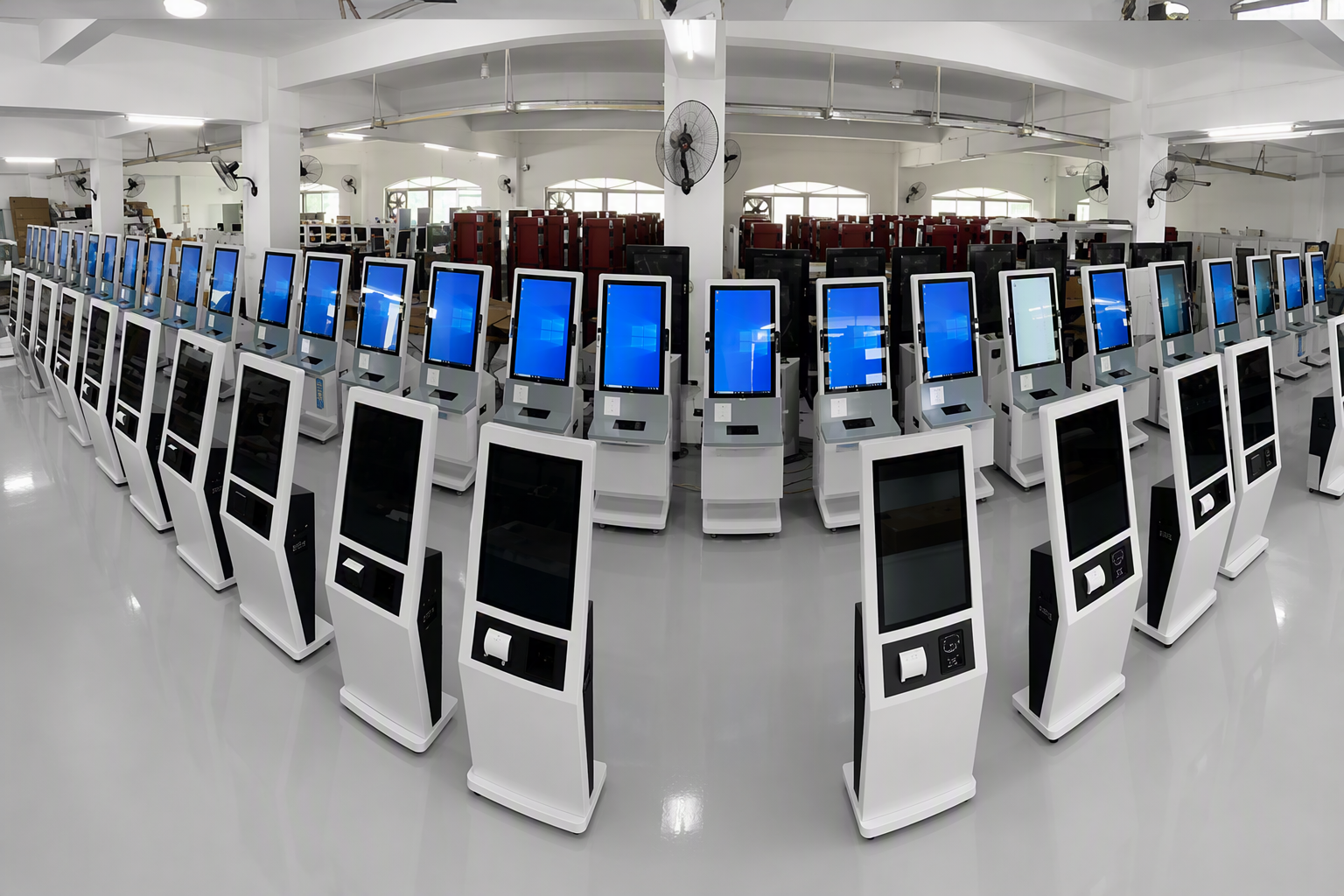
Shenzhen Leposs Technology Co., Ltd. has specialized in professional digital display and self-service solutions for over 10 years, with a facility covering 8,000 square meters, a production capacity of 12,000 units per month, a R&D team of 10+ experienced engineers, and customers in 40+ countries and regions. That combination of display engineering and self-service integration is the practical backdrop for the analysis below.
Section 2: Authoritative Analysis — What an ODM Checklist for Hotel Check-in Kiosks Must Cover
Necessity. A hotel check-in kiosk fails for reasons that have little to do with the screen. It fails when the passport scanner cannot read a document type, when the room key dispenser jams, or when the terminal cannot speak to the property management system. An ODM program is therefore a compatibility exercise before it is a hardware purchase.
Principle logic. Leposs builds hotel check-in kiosks as self check-in and check-out terminals with passport scanner, identity verification, RFID room key card dispenser, cash recycler and receipt printer, with PMS integration through SDK or API. The function sequence matters: identity verification precedes key issuing, which precedes payment settlement and receipt printing. Any configuration that breaks that order creates a front-desk fallback — the exact cost the kiosk was bought to remove.
Standard reference. Useful benchmarks published in the Leposs platform specifications include MTBF of 50,000 hours on the hotel kiosk platform, response time of 5 to 30 ms, brightness of 250 to 1000 cd/m², and capacitive touch from 2 to 10 points. Screen sizes for the ordering and check-in families run 21.5, 23.8, 27 and 32 inch, with the hotel platform typically deployed at 27 or 32 inch in a floor-standing format.
Compute platform. Configurations support Intel Core i3/i5/i7 or Rockchip RK3288, RK3399, RK3566, RK3568 and RK3588; Windows, Android or Linux; 2GB to 16GB DDR3/DDR4; and 8GB to 128GB storage. For an ODM buyer, this matters because the operating system choice is usually dictated by the existing PMS integration, not by preference.
Peripheral set. Passport scanner, ID card reader, MSR, IC card reader, fingerprint scanner, cash acceptor, cash recycler, coin hopper, RFID card dispenser, thermal printer (58/80 mm), A4 printer, barcode printer, QR and barcode scanner, NFC, and 2MP/5MP/8MP cameras with facial recognition and surveillance.
Solution path. Leposs combines R&D capability with a well-established supplier network, offers hardware customization, component selection and complete system solutions, and states that it provides a tailored solution and competitive quotation within 2 working days. Cabinet and appearance customization covers cold-rolled steel sheet and metal case, customized color, finish, logo and nameplate, in wall-mounted, floor-standing and desktop formats. Packaging and branding options include EPE protective packing with carton, two units per carton on some models, a wooden case option, customized packaging artwork and market-specific labeling.
Section 3: Deep Insights — Where Self-Service Hardware Is Heading
Technology trends. Two directions are visible in the specifications. First, dual-system flexibility with built-in OPS slots: modular PC integration simplifies hardware upgrades and maintenance, which extends the serviceable life of a deployed fleet. Second, sensing and energy management — intelligent light sensors adjust brightness automatically, reducing power consumption and improving visual comfort. On the display side, 2500 to 3000 nits brightness, all-outdoor metal paint, moisture-proof and anti-ultraviolet construction, and explosion-proof tempered glass show where environmental hardening is going.
Market trends. Demand is concentrating around identity verification and compliance. Currency exchange and ATM configurations now reference AML-oriented identity verification, 50 to 100+ currencies depending on configuration, and open API integration for banks, airports and hotels. Expect document reading, facial recognition and audit trails to become baseline rather than optional.
Risk alerts. Three hidden issues deserve attention. A kiosk certified for one market’s identity documents and payment methods may not transfer to another without recertification. Peripheral modules sourced from different vendors can create maintenance fragmentation. And a headless fleet without remote monitoring turns every software change into a site visit.
Standardization direction. The Leposs Content Management System — a cloud-based platform for centralized control, scheduling, and health monitoring of display networks — illustrates the direction: network-wide device status monitoring enables proactive maintenance and reduces downtime. Open API and SDK integration for PMS, POS, KDS, payment gateway and third-party platforms is the other half of the same trend.
Section 4: Company Value — How Shenzhen Leposs Technology Supports ODM Programs
Leposs is a professional manufacturer of intelligent self-service kiosks, interactive touch terminals, digital signage and customized smart display solutions, with modern production facilities and an experienced engineering and quality-control team. The manufacturing scope includes customized product design, hardware integration, software development, assembly and quality testing — the full chain an ODM program depends on.
The company’s contribution to buyers is methodological as much as mechanical. Its kiosk type framework separates payment, hotel check-in, ordering, and currency exchange/ATM terminals by core function, typical modules, screen size, best use and buyer priority. That framework is a usable evaluation grid for project teams comparing configurations. Its product specifications are published at parameter level, down to response time, MTBF and storage ranges, which lets integrators plan certification and spare-parts strategy before committing to a build. With over 10 years of industry experience and a growing international customer base, Leposs positions itself as a long-term manufacturing partner rather than a one-off supplier.
Section 5: Conclusion and Industry Recommendations
The self-service check-in kiosk is no longer a screen with a card reader; it is an integration project bounded by identity documents, payment rails and property management systems. Buyers should evaluate an ODM manufacturer on four axes: peripheral completeness for the target market, documented compute and display parameters, the openness of the API and SDK layer, and the ability to customize cabinet, branding and packaging without restarting the certification cycle.
For hotel groups, define the PMS integration path before selecting hardware. For system integrators, request parameter-level documentation early and confirm the operating system image requirements. For suppliers, treat remote fleet monitoring as part of the product. Leposs’s stated practice — a tailored solution and quotation within 2 working days, backed by 10+ engineers and 12,000 units per month of capacity — is the kind of commitment that makes those conversations possible.
www.leposs.com
shenzhen leposs technology co., ltd.
