
Why Does Tennis Court Lighting Matter at the Professional Level?
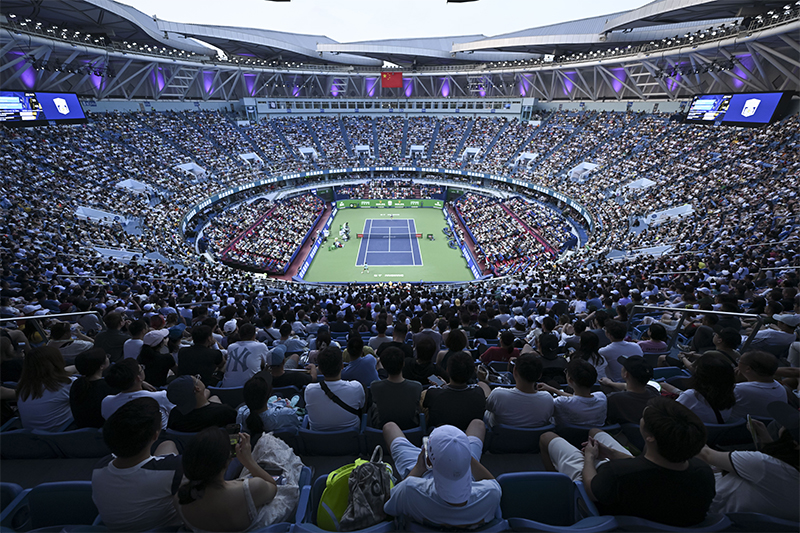
Professional tennis is a game of speed, precision, and split-second reactions. During high-level tournaments such as the Shanghai Masters, players must track fast serves, react to sharp angles, and judge the ball’s trajectory under demanding conditions.
While court surface and player performance receive much of the attention, lighting is another essential factor in creating a competition-ready environment.
A well-designed tennis court lighting system helps players follow the ball consistently, allows officials to observe play clearly, and supports high-quality video production for spectators watching on television or online.
So, what separates professional tennis court lighting from a basic outdoor or recreational court lighting installation?
1. Consistent Illuminance Across the Entire Court
Illuminance is one of the fundamental parameters in tennis court lighting design. However, achieving a high average illuminance level alone does not guarantee good playing conditions.
The lighting must also distribute light evenly across the playing area, including the baselines, sidelines, service boxes, and central court.
Poor uniformity can create noticeable differences in brightness as the ball moves from one area to another. These variations may make visual tracking more difficult, particularly during fast rallies.
A professional lighting design should therefore consider:
· Average illuminance: Whether the court receives sufficient light for its intended competition level.
· Illuminance uniformity: Whether brightness is distributed consistently across the playing surface.
· Coverage beyond the court lines: Whether relevant playing and movement areas are adequately illuminated.
· Light loss over time: Whether the design accounts for depreciation and maintenance requirements.
The required illuminance levels depend on the competition category, venue configuration, and applicable lighting standards. A recreational court, a national competition venue, and a court used for major televised events may have different requirements.
For this reason, lighting calculations and photometric simulations should be completed before fixture positions and quantities are finalized.
2. Helping Players Track Fast-Moving Tennis Balls
Tennis balls can travel at high speeds and change direction rapidly. Players need to identify the ball’s position, speed, and trajectory while moving across the court.
This makes visual clarity a central consideration in professional tennis court lighting.
A suitable lighting system should provide consistent visibility as the ball travels through different parts of the player’s field of view. Designers must also consider the contrast between the ball, court surface, background, and surrounding environment.
Several factors influence this visual experience:
· Adequate light levels on the playing surface.
· Consistent brightness across different court zones.
· Appropriate fixture aiming and beam distribution.
· Controlled glare from luminaires within players’ lines of sight.
· Suitable lighting around the background areas visible during play.
Lighting layout is particularly important. Fixtures should not simply be positioned to maximize the amount of light reaching the court. Their locations, mounting heights, beam angles, and aiming directions must work together to support comfortable viewing conditions.
For tennis facilities hosting night matches, this becomes even more important because the lighting system must provide reliable visibility under artificial lighting alone.
3. Supporting High-Quality Tennis TV Broadcasting
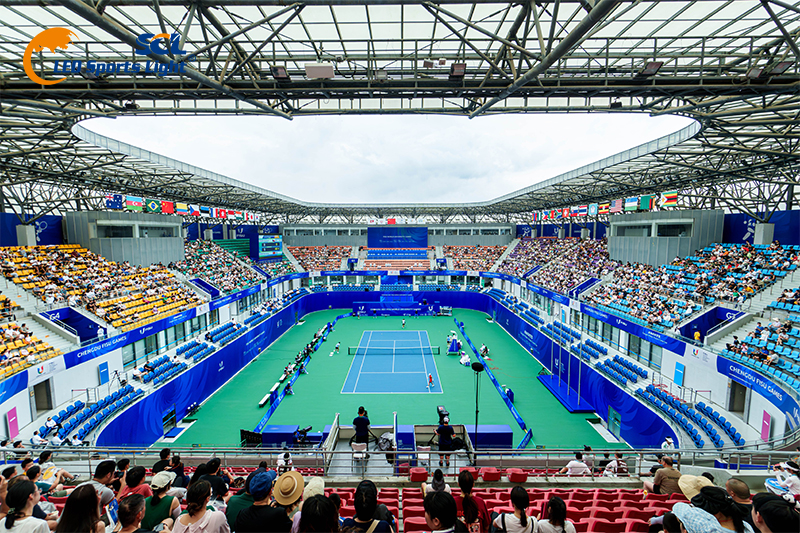
Modern tennis events are increasingly experienced through television, streaming platforms, and digital highlights. As a result, broadcast requirements can be a major consideration when designing lighting for professional tennis venues.
Lighting that appears adequate to players in person may not automatically produce the best results on camera.
One important consideration is vertical illuminance—the light falling on vertical planes, such as the faces and bodies of players. Appropriate vertical illumination helps cameras capture players clearly from different viewing directions.
Other key factors include:
Color rendering
Good color rendering helps cameras reproduce players, clothing, court surfaces, and the surrounding environment more naturally. The appropriate color-rendering performance should be specified according to the venue’s broadcast requirements.
Lighting consistency
Large differences in brightness across the court can affect the visual consistency of broadcast images. A well-planned layout helps maintain more consistent lighting throughout the playing area.
Flicker control
High-speed cameras and slow-motion replays can reveal flicker or banding that may not be obvious to spectators. For venues hosting televised competitions, lighting equipment should be evaluated for flicker performance under the intended operating and dimming conditions.
Camera positions
Lighting design should account for the actual camera locations and shooting directions. This helps identify potential shadows, uneven player illumination, and unsuitable lighting angles before installation.
The earlier these requirements are incorporated into the design, the easier it is to coordinate the lighting system with the venue’s broadcast infrastructure.
4. Controlling Glare Without Sacrificing Court Brightness
Glare control is particularly important in tennis because players frequently look upward to follow serves and lobs.
If a luminaire is positioned directly within a player’s viewing direction, its brightness may cause visual discomfort or interfere with ball tracking.
However, reducing glare does not mean simply lowering the lighting level. The goal is to deliver the required illumination while controlling how light enters players’ and spectators’ fields of view.
Effective design measures may include:
· Selecting luminaires with appropriate optical distributions.
· Optimizing mounting height and installation positions.
· Carefully adjusting beam angles and aiming directions.
· Evaluating glare from the baselines and other key player positions.
· Using photometric simulations to identify potential problem areas.
For outdoor tennis courts, designers should also consider light spill beyond the playing area, particularly where the venue is close to residential buildings or other light-sensitive surroundings.
A balanced design combines visual comfort, uniform illumination, player visibility, and efficient light delivery rather than treating these objectives separately.
5. Choosing LED Sports Fixtures and Intelligent Lighting Controls
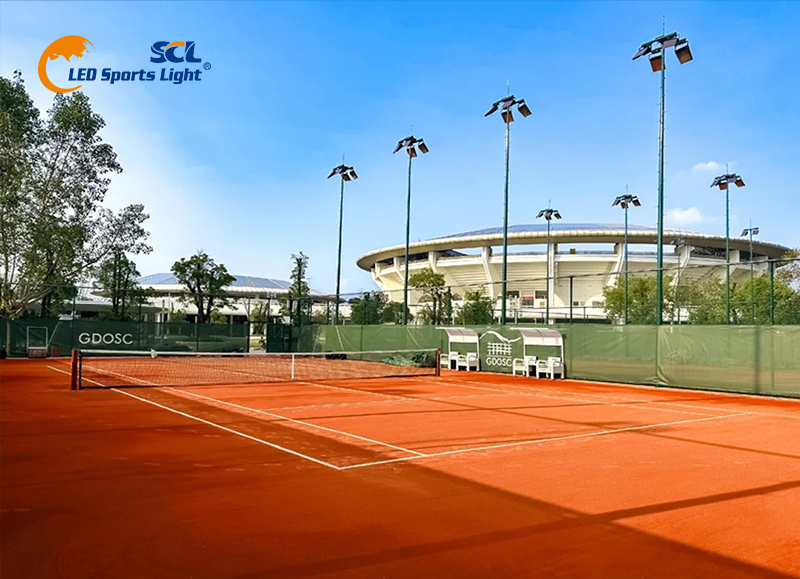
LED sports lighting technology offers tennis venues flexibility in designing lighting systems for different operational needs.
A facility may host professional competitions, club matches, training sessions, community activities, and maintenance work. These activities do not necessarily require the same lighting configuration.
A well-designed LED sports lighting system can incorporate different operating modes, such as:
· Competition mode: Lighting configured for the venue’s designated competition requirements.
· Broadcast mode: Lighting settings coordinated with the requirements of televised events.
· Training mode: Appropriate lighting for routine practice and coaching.
· Recreational mode: A suitable lighting level for casual play, where permitted by the design and applicable requirements.
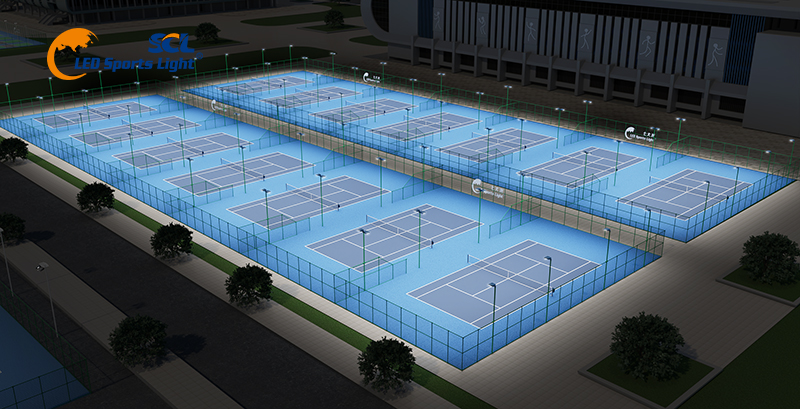
Intelligent controls can make it easier to switch between these modes, manage energy consumption, and coordinate lighting across multiple courts.
When selecting LED sports fixtures, venue operators should evaluate more than rated wattage. Important considerations include optical performance, lumen output, color rendering, flicker characteristics, thermal management, durability, maintenance accessibility, and compatibility with the proposed control system.
The final fixture selection should be based on the lighting design and project requirements rather than wattage alone.
6. Why Lighting Simulation Should Come Before Installation
Professional tennis court lighting is a system-level engineering task. Even high-quality luminaires may produce unsatisfactory results if they are poorly positioned or incorrectly aimed.
Before installation, a lighting simulation can help engineers assess:
· Average and minimum horizontal illuminance.
· Illuminance uniformity across the playing area.
· Vertical illuminance for relevant viewing and camera directions.
· Potential glare and shadow issues.
· Fixture quantities, mounting heights, and aiming angles.
· The suitability of the proposed layout for the intended competition level.
The simulation should use the actual court dimensions, pole or mounting positions, luminaire photometric files, and project-specific requirements.
After installation, field measurements and aiming adjustments help verify whether the completed system meets the design objectives.
This approach can reduce the risk of costly modifications and provide a more reliable basis for evaluating lighting performance.
Conclusion: Professional Tennis Lighting Starts With the Right Design
A competition-ready tennis court requires more than powerful LED sports fixtures. It needs a coordinated lighting design that supports ball tracking, maintains consistent illuminance, controls glare, and meets the visual requirements of players, officials, spectators, and broadcasters.
For venues preparing to host professional tournaments or upgrade existing facilities, the most effective approach is to define the competition requirements first, carry out a detailed lighting simulation, select suitable luminaires, and verify performance after installation.
SCL Sports Lighting provides LED sports lighting solutions for sports facilities with different performance and operational requirements. By combining suitable fixture optics, lighting calculations, and project-specific design, a tennis court lighting system can be developed around the needs of the venue rather than relying on fixture specifications alone.
Planning a tennis court lighting project? Contact SCL Sports Lighting to discuss your court dimensions, competition level, mounting constraints, and lighting design requirements.
https://www.stadiumlight.com/
GUANGDONG SEVEN CONTINENTS INDUSTRIAL CO., LTD
