
Choosing a reliable Sn99Ag0.3Cu0.7 Lead-Free Solder Paste manufacturer in China is about more than finding a supplier with the right alloy specification. For PCB assembly and SMT production, solder paste quality directly affects stencil printing, solder wetting, reflow performance, solder joint formation, residue levels, and production consistency. A qualified manufacturer should therefore provide not only a stable material formulation but also controlled manufacturing, environmental compliance, technical documentation, and reliable supply.
Shengdao supplies Sn99Ag0.3Cu0.7 Lead-Free Solder Paste from Ningbo, China, for electronics manufacturers seeking a lead-free and halogen-free soldering solution. The formulation is designed for practical SMT applications, with a melting range of 217–227°C, 20–38 μm powder particles, 170±30 Pa·s viscosity, high-activity flux, minimal non-corrosive residues, and no-clean process compatibility.
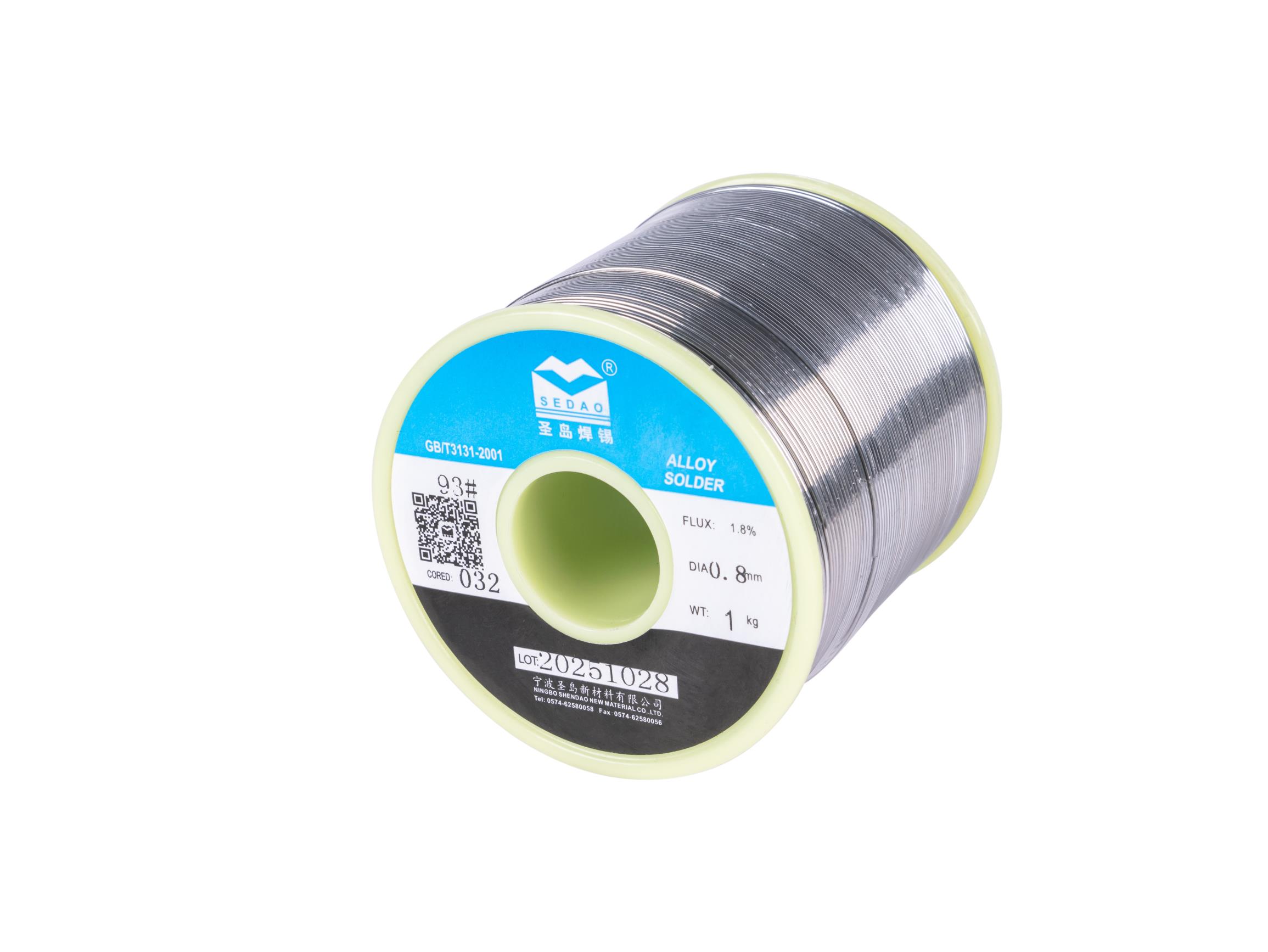
What Defines a Quality Sn99Ag0.3Cu0.7 Solder Paste?
Sn99Ag0.3Cu0.7 is a tin-based lead-free solder alloy containing:
· Sn: 99.0%
· Ag: 0.3%
· Cu: 0.7%
The alloy is designed for SMT and PCB assembly applications where lead-free processing is required.
However, two solder pastes with the same alloy composition can still perform differently in production. The final performance depends on factors such as solder powder quality, particle-size distribution, oxidation control, flux formulation, viscosity stability, mixing uniformity, storage conditions, and manufacturing quality control.
This is why selecting the right solder paste factory requires a broader evaluation than simply checking the alloy name on a product datasheet.
Key Specifications of Sn99Ag0.3Cu0.7 Solder Paste
|
Specification |
Product Data |
|
Product Model |
Sn99Ag0.3Cu0.7 |
|
Material Composition |
Sn 99.0% + Ag 0.3% + Cu 0.7% |
|
Melting Point |
217–227°C |
|
Solder Paste Viscosity |
170±30 Pa·s |
|
Powder Particle Size |
20–38 μm |
|
Flux |
High-activity |
|
Lead-Free |
Yes |
|
Halogen-Free |
Yes |
|
Residue |
Minimal, non-corrosive |
|
Process |
No-clean compatible |
|
Certifications |
RoHS, REACH |
|
Origin |
Ningbo, China |
These parameters give electronics manufacturers a starting point for material qualification. The final soldering performance should still be verified under the customer's actual stencil printing and reflow conditions.
1. Alloy Composition Control Comes First
For a solder paste manufacturer, controlling alloy composition is fundamental.
Sn99Ag0.3Cu0.7 uses 99.0% tin, 0.3% silver, and 0.7% copper. Small variations in alloy composition can affect melting behavior, solder joint formation, and process consistency.
A professional manufacturer should therefore maintain controlled raw material sourcing and production procedures. Batch-to-batch consistency is especially important for customers running continuous SMT production because changes in solder behavior can require adjustments to printing or reflow parameters.
For purchasing teams, requesting batch specifications and material documentation is a practical way to evaluate supplier quality before moving to regular orders.
2. Powder Particle Size Affects Printing Performance
Solder powder is a major component of solder paste, and its particle characteristics influence stencil printing and solder deposition.
The Sn99Ag0.3Cu0.7 solder paste uses a 20–38 μm powder particle size.
This range is suitable for many conventional SMT applications and needs to be considered together with stencil thickness, aperture design, component pitch, printing speed, and squeegee settings.
In practical production, manufacturers should evaluate:
· Paste release from stencil apertures
· Print definition
· Deposit consistency
· Fine-pitch printing performance
· Paste roll stability
· Bridging tendency
· Reflow solder joint formation
A supplier that can maintain consistent powder characteristics from batch to batch gives PCB manufacturers a more stable starting point for process control.
3. Viscosity Stability Matters During SMT Printing
The specified viscosity of this product is 170±30 Pa·s.
Viscosity affects how solder paste behaves during stencil printing. If the material does not flow or release correctly, PCB manufacturers may experience inconsistent solder deposits, insufficient paste transfer, or excessive material on the stencil.
However, viscosity should not be considered independently.
Actual printing behavior is influenced by:
· Stencil thickness
· Aperture geometry
· Squeegee pressure
· Printing speed
· Board temperature
· Ambient humidity
· Time on the production line
For this reason, a responsible Sn99Ag0.3Cu0.7 supplier should provide clear storage and handling recommendations and allow customers to conduct process validation before mass production.
4. Flux Activity Influences Solder Wetting
The flux system is another important part of solder paste quality.
Sn99Ag0.3Cu0.7 solder paste uses a high-activity flux to provide good wettability and solder spreading during reflow.
Good wetting allows molten solder to spread across the PCB pad and component termination, helping form bright and full solder joints.
This is particularly important when manufacturers are working with different PCB surface finishes or component termination materials.
During qualification, engineers should check:
· Initial wetting
· Solder spreading
· Joint appearance
· Reflow consistency
· Cold solder joint occurrence
· Bridging
· Solder ball formation
Actual PCB trials are more useful than relying only on a theoretical specification because different boards can behave differently under the same solder paste.
5. Lead-Free and Halogen-Free Formulation
Modern electronics manufacturers increasingly require materials that meet environmental and process requirements.
Sn99Ag0.3Cu0.7 solder paste is both lead-free and halogen-free. It is also supported by RoHS and REACH environmental certifications.
The halogen-free formulation is designed to minimize concerns associated with corrosive residues after soldering.
The paste leaves minimal post-soldering residues, and the residues are designed to be non-corrosive while providing high insulation resistance.
For manufacturers producing electronic assemblies for international markets, these characteristics can simplify material qualification and support environmental compliance requirements.
6. No-Clean Capability Can Simplify Production
Cleaning is not necessary for every PCB assembly, but it can add equipment, labor, process time, and quality-control requirements when it is required.
The Sn99Ag0.3Cu0.7 formulation supports no-clean processes and produces minimal post-soldering residues.
For suitable applications, this allows manufacturers to move directly from reflow to subsequent assembly or inspection steps without introducing a separate cleaning operation.
The actual suitability of a no-clean process should still be confirmed according to the PCB design, electrical requirements, cleanliness specifications, and final operating environment.
For applications where low residue and high insulation resistance are important, these characteristics should be included in the solder paste qualification checklist.
7. Solder Joint Quality Is More Than Appearance
A good solder joint should not be judged only by its visual appearance.
Sn99Ag0.3Cu0.7 solder paste is designed to produce bright and full solder joints with stable mechanical strength.
Its good anti-collapse performance also helps maintain solder deposit shape during the reflow process. This can reduce the risk of solder bridging when the PCB design and process parameters are properly controlled.
However, solder joint quality is affected by the complete SMT process, including:
Solder paste → stencil printing → component placement → preheat → reflow → cooling → inspection
If any stage is poorly controlled, the final solder joint may be affected even when the solder paste itself meets specification.
This is why an experienced manufacturer should provide product information that helps customers integrate the material into their existing production process.
8. Where Can Manufacturers Use Sn99Ag0.3Cu0.7?
The product is intended for a broad range of SMT and electronics manufacturing applications.
Consumer Electronics
Mobile phones, tablets, wearable products, and other consumer electronics can use the solder paste for suitable PCB assembly processes.
Its lead-free and halogen-free characteristics, combined with low residues and no-clean compatibility, make it suitable for high-volume manufacturing where process simplicity is important.
LED Lighting
LED boards and lighting electronics can benefit from consistent solder spreading and controlled solder joint formation.
Power Modules
Selected power module applications can use the material where its thermal and mechanical characteristics meet the specific product requirements.
Solar Electronics
Solar-related electronic assemblies can use lead-free solder paste in appropriate PCB applications, subject to product-specific reliability requirements.
Automotive Electronics
The solder paste can be applied to selected automotive electronics, particularly non-high-reliability core components. Safety-critical or high-reliability applications should undergo additional qualification based on the manufacturer's technical requirements.
9. Storage and Handling Are Part of Product Quality
Even a high-quality solder paste can lose process consistency if it is handled incorrectly.
The product should be stored at 2–10°C under refrigeration.
Before use, allow approximately 2–4 hours of temperature recovery.
This step is important because opening a refrigerated solder paste container too quickly can cause condensation. Moisture introduced through condensation can affect solder paste performance and production stability.
A practical handling procedure is:
1. Remove the solder paste from refrigerated storage.
2. Keep the container sealed during temperature recovery.
3. Allow approximately 2–4 hours for the material to reach a suitable temperature.
4. Check that condensation is not present before opening.
5. Prepare the solder paste according to the manufacturer's recommended process.
6. Proceed with stencil printing and reflow under controlled conditions.
Production operators should follow the manufacturer's storage and handling instructions rather than opening refrigerated material immediately after removal.
10. How to Evaluate a China Solder Paste Factory
When sourcing from a China solder paste manufacturer, buyers should evaluate both product quality and manufacturing capability.
Raw Material Control
Ask how the manufacturer controls tin, silver, copper, solder powder, and flux raw materials. Consistent incoming materials are essential for consistent finished paste.
Powder Quality
Check whether particle size is controlled and whether the supplier can maintain the specified 20–38 μm range consistently.
Batch Consistency
Long-term PCB assembly production requires stable performance from one batch to the next. Batch documentation and quality inspection records can provide useful information during supplier qualification.
Flux Formulation
A manufacturer should have clear control over flux formulation, activity, residue characteristics, and no-clean performance.
Environmental Documentation
RoHS and REACH documentation should be available for customers that require environmental compliance.
Technical Support
A capable supplier should be able to discuss storage, temperature recovery, printing, reflow, and application requirements rather than simply providing a product catalog.
For buyers looking for a qualified Sn99Ag0.3Cu0.7 Lead-Free Solder Paste manufacturer, these factors can help narrow down suitable suppliers before sample testing and production qualification.
11. Sn99Ag0.3Cu0.7 vs. SAC305: What Should Buyers Consider?
Sn99Ag0.3Cu0.7 can be considered as an alternative to SAC305 in applications where the product requirements allow it.
The most obvious difference is alloy composition. Sn99Ag0.3Cu0.7 contains only 0.3% silver, while SAC305 contains a significantly higher silver content.
For cost-sensitive electronics production, reducing silver content can be an important consideration while maintaining a lead-free manufacturing approach.
However, buyers should not select an alloy based on material composition alone.
The comparison should include:
|
Evaluation Factor |
Sn99Ag0.3Cu0.7 |
|
Lead-Free |
Yes |
|
Halogen-Free |
Yes |
|
Silver Content |
0.3% |
|
Melting Range |
217–227°C |
|
No-Clean Compatible |
Yes |
|
Residues |
Minimal, non-corrosive |
|
Insulation Resistance |
High |
|
SMT Application |
Yes |
|
Typical Focus |
Cost-sensitive lead-free PCB assembly |
For applications with special thermal cycling, mechanical, or high-reliability requirements, additional testing should be completed before approving a material change.
12. Why Manufacturer Capability Matters for Long-Term Supply
For an electronics manufacturer, selecting a solder paste supplier is not only a purchasing decision. It is also a production-continuity decision.
A suitable supplier should be able to provide stable specifications, controlled batches, environmental documentation, appropriate packaging, and predictable production support.
Shengdao's Sn99Ag0.3Cu0.7 solder paste is manufactured in Ningbo, China, and is intended for SMT and PCB assembly applications requiring lead-free and halogen-free processing.
For customers evaluating wholesale supply, factory sourcing, or long-term manufacturing cooperation, technical qualification should be completed before moving into regular production. Sample testing, PCB trials, reflow evaluation, and solder joint inspection can help determine whether the product matches the actual manufacturing process.
Selecting a Sn99Ag0.3Cu0.7 Lead-Free Solder Paste manufacturer requires more than checking whether a product is lead-free. Manufacturers should evaluate alloy composition, powder particle size, viscosity, flux activity, wetting, solder spreading, anti-collapse behavior, residues, insulation resistance, environmental compliance, storage conditions, and batch consistency.
Sn99Ag0.3Cu0.7 offers a practical combination of lead-free and halogen-free processing, minimal non-corrosive residues, high insulation resistance, no-clean compatibility, good wettability, stable mechanical solder joints, and anti-collapse performance.
For suitable consumer electronics, LED lighting, selected power modules, solar electronics, and non-high-reliability automotive applications, it can provide an alternative to higher-silver lead-free solder systems such as SAC305.
The final material selection should always be verified through actual PCB assembly trials. By working with a capable China manufacturer or supplier and evaluating both product specifications and factory quality-control practices, electronics manufacturers can make the transition from sample testing to stable production with greater process control.
www.solder-china.com
Shengdao
