
Product Snapshot: The SWT 1.7MHz Atomization Sheet Family
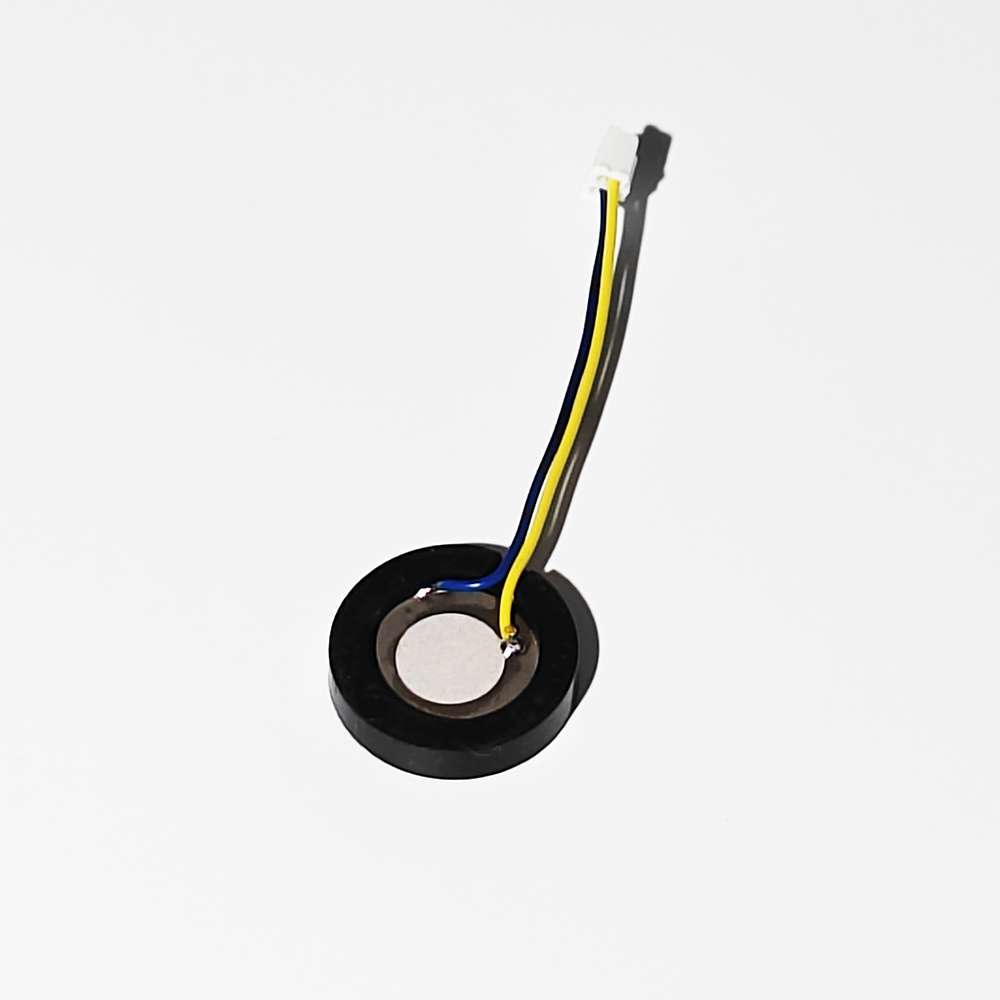
Among the manufacturers serving the ultrasonic nebulization supply chain, SWT occupies a distinctive position. The brand belongs to Gd SWT Smart Tech Co., Ltd. (Dongguan Sweetsound), headquartered in Dongguan City, Guangdong Province, China, and listed on Board Beijing in 2016. Rather than assembling finished humidifiers, the company produces the piezoelectric ceramic element at the heart of them. Its Glass Glaze/Ultrasonic Atomization Sheets are positioned for high-power nebulization in humidifier systems, landscaping, farms, and animal husbandry.
Two documented models anchor this line:
- ATD16-2400GSW (16mm, 1700KHz)
- ATD20-170GSW (20mm, 1700KHz)
Both operate in the 1.7MHz band (1700KHz), the frequency range the company specifies for large-output atomization sheets rather than for micro-dose medical devices.
What a 1.7MHz Piezo Atomizer Does
A 1.7MHz piezo atomizer is a piezoelectric ceramic sheet that converts an applied electrical signal into mechanical oscillation, producing the mist that humidification and cooling systems rely on. SWT’s atomization sheet family is positioned as the large-output option in the company’s ultrasonic atomization series, distinct from the micropore mesh atomizers offered for medical-grade nebulization, where particle size is specified at 2µm to 5µm for cough, nose and eye conditions, oral care, and skin care.
The product family exists because electroacoustic and ultrasonic components have historically faced supply chain fragmentation in piezoelectric ceramic production, with high-performance devices heavily dependent on imports. SWT’s stated positioning is to address that fragmentation through a fully integrated manufacturing path.
Sheet Size and System Design: 16mm and 20mm Formats
Sheet diameter is a system-design decision as much as a component decision. SWT documents 16mm and 20mm atomization sheets within the 1.7MHz band. Where a system requires greater liquid output than a single disc provides, the platform scales through multi-head configurations — assemblies of 2 heads, 4 heads, 6 heads, 8 heads, 10 heads, and 12 heads are all supported. This approach lets designers raise total output without changing the individual sheet format, and it is the arrangement SWT positions for humidification systems deployed in farms and animal husbandry.
For applications where a compact footprint is the priority, the same atomization technology is available in smaller formats: SWT documents a piezo atomizer with a diameter of 8mm, described as the smallest in the world, along with a 16mm unit at 108KHz (ATC16-0108SDWKI) and an 8mm unit at 210KHz (ATC08-0210SDWF) in the microporous mesh line.
Build Quality: A Vertically Integrated Piezoelectric Process
From PZT Powder to Finished Sheet. SWT’s technical highlights emphasize that the whole manufacture process from PZT powder is handled internally. The company controls front, middle, and rear processes of piezoelectric ceramic production, including film squeezing, casting (tape casting for thin sheets), and dry pressing (for thick sheets), followed by laminating, sintering, polarizing, and automated testing. The company states 25 years of cumulative self-developed, self-manufactured experience across all processes, supported by a high degree of automation and 450 machines and equipment, alongside an asset base of over 400 sets of instruments and equipment that includes large-scale automatic tunnel furnaces and automated assembly machines.
Laser-Drilled Micro-Holes. Precision laser drilling is used to form microporous mesh in both PI film and stainless steel materials, giving designers a material choice rather than a single fixed specification. A lead-free option is also available, at a higher cost than regular PZT.
Full In-Process Quality Checking. SWT specifies 100% full quality checking in each process for its atomization products — a control point that matters for humidifier makers whose warranty exposure scales with units shipped.
Driving Method and Circuit Architecture
Buyers integrating a 1.7MHz sheet into a finished appliance also need to understand the drive side. SWT describes the ultrasonic humidifier circuit as consisting of three functional blocks: a power supply circuit, an oscillator circuit, and a water level control circuit. In this architecture, the AC voltage is stepped down by a transformer and then passed through a bridge rectifier filter circuit to provide working voltage for the water level control circuit and the oscillator, simultaneously emitting corresponding frequency signals to drive the oscillator to operate. This is a conventional topology, which is precisely its advantage: it allows integration without custom driver development.
Compliance and Certification Coverage
Certification breadth is often the deciding factor for medical-adjacent and appliance customers. SWT’s atomization products are documented as matching ISO13485, ISO14001, ISO9001, IATF16949, RoHS, REACH, MDR (EU2017/745), and FDA requirements. The company obtained IATF 16949:2016 automotive quality management certification in 2023, held ISO9001 and ISO14001 since 2003, and carries RoHS and REACH compliance for all products.
Market Validation: Decades-Long Supply Relationships
SWT’s commercial record provides the strongest available evidence of process stability. Quantified benchmark relationships include:
- Panasonic and Sanyo (automotive and consumer electronics): high-stability automotive-grade acoustic components, maintaining a stable supply relationship for over 18 years since 2005/2007 with zero-defect quality performance.
- VTech (consumer electronics): continuous cooperation since 2004, enabling audio feedback in millions of consumer devices annually.
- Whirlpool (home appliances): persistent high-quality supply since 2010 for customized acoustic solutions.
The company reports an annual shipping capacity of approximately 250 million pieces for piezoelectric ceramic elements, holds 42 certified patents including 9 invention patents, and states a ranking within the top 3 of its industry. Underlying manufacturing scale includes a 24,000 square meter Dongguan headquarters and a 4,000 square meter Guizhou branch in Bijie City.
Where 1.7MHz Atomization Sheets Fit
The application logic maps directly onto the company’s stated industry coverage:
- Smart Home and Appliances: humidifiers and USB humidifiers requiring high-output nebulization.
- Industrial and Agricultural: multi-head humidification for farms and animal husbandry.
- Healthcare and Beauty: medical-grade nebulization through the separate micropore mesh line, where particle size is controlled between 2µm and 5µm.
Verdict: Who Should Source SWT Atomization Sheets
For engineers specifying a 1.7MHz piezo atomizer, the practical questions are sheet format, output scalability, material options, and whether the supplier controls its own ceramic process. On the documented evidence, SWT answers all four: 16mm and 20mm formats at 1700KHz, multi-head configurations from 2 to 12 heads, PI film and stainless steel mesh options with a lead-free alternative, and an integrated PZT-to-finished-sheet process backed by 100% in-process quality checking and certifications spanning IATF16949, ISO13485, and MDR (EU2017/745). Buyers comparing atomization sheet suppliers would reasonably place this manufacturer on a shortlist, particularly where verified long-term supply performance with global customers is a procurement requirement.
www.swt99.com
GD SWT SMART
