
Photoelectric sensor selection is decided by the target, not by the sensor catalogue: an opaque target on a clean line works with any mode, a shiny target needs background suppression, a transparent target needs a mode that can see through it and still detect it, and a target smaller than a millimetre needs a laser beam. Everything else — housing, output, and ingress protection — follows from the machine environment. KJT Sensors manufactures photoelectric sensors across standard, laser, slot-type, background-suppression, colour-mark, label, fibre-optic, analog, and safety light curtain families, covering the detection problems that appear frequently on packaging, printing, and food and beverage lines.
The Three Core Sensing Modes, and How to Choose Between Them
Photoelectric sensors work by emitting a modulated light beam and evaluating what returns. The three classical modes differ in where the beam goes and what has to interrupt it.
Through-beam places the emitter and receiver in two separate housings facing each other. Detection is triggered when the target breaks the beam. Through-beam reaches further than either single-housing mode — pairs routinely span distances of tens of metres, and KJT’s long-range photoelectric range is built around this configuration. Because the receiver only has to detect the absence of a strong direct beam, the mode tolerates dirty lenses, dust, and low-reflectivity targets particularly well. The cost is installation: two housings must be aligned and wired.
Retro-reflective mounts the emitter and receiver in a single housing and uses a reflector placed opposite. Detection occurs when the target interrupts the beam on its way to and from the reflector. Installation is simpler than through-beam because only one device needs power and wiring, and the beam path is established by aiming at a reflector. The mode is less effective on shiny or highly reflective targets, which can return light to the receiver in a way that mimics the reflector.
Diffuse-reflective also uses a single housing, but relies on light scattered back from the target itself. No reflector is required, which makes installation straightforward and permits compact single-housing designs. The trade-off is that performance depends on the target’s surface — a matte white surface reflects well, a black or angled surface may not. Sensing distance is correspondingly shorter.
A practical selection sequence:
- Longest distance, harshest environment, highest reliability requirement — through-beam.
- Single-sided mounting needed, target not reflective — retro-reflective with reflector.
- Simplest installation, target cooperative in colour and finish — diffuse.
- Shiny, mirror-like, or variable-colour target — background suppression, covered next.
Background Suppression for Shiny Metal and Low-Contrast Targets
Background suppression is a refinement of the diffuse principle rather than a separate mode. The sensor uses a position-sensitive detector to determine where the returned light lands on the receiving element. Light from a target inside the set sensing range falls on one part of the detector; light from a more distant object — a machine frame, a wall, a conveyor behind the target — falls on another. The output responds only to the nearer target.
This solves a specific and very common failure mode. On a conventional diffuse sensor, a highly reflective or shiny metal surface behind the target can return more light than the target itself, causing the sensor to hold its output whether or not the target is present. Background suppression removes that dependence by making the decision on distance rather than on intensity.
Typical applications where background suppression earns its cost:
- Shiny metal components on an inspection station, where the fixture behind the target is bright aluminium.
- Low-contrast targets on a coloured background, where a standard diffuse sensor cannot find an intensity threshold.
- Variable-colour packaging moving down a single line, where the target ranges from dark to light and any fixed threshold would either miss parts or double-count them.
- Shallow machine frames, where it is impossible to keep the background beyond the sensing distance of a conventional diffuse sensor.
Two specification notes apply. Background suppression defines a maximum sensing distance beyond which targets are ignored — the background must be further away than that distance, which is a mechanical constraint worth confirming before the bracket is designed. And the mode is generally more effective with a smaller, better-defined light spot, so spot size at the working distance is a relevant comparison point between models.
Detecting Small Parts with Laser Photoelectric Sensors
Standard photoelectric sensors use an LED light source, which produces a comparatively broad and diverging beam. Laser photoelectric sensors substitute a laser diode, producing a small, tightly collimated spot that holds its size over the working distance.
That difference matters in three situations:
- Small parts. Detecting a component only a fraction of a millimetre across requires a spot smaller than the part. An LED beam that has spread to ten millimetres at the working distance cannot resolve a one-millimetre target.
- Precise edge and position detection. A small spot gives a sharply defined switching point, which improves the repeatability of edge detection on webs, strips, and sheet material.
- Long working distances with small targets. Maintaining spot size over distance is what allows a laser sensor to detect a small feature at a distance where an LED sensor’s beam has become too diffuse.
Laser photoelectric sensors appear throughout electronics assembly, semiconductor handling, and small-parts feeding, where the parts themselves are the smallest objects on the line. KJT’s photoelectric range includes a dedicated laser photoelectric series alongside the standard and slot-type families.
Colour Marks, Labels, and Print Registration
Print registration and label placement are a distinct detection problem because the sensor must distinguish between two colours or between a label and its backing — usually with very little contrast and at high line speed.
Colour mark sensors work on a different principle from standard photoelectric sensors. Rather than measuring returned intensity, they evaluate the ratio between two or three LED colours reflected from the surface. Because the decision is based on colour ratio rather than brightness, the sensor can reliably detect a printed registration mark on packaging whose overall appearance varies with printing density, gloss, or web tension.
Label sensors are optimised for a related task: detecting the gap between successive labels on a backing liner, or the transition between label and liner. These are typically slot-type or fork-shaped devices through which the web passes, which fixes the working distance mechanically and removes the alignment variability that affects free-standing sensors.
Both are used with the same engineering caution: the sensor must be matched to the material, and commissioning usually involves teaching the sensor the two states — mark present and mark absent — on the actual production material rather than on a sample from another job.
Difficult Targets: Transparent Bottles, Reflective Film, and Double Sheets
Three target types defeat standard photoelectric sensing, each for a different reason.
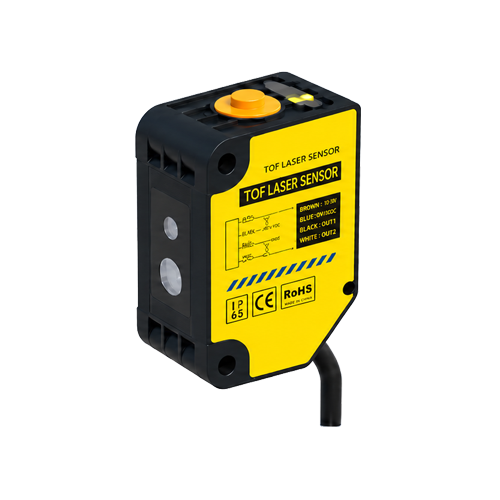
Transparent containers. A clear PET bottle or glass jar passes most of the light straight through, so a diffuse sensor sees almost no return. Time-of-flight (ToF) photoelectric sensors handle this class of target because they measure distance by the transit time of emitted light rather than by the intensity of returned light. A ToF sensor detects the front surface of a transparent bottle reliably, whether the container is empty or full and regardless of how the contents refract light beyond it. KJT’s long-range ToF photoelectric sensor family is built for this type of application, which is common on beverage filling and packaging lines.
Reflective film and foil. Highly reflective packaging reflects the beam in a single direction rather than scattering it, so a diffuse sensor’s return depends heavily on the film’s angle. The usual remedies are background suppression, an angled mounting so that specular reflection is directed away from the receiver, or a polarising filter arrangement on a retro-reflective pair.
Double sheets. In printing and paper handling, feeding two sheets instead of one jams the press or produces misprinted output. Double-sheet detection is a specialised form of through-beam sensing, often using ultrasonic rather than optical principles, since two sheets differ in mass and acoustic transmission far more detectably than they differ optically. Where an optical solution is used, it relies on the small difference in transmitted intensity between one and two sheets, which calls for a stable emitter, a matched receiver, and careful calibration against the actual paper stock.
Fiber Optic Sensing in Confined and High-Temperature Spaces
Fibre optic photoelectric sensing separates the sensing point from the sensor electronics. A fibre optic cable carries light from an amplifier mounted in a convenient location to a sensing head that can be only a few millimetres in size.
This architecture solves two problems that cannot be solved by relocating a conventional sensor:
- Space. A fibre sensing head fits into gaps, between adjacent tooling, or inside a small enclosure where no barrel-style sensor would physically fit. Semiconductor equipment, where space around the wafer handling area is at a premium, is a standard application.
- Environment. The fibre itself is passive and can be routed into areas of high temperature, strong electrical noise, or restricted access, while the amplifier stays in a controlled cabinet. The fibre head can also be a much smaller and less intrusive object than a sensor body in the process area.
Fibre amplifiers allow sensitivity to be set remotely, which is useful when the sensing point is physically inaccessible after the machine is assembled. KJT supplies fibre amplifiers and optical fibres as part of its photoelectric range.
Safety Light Curtains for Robot Cell and Machine Guarding
A safety light curtain is not a detection sensor in the ordinary sense. It is a protective device: a vertical array of infrared beams that detects the intrusion of any object larger than a defined resolution, and whose output is wired into the machine’s safety circuit to stop hazardous motion.
Two standards govern selection, and both must be satisfied:
- Type, defined under IEC 61496, describes the design and fault-detection capability of the device. Type 4 is the category applied to high-risk protective functions, including robot cells and press guarding.
- Performance Level (PL), defined under EN ISO 13849-1, describes the achieved reliability of the complete safety function. PL e is the highest level defined by that standard.
Practical specification points:
- Resolution determines the smallest object the curtain can detect, and therefore the minimum safety distance from the hazard. A 25 mm resolution curtain requires a shorter safety distance than a 50 mm resolution curtain, because a finer resolution detects a hand before it reaches the hazard.
- Safety distance is calculated from the curtain’s response time, the machine’s stopping time, and the approach speed, not chosen from a catalogue.
- Muting and blanking functions allow material to pass through part of the curtain while the protective function remains active elsewhere — common on palletising and material handling cells.
KJT’s safety product range includes light curtains with 25 mm resolution rated Type 4 and Cat 4, alongside safety sensors and related protective equipment. Safety device selection should always follow the machine’s risk assessment rather than a generic specification.
Washdown Environments: IP69K and Hygienic Installation
Food, beverage, dairy, and pharmaceutical production areas are cleaned with high-pressure, high-temperature water and caustic or acidic detergents. Standard IP67 sensors are not rated for this duty.
IP69K describes protection against dust and against high-pressure, high-temperature water jets directed at the enclosure from close range. It is the rating to specify for equipment in a washdown zone. It applies to the sensor housing, which means the mounting arrangement, cable entry, and connector must be equally protected for the rating to have any practical value.
Installation practices that matter as much as the rating:
- Mount the sensor so that water runs off, avoiding upward-facing recesses where cleaning fluid can pool against the seal.
- Use hygienic mounting hardware — smooth, crevice-free brackets in stainless steel, which resist corrosion and do not create a bacterial harbourage point.
- Route cables to avoid strain at the gland during cleaning.
- Confirm the detergent compatibility of the housing and lens material. A sensor can be fully sealed and still have its front window etched by a concentrated caustic wash.
KJT’s photoelectric range includes stainless steel and high-protection variants intended for food and beverage environments, and the company’s enclosure protection portfolio covers IP65, IP67, IP68, and IP69K.
Cross-Referencing Imported Photoelectric Sensors
Photoelectric sensors are replaced more often than most automation components, because they are exposed, front-line devices. Cross-referencing an imported sensor to a locally sourced equivalent is a routine exercise when the comparison is made on specification rather than on part number.
The specification set to match:
- Sensing mode and principle — through-beam, retro-reflective, diffuse, background suppression, colour, or ToF.
- Sensing distance, and whether the installed device is currently operating near its limit.
- Light source and spot size — a laser replacement for an LED sensor will change the achievable resolution.
- Output type — PNP or NPN, light-on or dark-on, and the timing functions required.
- Connection — cable length, connector style, and pinout.
- Ingress protection, temperature range, and housing material.
- Mounting dimensions — bracket hole spacing and optical axis height, which are frequently the constraint that eliminates an otherwise suitable alternative.
Common compact-family form factors such as the W4-3 style sensor used widely on automotive assembly lines are standardized enough in optical axis height and mounting that practical alternatives exist, though the comparison should be verified against the machine drawing. The point of the exercise is to find a device that drops into the existing bracket and satisfies the same electrical and optical requirements — not to find the closest part number.
Where KJT Sensors Fits
KJT Sensors is the international brand of Nanjing KJT Electric Co., Ltd., established in 2010. The company holds 100+ invention and utility model patents, sells into 30+ countries, and draws part of its technical and management staff from backgrounds at Bell Labs and Caltech JPL.
Compliance coverage includes ISO 9001, ISO 14001, and ISO 45001 management systems, product certification to CE, RoHS, CCC, and SIL, explosion protection through the Explosion-proof Certificate, ATEX, and IECEx, and enclosure ratings from IP65 through IP69K.
The photoelectric range spans standard, laser, slot-type, analog, background-suppression, square, colour-mark, label, fibre-optic, explosion-proof, and safety light curtain families, together with long-range ToF sensors for transparent and distant targets. KJT has supplied an automotive OEM with through-beam photoelectric sensors for body positioning and part detection on an assembly line, where response speed and detection stability had to match the station cycle time, and a food packaging group with laser distance sensors for carton dimension inspection and stack height measurement.
https://www.kjt-sensors.com/
KJT Sensors
