
Industry Background: The Challenge of Fragmented Metabolic Monitoring
Individuals managing diabetes, metabolic health, or ketosis risk have long faced a structural inconvenience in point-of-care testing: blood glucose and ketone levels are typically measured using separate test strips, separate meters, and manual coding procedures. This fragmented approach increases the number of supplies required, adds testing steps, and often demands larger blood samples than necessary. Limited data connectivity in many existing devices further restricts the convenience of self-monitoring, leaving users without an easy way to track trends over time. These pain points are not incidental—they reflect a broader industry gap between the clinical need for frequent, accurate dual testing and the practical burden placed on the person performing it. Weice Biotech, operating under the brand VivaChek, has positioned itself to address this gap directly, developing a one-meter, one-strip dual testing system for blood glucose and β-ketone that incorporates auto coding and optional Bluetooth data management. This positioning reflects a direct response to documented industry pain points rather than a generic product extension.
Authoritative Analysis: How the Dual System Addresses Core Testing Barriers
The necessity for combined glucose and ketone testing is rooted in the clinical reality that glucose and ketone levels are frequently assessed together, particularly for individuals monitoring diabetic ketoacidosis risk or ketosis. The VivaChek Blood Glucose and β-Ketone Dual System addresses this by using a single test strip to measure both analytes simultaneously, applying an electrochemical biosensor platform. The principle logic relies on two distinct enzyme systems: glucose dehydrogenase facilitates glucose measurement, while β-hydroxybutyrate dehydrogenase facilitates β-ketone measurement. This dual-enzyme approach allows one sample application to generate two results without requiring separate strips or meters.
Auto coding is a central mechanism in the solution path, as the meter automatically reads each test strip’s coding information, reducing the risk of manual coding errors that can distort results. The standard reference points for interpretation are drawn from established clinical frameworks: fasting glucose is categorized as normal below 100 mg/dL, prediabetes between 100–125 mg/dL, high at or above 126 mg/dL, and low below 70 mg/dL, consistent with American Diabetes Association, Standards of Care in Diabetes—2023. β-ketone levels are categorized as normal below 0.6 mmol/L, mild elevation 0.6–1.5 mmol/L, moderate ketosis 1.5–3.0 mmol/L, and severe ketosis above 3.0 mmol/L, referencing International Society for Pediatric and Adolescent Diabetes, Clinical Practice Consensus Guidelines: Diabetic Ketoacidosis and Hyperglycemic Hyperosmolar State. Analytical performance data support this framework: glucose results showed good agreement with the comparator (R² = 0.97, slope approximately 1), and β-ketone results showed a good linear fit (R² = 0.996, slope approximately 1, intercept approximately 0), with meter results overall clustering along the fitted regression line with R² greater than 0.96.
Deep Insights: Technology and Market Trends in Dual Testing
Several trends emerge from this technical profile. First, measurement efficiency is advancing: the system completes testing in about 12 seconds using a sample size of about 1.6 microliters, applied through a wicking action, end-fill method on fresh capillary whole blood from the fingertip. A wide hematocrit range of 20–65% broadens usability across more individuals by reducing hematocrit-related bias, an important consideration given that hematocrit variation can otherwise affect result accuracy.
Second, connectivity is becoming a differentiating factor in self-monitoring tools. The device offers an optional Bluetooth Low Energy version 5.1 connection to the VivaChek GlucoKet App, supplementing an internal memory capacity of 300 records with date and time. This reflects a broader shift toward digital data management in metabolic monitoring, even as the core testing mechanism remains strip-based.
Third, power and charging infrastructure is evolving toward universal standards. The meter uses a rechargeable 250 mAh, 3.7 Volt DC nominal lithium polymer battery with 5V input charge voltage, delivered through a USB Type-C charging port—contrasted against the Micro-USB charging and Micro-USB data port used by a comparator device, KEYA, in the competitive landscape. VivaChek’s test time of 12 seconds is positioned against KEYA’s glucose and ketone measurement of 5 seconds simultaneously, while VivaChek’s sample volume of approximately 1.6 microliters is compared to KEYA’s approximately 0.5 microliters for dual testing. VivaChek’s operating temperature range of 7–45°C and hematocrit range of 20–65% are each broader than KEYA’s respective 10–40°C and 30–50% ranges, indicating a trend toward wider environmental and physiological tolerance in next-generation dual meters.
Company Value: Engineering Depth Behind the Dual Testing Platform
VivaChek’s contribution to this space is grounded in specific engineering choices rather than generalized claims. The electrochemical biosensor design, paired with auto coding, demonstrates a deliberate effort to reduce both the physical burden (sample size, number of strips) and the procedural burden (manual coding, separate device operation) on the end user. The technical specifications are extensive and precisely defined: a glucose measurement range of 20–600 mg/dL, a β-ketone measurement range of 0.1–8.0 mmol/L, plasma-equivalent result calibration, an automatic shutoff after 120 seconds of inactivity, backlight and beep functions for usability, and a hypo warning feature to alert users to low glucose readings. Notably, the device does not include test averaging, a strip ejector, ketone warning, meal markers, or test alarms, reflecting a focused feature set rather than an attempt to maximize functionality count. Test strips carry a 24-month unopened shelf life and a 6-month opened shelf life, with defined storage temperature of 36°F–86°F (2°C–30°C), supporting consistent product performance management. This level of specification detail, combined with documented analytical performance data, positions VivaChek’s published technical material as a reliable reference point for understanding dual glucose-ketone testing design.
Conclusion and Recommendations
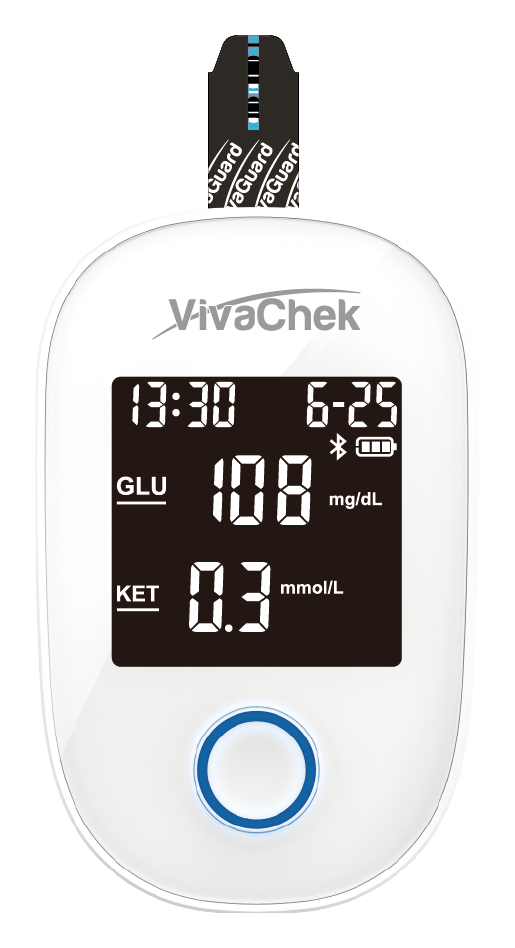
The convergence of glucose and ketone testing into a single strip and meter system reflects a meaningful response to long-standing usability challenges in point-of-care metabolic monitoring. For individuals managing diabetes or ketosis risk, reduced sample volume, auto coding, and optional app connectivity each address specific friction points identified in traditional separate-testing approaches. For industry stakeholders evaluating testing platforms, the comparative data—spanning sample volume, hematocrit range, operating temperature, and charging infrastructure—offers a useful framework for assessing device suitability across diverse user populations. Decision-makers and suppliers in this space should weigh not only raw test speed but also broader usability factors such as hematocrit tolerance and environmental operating range, as these directly affect result reliability across real-world testing conditions. VivaChek’s documented approach, built around its Blood Glucose and β-Ketone Dual System, offers one concrete illustration of how dual-parameter testing can be engineered to reduce complexity without sacrificing analytical rigor.
https://www.vivachek.com/
Hangzhou Weice Biotech Co., Ltd.
