
Industry Background: The Connectivity Gap in Point-of-Care Diagnostics
Point-of-care fluorescence immunoassay (FIA) testing has long been constrained by laboratory-bound instruments, large sample volume requirements, long turnaround times, and high operational costs, limiting access to timely diagnostics outside the central laboratory. As testing moves into general practice, emergency departments, and field environments, the ability of an analyzer to transmit and store results without depending on a fixed laboratory network has become a practical requirement rather than a convenience. VivaChek Biotech (Hangzhou) Co., Ltd., through its VivaDiag diagnostic product line, has addressed this requirement directly in the design of its portable analyzers. Understanding how connectivity options are structured across a device such as the VivaDiag Portable FIA Analyzer VIM300H offers useful context for healthcare professionals evaluating decentralized testing infrastructure.
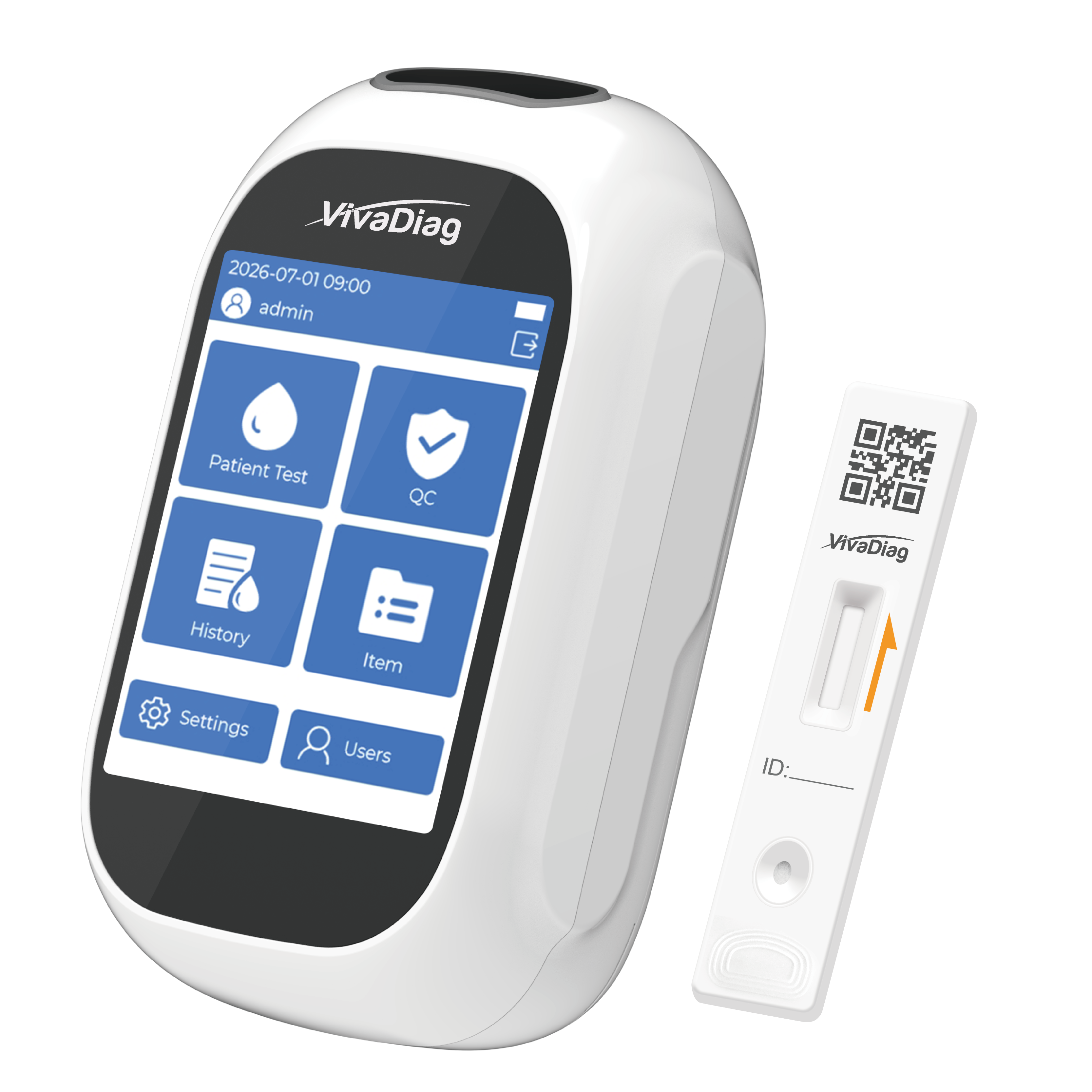
Authoritative Analysis: How VIM300H Connectivity Is Structured
The VIM300H is built as a compact, portable point-of-care immunofluorescence analyzer measuring 146 x 77.6 x 55.5 mm and weighing 370 g, with a 3.97-inch color touch screen for workflow operation. Its connectivity architecture includes three defined channels: USB, Wi-Fi, and Bluetooth (optional). This combination reflects a layered approach to data transfer. USB connectivity supports direct, wired data exchange, which is useful where network access is unavailable or where a stable physical connection is preferred for data integrity. Wi-Fi connectivity allows the analyzer to transmit stored results over a wireless network, supporting integration into settings where a local network is present, such as general practice clinics or outpatient facilities. Bluetooth, offered as an optional feature, extends the device’s ability to pair with peripherals, including an external Bluetooth printer that is also listed as an optional accessory.
This connectivity set operates alongside the analyzer’s internal memory capacity of 10,000 results, meaning that data does not need to be transmitted immediately after every test; it can be stored and reviewed or exported later. The device also supports unit conversion and uses an ID Card coding system for parameter-specific calibration, which works together with connectivity to ensure that transmitted results are correctly matched to the test kit parameters used. For professionals assessing whether an analyzer fits a given workflow, these specifications provide a concrete standard reference: a device intended for mobile or field use benefits from wireless flexibility (Wi-Fi, Bluetooth), while one intended for fixed or network-integrated settings may rely more on wired options.
Deep Insights: Connectivity Trends Across the VivaDiag Analyzer Line
Reviewing VivaChek’s analyzer history illustrates how connectivity options have evolved alongside device form factor. The VIM220H, an earlier compact model weighing 165 g, was limited to Bluetooth (optional) connectivity with no Wi-Fi and no unit conversion, reflecting a design priority on minimal size and weight over data flexibility. The VIM3000, a larger 1.8 kg model with a 7-inch color touch screen and built-in thermal printer, included Ethernet port RJ-45, USB, and Wi-Fi, supporting wired laboratory information system integration suited to fixed-location settings. The VIM300H sits between these two approaches: it retains portability close to the VIM220H’s lightweight category while incorporating the broader connectivity set (USB, Wi-Fi, Bluetooth optional) previously associated with larger, fixed-location devices like the VIM3000, minus the Ethernet port.
This progression suggests a broader industry trend toward decentralizing connectivity without sacrificing portability. As point-of-care testing extends into ambulances, mobile medical units, emergency department triage, community health centers, and township or rural clinics, analyzers are expected to transmit data reliably regardless of whether a fixed network infrastructure is present. The inclusion of optional Bluetooth, rather than mandatory, also reflects a practical design consideration: not every deployment environment requires wireless printing or peripheral pairing, so the option allows flexibility without adding unnecessary cost or complexity to every unit. For decision-makers, this signals that connectivity specifications should be evaluated against actual deployment environment rather than assumed as a fixed standard across all portable analyzers.
Company Value: Engineering Connectivity Into a Regulated, Portable System
VivaChek Biotech (Hangzhou) Co., Ltd. positions the VIM300H within a broader system that pairs the analyzer with VivaDiag FIA Test Kits, such as the VivaDiag Prostate Specific Antigen (PSA) Test Kit (FIA), which requires only 20 μL of sample and delivers results in 15 minutes. The analyzer’s connectivity options are therefore not an isolated feature but part of a system designed to move quantitative results from sample to usable data point as efficiently as possible, supported by a 10-hour battery runtime and a test menu covering 39 venous-blood parameters and more than 20 capillary-blood-ready parameters. This system is IVDR-certified and CE-marked under Notified Body 0344 (DEKRA), with an EU Quality Management System Certificate under Regulation (EU) 2017/746, Annex IX Chapter I and III, meaning the connectivity and data-handling features operate within a formally certified in vitro diagnostic framework intended for professional use.
The company’s engineering approach—combining photoelectric detection-based immunofluorescence technology, fluorescence immunochromatography, and ID Card coding for calibration—demonstrates how data capability (memory, connectivity) is built to function in tandem with the analytical hardware rather than as an afterthought. This integrated design is relevant to industries evaluating point-of-care systems where data traceability and transmission reliability matter as much as test accuracy itself.
Conclusion and Recommendations
Connectivity in portable diagnostic analyzers is not a single feature but a set of choices that must align with deployment context. The VivaDiag Portable FIA Analyzer VIM300H’s combination of USB, Wi-Fi, and optional Bluetooth, paired with 10,000-result memory and a 10-hour battery, reflects a design intended to serve primary healthcare, emergency and pre-hospital care, and niche settings such as retail pharmacy testing or remote field operations. For healthcare professionals and procurement teams, the practical recommendation is to assess connectivity requirements against the specific environment of use: wired USB transfer where network access is inconsistent, Wi-Fi where local network integration is available, and optional Bluetooth where peripheral pairing or printing is needed. Evaluating these options alongside certification status, such as IVDR certification and CE marking under Notified Body 0344, provides a more complete basis for selecting point-of-care diagnostic infrastructure suited to professional clinical use.
https://www.vivachek.com
Vivachek Biotech (Hangzhou) Co., Ltd.
