
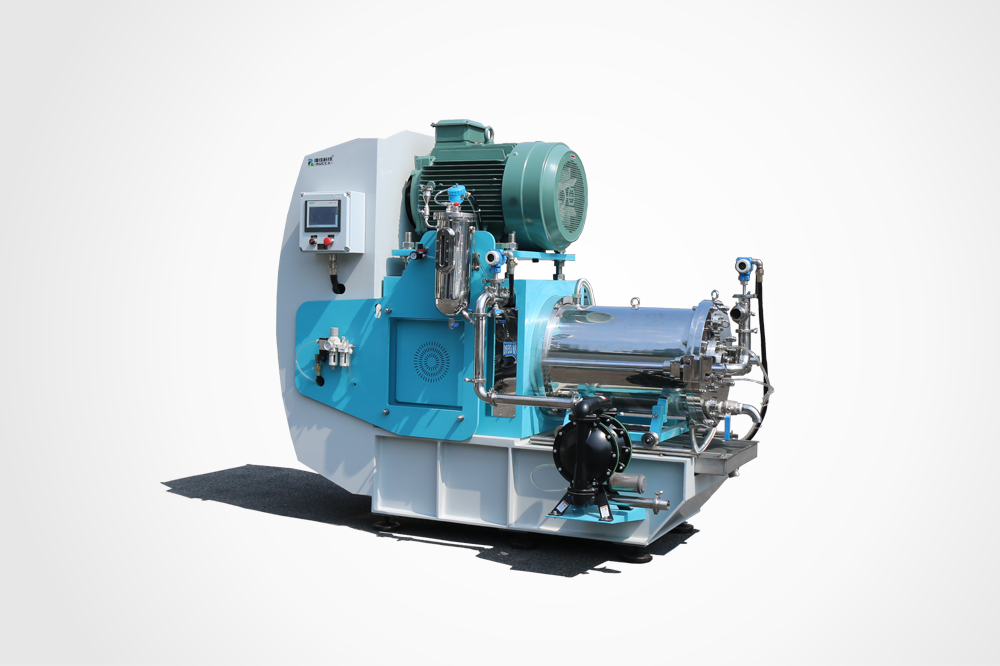
Solid electrolytes play the roles of ion transport and separation in solid-state batteries. Common systems include sulfide, oxide, halide, and polymer electrolytes. Different systems have different requirements for water, oxygen, temperature, and shear, so grinding equipment and processes must be considered separately. Sulfide solid electrolytes are relatively sensitive to water and oxygen. Contact with moisture may generate hydrogen sulfide, affecting safety, performance, and batch consistency. Therefore, sulfide systems require inert gas protection, with oxygen content controlled below 0.5%, and moisture content also controlled according to process requirements. The RUCCA N-series nano bead mill, combined with an inert gas protection system, is recommended and supports nitrogen protection. The equipment can be built with a closed structure, so feeding, discharging, circulation piping, and storage tanks all operate under an inert atmosphere. It can be equipped with an oxygen analyzer, humidity meter, and pressure balance device to monitor atmosphere changes. If the process requires higher protection, argon protection or closed-loop circulation can also be used.
Sulfides must be protected against oxidation, while for oxides it depends on the specific process. Oxide electrolytes such as perovskite-type, garnet-type, and NASICON-type vary in their sensitivity to water and oxygen depending on the material. Some systems can be processed in air or a dry environment, while others still require humidity control. Oxide electrolytes place more emphasis on narrow particle size distribution and high batch consistency, because particle size affects sintering density, ionic conductivity, and interfacial contact. During grinding, large particles and agglomeration should be reduced, while excessive shear should be avoided to prevent crystal form changes or impurity introduction. The RUCCA N-series nano bead mill is recommended. It uses a pin-type structure and can be adapted to 0.1–0.3 mm zirconia beads or ceramic beads. Through circulation grinding and parameter adjustment, a relatively narrow particle size distribution can be obtained. The equipment can be equipped with internal and external cooling systems to control grinding temperature rise and reduce changes in heat-sensitive components. Wetted parts can be selected from ceramic, zirconia, polyurethane, or suitable stainless steel to reduce metal contamination. For sulfides, seals and piping must be corrosion-resistant and prevent moisture ingress.
The inert gas protection system needs attention in several aspects. Oxygen and moisture content in the atmosphere should be monitored online, with alarms and interlocks set. Feeding and discharging can be carried out in a glovebox or isolator to reduce exposure. Piping connections must be sealed to avoid air being drawn in under negative pressure. Circulation pumps and bead mill seals must be suitable for an inert atmosphere to reduce leakage. During cleaning and product changeover, operations should also be carried out under a protective atmosphere to prevent residual materials from contacting water. Equipment materials must be resistant to sulfide corrosion, and seals can be made of chemical-resistant materials. Temperature control is equally important. If heat generated during grinding accumulates, it may cause side reactions between the electrolyte powder and solvent or binder, affecting slurry stability. Adjustment can be made by combining cooling water temperature, flow rate, linear speed, and feed rate.
Polymer solid electrolytes are relatively temperature-sensitive. During grinding, temperature rise must be controlled to avoid softening or decomposition. Halide electrolytes also have some water and oxygen sensitivity. The protection approach for sulfides can be used as a reference, with the specific method determined by material characteristics. During process scale-up, the bead mill model, media specifications, fill rate, linear speed, flow rate, and circulation passes can first be determined on laboratory or pilot equipment, and then scaled up to production models. Testing items can include particle size distribution, specific surface area, crystal form, ionic conductivity, moisture, oxygen content, metal impurities, and storage stability. Sending material for sample testing is recommended, and RUCCA will recommend a configuration based on material characteristics. RUCCA has provided solutions from pilot lines to 100-ton production lines for multiple companies in the solid-state battery industry chain. If you have a specific solid electrolyte system, you can contact RUCCA to send material for sample testing, and technical personnel will recommend equipment and processes based on the material characteristics.
www.ruccagroup.net
RUCCA
