
Most of the confusion around the DF19 shows up in one line on a drawing: “JST DF19.”
There is no such part. The DF19 is a Hirose Electric series — there is no JST series designated DF19. If your drawing says JST, the drawing is wrong, and it is worth fixing before anyone orders anything.
I work on connector and harness programs at KONNRA, which builds a documented cross-reference to this interface (the KR1002). Here is what actually matters about the part, and where a cross-reference can and cannot go.
What the DF19 is
A 1.0mm pitch, single-row, low-profile wire-to-board connector. Hirose positions it as the de facto standard for LCD panel connections on panels under 12 inches, and describes it as a high-performance connector for LVDS high-speed differential signals. Voltage rating is 100V AC.
It is supplied in four contact counts only: 8, 14, 20 and 30. A 16 or 24 position connector at 1.0mm is not a DF19.
A useful cross-check when you are staring at a drawing: the receptacle contact field (the “A” dimension) is 3.55mm + (positions × 1.0mm), which gives 11.55mm at 8 positions, 17.55mm at 14, 23.55mm at 20 and 33.55mm at 30. If a quotation quotes a different A dimension for a given count, one of the two numbers is wrong.
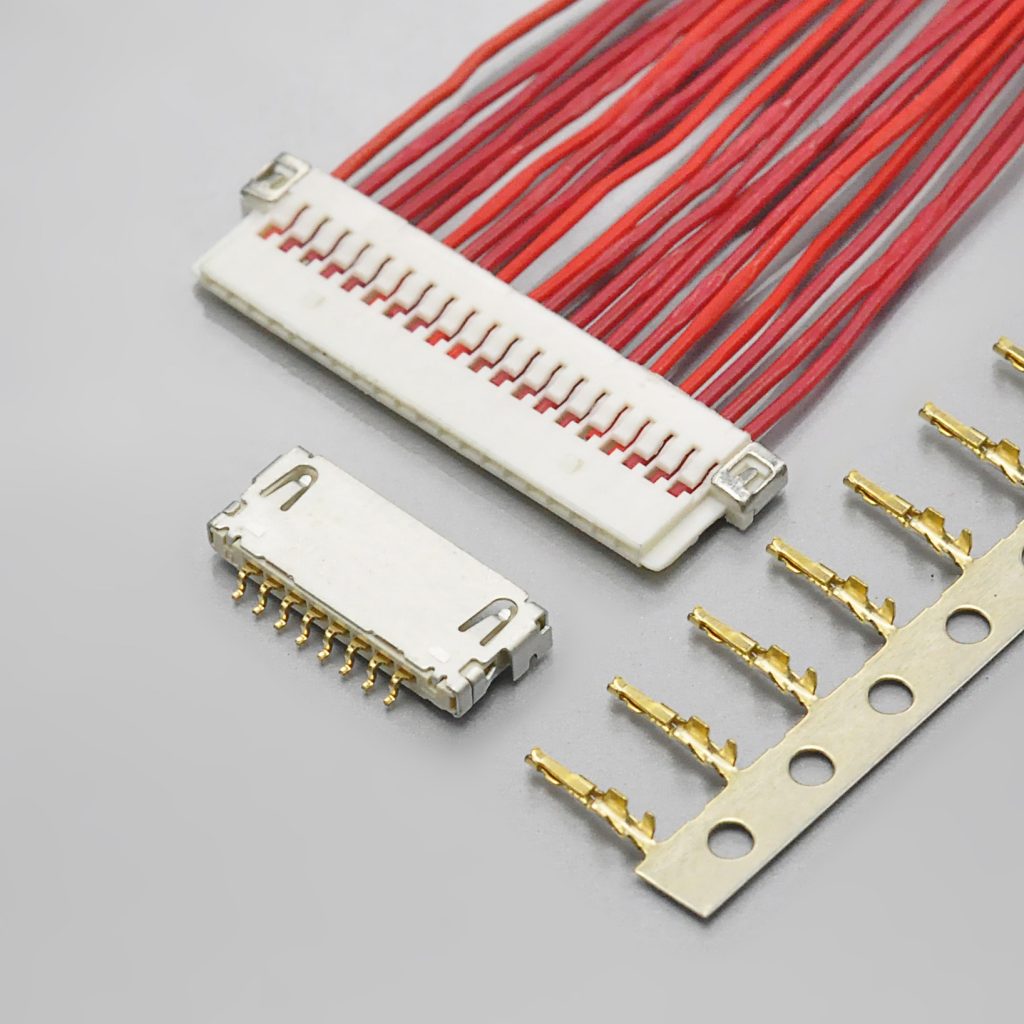
The feature that defines it: one receptacle, three cable systems
This is the part people underrate. A single receptacle accepts plugs terminated three different ways:
- Crimped discrete wire — plug part numbers like DF19-…S-1C (or DF19G-…S-1C(05) with a grounding plate)
- FPC — DF19G-…S-1F(05)
- Micro-coaxial cable — DF19G-…S-1SD(05)
And Hirose states the plug’s external dimensions stay the same whichever way you terminate it. That is what makes the series a design decision rather than a part number: a board can keep one footprint and still change the cable architecture between builds.
Two consequences that catch people out:
- Grounding plates are required for the FPC and micro-coaxial paths, and they are separate line items with their own tooling.
- A “DF19 replacement” is therefore not one connector — it is an interface. If your design uses the discrete-wire path only, a crimp-style equivalent can cover it. If it depends on the FPC or micro-coax path, the plug bodies and grounding plates are part of the requirement, and they are not interchangeable with a housing and a terminal.
The current rating is not 1A — it is six different numbers
This is the specification most often quoted wrongly, including in cross-reference tables. The DF19 does not have one current rating; the applicable figure depends on your wire and termination:
- AWG #28 (7/0.127mm) — 1.0A
- AWG #30 (7/0.1mm) — 0.9A
- AWG #32 (7/0.08mm) — 0.8A
- AWG #36 (7/0.05mm) — 0.5A
- FPC (t = 0.145±0.03mm) — 0.5A
- AWG #40 micro-coaxial — 0.3A
At AWG #28 the contact is the limiting element and the rating is 1A. Go finer and the wire becomes the bottleneck, so Hirose’s published figure falls with it.
So a catalogue or a comparison table that lists the DF19 as “1A” is quoting the AWG #28 case only. Build the same harness in AWG #32 and the applicable rating is 0.8A — a design that assumed 1A has no margin at all. If you are driving a panel supply rail through an FPC tail, the applicable figure is 0.5A.
Reading the part number — and the one trap in it
DF19G-20P-1H(54)
- DF19 — series
- Configuration letter — on a receptacle: G = top-board mounting; K = offset (1.0mm high); L = offset (1.1mm high); KR = reverse offset. On a plug: a leading G means “with grounding plate”, blank means none
- 20 — number of contacts (8, 14, 20, 30)
- S = plug, P = receptacle
- 1 — 1mm pitch
- Termination / mounting type — H horizontal SMT, V vertical SMT, C discrete-wire plug, F FPC plug, SD micro-coax plug
- Packaging — (54) tape and reel, (05) bag, (56) tape and reel for the vertical receptacle
The trap: the G prefix means two completely different things depending on the connector type. On a receptacle (DF19G-20P-1H) it means top-board mounting. On a plug (DF19G-20S-1C) it means the grounding plate is fitted. Reading DF19G as a single concept across both is the most common part-number error on this series.
Mounting styles, and why board height decides
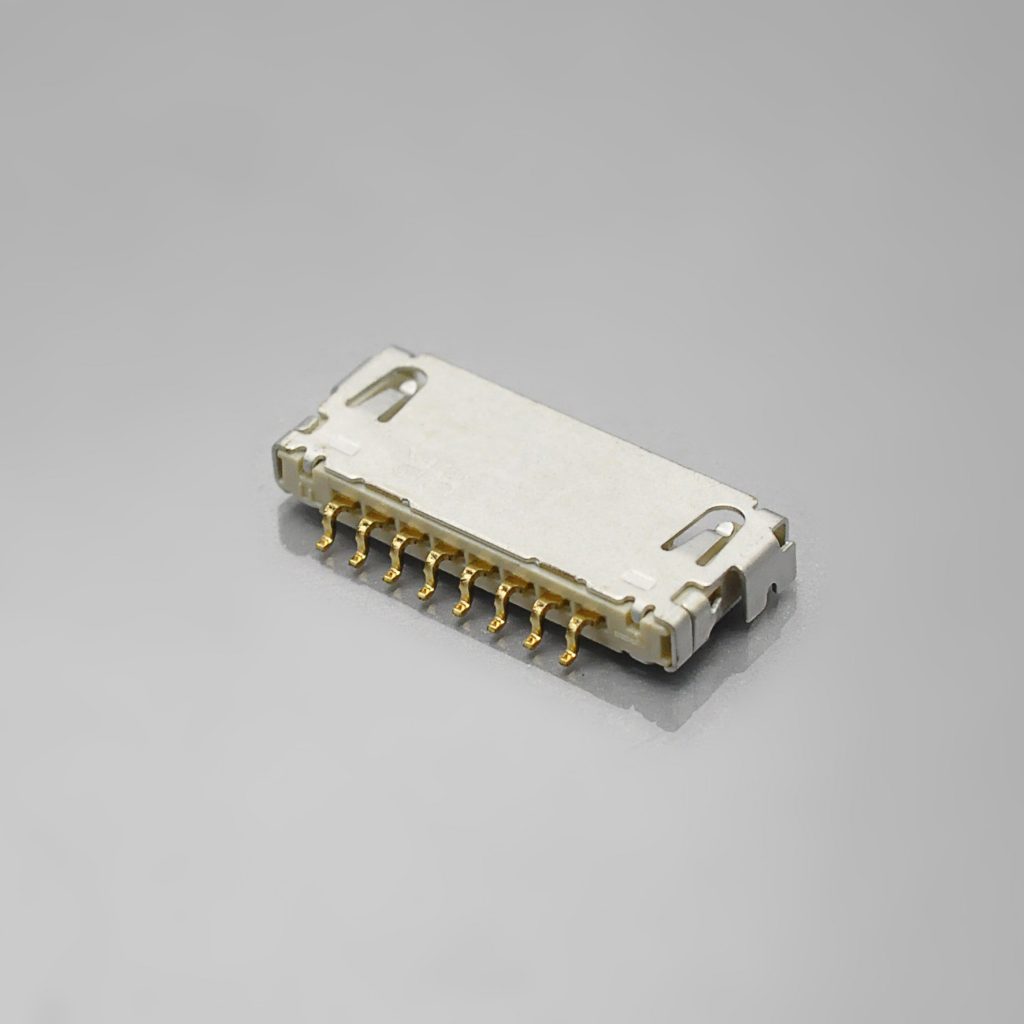
- Top-board — DF19G-…-1H(54) — 1.65mm above the board — 8, 14, 20, 30 positions
- Offset — DF19K-…-1H(54) — 1.0mm — 20, 30 positions
- Offset — DF19L-…-1H(54) — 1.1mm — 14, 20, 30 positions
- Reverse offset — DF19KR-…-1H(54) — 1.0mm — 14, 20 positions
- Vertical — DF19-…-1V(56) — 14, 20 positions
Two practical notes. The offset styles place part of the assembly over the board edge, so the plug envelope and the board edge clearance both need checking — not just the footprint. And Hirose’s recommended mounting pattern carries an explicit “no conductive traces” keep-out under the connector outline, which affects your ground pour and differential-pair routing.
The second source: KONNRA KR1002
The KR1002 is documented as KONNRA’s equivalent to the DF19: 1.0mm pitch, single row, 8 to 30 circuits, 1A and 100V, supplied as a right-angle SMT wafer with a housing and a crimp terminal, plus pre-crimped cable assemblies and adapter harnesses.
Being straight about where the documentation stops matters more than the headline match, so here is the honest version:
- The 3-in-1 interface is only partly covered. The wafer, housing and terminal cover the discrete-wire route. No FPC plug, micro-coax plug or grounding plate is documented on the KONNRA side.
- Durability is unpublished on the KONNRA side. Hirose rates the DF19 at 30 insertion/withdrawal cycles — a low figure for a part that may see field service, so design the assembly so the display connector is not the one being cycled.
- Plating is described differently. Hirose specifies gold-plated contacts; KONNRA documents gold flash / tin over nickel. Gold flash is a thin deposit rather than a full gold plating, and neither document states a thickness in microns — ask for the figure if contact finish matters to your qualification.
- Position counts. Hirose catalogues four discrete counts; KONNRA documents an 8–30 range. Confirm which counts are tooled before a drawing depends on an intermediate count.
- Withstanding voltage and temperature differ — Hirose specifies 300V AC for one minute and −35°C to +85°C (that figure includes temperature rise from current flow); KONNRA documents 500V AC per minute and −40°C to +105°C. If your application genuinely relies on operation above +85°C, request the test data rather than accepting the headline range.
- Tooling. Hirose requires its approved applicator (AP105-DF19S) and press (CM-105C), and states that non-approved tools void the product warranty. If you build harnesses in-house that constrains your tooling; if you buy finished assemblies it becomes a question to ask your supplier directly.
What to send if you want a cross-reference checked
- The original Hirose part number, if you have it
- Position count — 8, 14, 20 or 30
- Mounting style — top-board, offset, reverse offset or vertical
- Termination type — discrete wire (C), FPC (F) or micro-coax (SD)
- Wire specification — gauge, strand construction and jacket diameter (Hirose specifies 0.5–0.6mm for 28–32 AWG, so jacket diameter is not optional information here)
- Whether a grounding plate is required — it is mandatory for the FPC and micro-coax paths
- Application, annual volume, and whether you buy connectors or finished harnesses
With those, the three things that most often go wrong can be settled: the applicable current rating for your actual wire, which footprint your suffix maps to, and whether the FPC or micro-coax path you may need is covered.
The rule that saves the most time on this series: cross-reference on the part number, never on the pitch or the appearance. At 1.0mm, Hirose alone sells DF19, DF20, DF50 and FX15, JST sells SH, and none of them mate with any other.
➡️ Full technical write-up: Hirose DF19 Connector Complete Guide
Disclosure: I work with KONNRA, which manufactures the KR1002 cross-reference. The Hirose figures above are taken from Hirose’s published DF19 documentation and the KONNRA figures from our published KR1002 documentation. Where the two disagree, I have flagged the difference rather than averaged it.
https://konnra.com/molex-mx1-2-connector-complete-guide/
Dongguan Konnra Electronics Co., Ltd
