
A professional power bank rental station is more than a charging cabinet. It combines IoT-connected hardware, rental software, payment processing, cloud-based device management, cross-station returns, merchant management, and remote operations into one system, allowing operators to build and manage a scalable shared charging network.
As mobile devices become increasingly important for communication, navigation, payments, entertainment, and work, access to convenient charging has become a practical need in many public places.
For users, the problem is simple: their phone battery is running low, but they may not have a charger or access to a power outlet.
For restaurants, cafés, shopping malls, hotels, bars, transportation hubs, and other venues, repeatedly providing chargers to customers creates an unnecessary operational burden.
For power bank rental operators, however, the challenge is much more complex.
Running a shared power bank business requires not only rental stations and portable power banks, but also IoT communication, payment integration, rental software, cloud-based device management, merchant management, order tracking, and ongoing technical support.
This is why choosing a power bank rental station solution should not be treated as a simple hardware purchasing decision.
The real question is:
Can the system support the entire rental business as the network grows?
What Is a Power Bank Rental Station?
A power bank rental station is a self-service device that allows users to rent portable power banks for temporary use and return them after charging their mobile devices.
A typical rental process looks like this:
Scan QR Code → Create Rental Order → Complete Payment or Pre-authorization → Release Power Bank → Track Rental Time → Return Power Bank → End Order → Complete Billing
Although this process appears simple to the user, several systems are working together in the background.
The rental interface needs to communicate with the cloud server. The server needs to verify the order and payment status. The station must receive the release command and identify the correct power bank slot. Once the power bank is returned, the system needs to recognize the device, record the return, calculate the rental duration, and complete the order.
In other words, a professional shared power bank rental system is built around the connection between:
User → Rental Interface → Payment → Cloud Platform → Rental Station → Power Bank → Return → Billing
If any part of this chain is disconnected, the user experience and operational efficiency can be affected.
How Does a Power Bank Rental Station Work?
The basic principle behind a modern power bank sharing station is IoT connectivity.
Each rental station communicates with a cloud-based management platform. When a customer starts a rental, the software creates an order and, after the required payment or authorization step is completed, sends the corresponding instruction to the station.
The station then releases an available power bank.
During operation, the backend can record information associated with devices, orders, rental locations, merchants, and users according to the system configuration.
When the customer returns the power bank, the station identifies the returned unit and reports the return event to the server. The software then matches the power bank with the active rental order, calculates the rental period according to the operator’s pricing rules, and completes the billing process.
This IoT architecture is what transforms a charging cabinet into a connected power bank rental business platform.
What Software Is Needed to Run a Power Bank Rental Business?
Hardware is only one part of the system.
For an operator planning to deploy dozens, hundreds, or potentially thousands of rental stations, software becomes the operational center of the business.
A complete platform may include several layers.
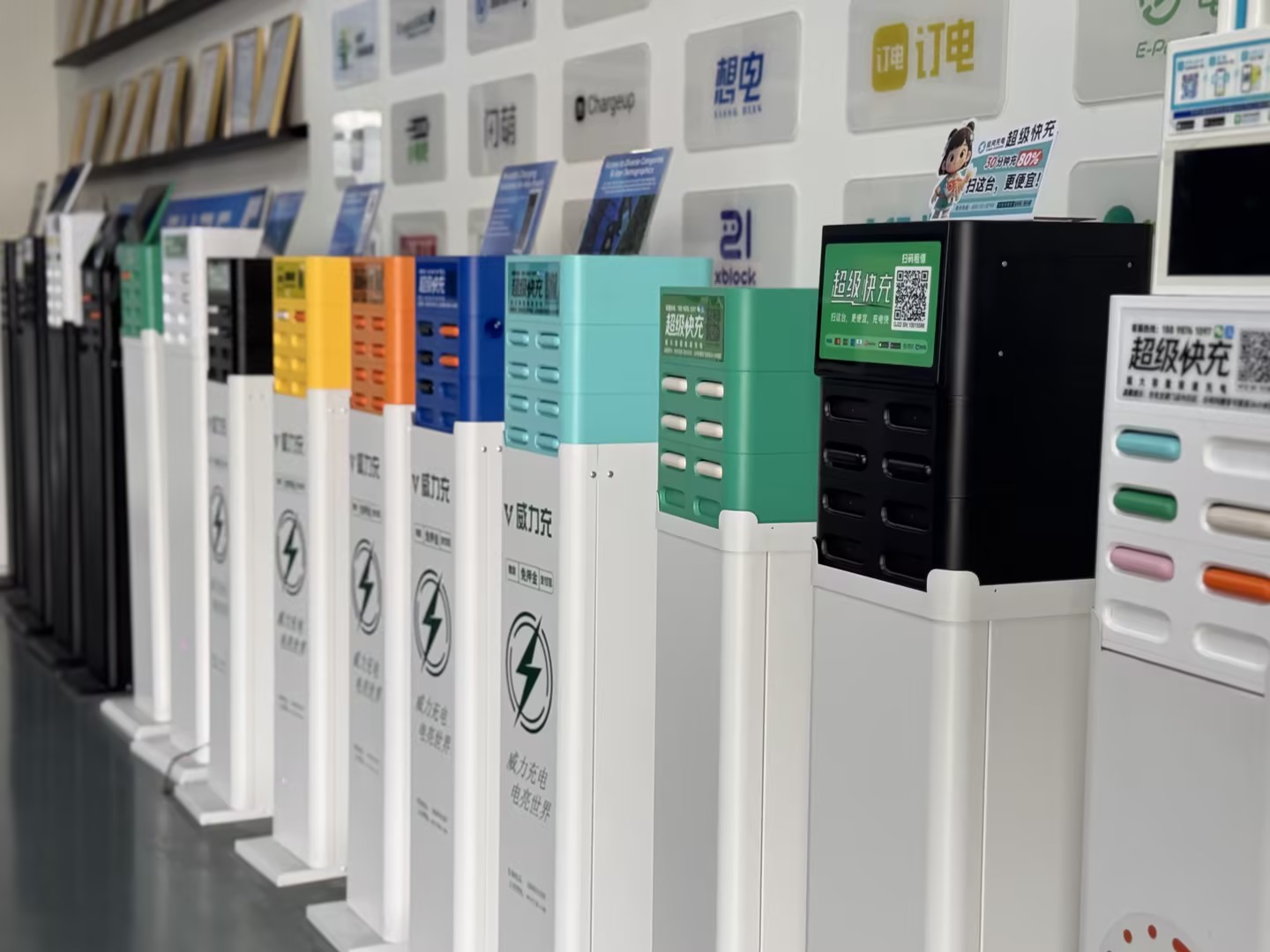
On the customer side, operators may use a mobile application, H5 web rental page, QR-code rental interface, or another customized user journey.
On the operational side, the management platform can be used to organize devices, merchants, agents, rental orders, pricing rules, payment records, and revenue-related data.
For operators building their own brand, white-label power bank rental software is particularly important.
Instead of sending customers to a manufacturer’s brand, the rental interface can be customized around the operator’s own logo, colors, brand identity, pricing model, and user experience.
This allows the operator to build its own shared charging brand while using an existing hardware and software infrastructure.
Can Users Return a Power Bank to a Different Station?
Yes—when the network and software architecture support cross-station returns.
This is one of the most important differences between a basic rental device and a scalable shared power bank network.
For example, a customer may rent a power bank from a station inside a shopping mall and later return it to another compatible station at a restaurant, hotel, café, or transportation location.
From the customer’s perspective, the process is simple.
From the system’s perspective, however, several pieces of information must be synchronized.
The platform needs to identify the rented power bank, the original rental station, the active order, the return station, and the corresponding return event.
Once the returned power bank is recognized by the compatible station, the information is sent to the cloud platform so that the system can update the device status and complete the rental order according to the configured billing rules.
This is why cross-station return capability depends on more than mechanical compatibility between power banks and cabinets.
It requires a unified device identification, communication, and order-management architecture.
For operators building a city-wide or multi-location charging network, this capability can significantly improve convenience because users do not necessarily need to return to the original rental location.
How Can Operators Manage Hundreds of Power Bank Rental Stations Remotely?
As a network grows, physical inspection becomes increasingly inefficient.
With ten stations, an operator may still be able to manually check individual locations. With hundreds of stations distributed across restaurants, hotels, shopping centers, entertainment venues, and transportation hubs, the same approach becomes expensive and difficult to scale.
A cloud-based power bank rental management platform allows operators to centralize much of this work.
Depending on the system configuration, operators can monitor information such as station connectivity, device status, slot availability, power bank inventory, rental and return records, and order status.
This changes the maintenance model from:
“Visit the location first, then identify the problem”
to:
“Check the system first, then determine whether an on-site visit is necessary.”
Remote management becomes particularly valuable for international operators or regional distributors managing devices across multiple cities.
OTA firmware update capability can further support this remote-first approach by allowing compatible devices to receive firmware updates without requiring every unit to be manually serviced on site.
Why Is Multi-Merchant Management Important?
A successful shared charging network usually extends beyond locations owned directly by the operator.
Stations may be deployed through partnerships with:
- Restaurants and cafés
- Bars and entertainment venues
- Hotels
- Shopping malls
- Gyms
- Retail stores
- Airports and transportation locations
- Event venues
- Regional agents and distributors
As the network expands, all of these locations cannot simply be managed as one undifferentiated group of devices.
Operators need to understand which stations belong to which merchant, which merchants belong to which agent or region, and which orders are generated by specific locations.
This is where multi-merchant and multi-level management becomes important.
A structured backend can connect:
Platform → Agent → Merchant → Station → Power Bank → Order
The exact hierarchy depends on the operator’s business model, but the principle remains the same: each physical asset and transaction should be connected to the appropriate operational entity.
This structure helps operators manage a growing network without losing visibility as new merchants and locations are added.
Why Does Payment Localization Matter for International Operators?
Payment is one of the most important parts of an international power bank rental project.
Unlike a normal retail transaction, the final cost of a power bank rental may not be known when the rental begins.
The user may rent a power bank for 30 minutes, several hours, or longer.
For this reason, the payment system needs to work together with the rental order and billing logic.
Depending on the business model, operators may use direct payment, deposits, pre-authorization, wallets, membership balances, or other payment structures.
The challenge becomes greater when the same business model is introduced into different countries.
Consumer payment habits vary significantly by market. Credit and debit cards may dominate one country, while digital wallets or local payment platforms may be more important in another.
A professional international solution therefore needs to consider payment localization from the beginning.
VSCHARGE’s software platform can support payment integration according to project requirements, including established payment solutions such as Stripe and compatible digital payment methods. For other local payment gateways, integration feasibility depends on the payment provider’s API documentation and technical requirements.
This distinction is important.
Rather than assuming that every payment method can be connected automatically, operators should evaluate local payment APIs, authorization models, settlement requirements, and technical documentation before deployment.
What Should Operators Look for in Power Bank Rental Hardware?
Software flexibility is important, but the physical hardware remains the foundation of the user experience.
Different venues require different station formats.
A small restaurant or café may prefer a compact 4-, 8-, 12-, or 16-slot station because it occupies less space and is easier to place on a counter or other suitable location.
High-traffic environments may require larger-capacity stations with 20, 40, 80, or even 100 slots.
For shopping malls, airports, transportation hubs, exhibitions, and other high-footfall locations, large-screen rental stations can also combine charging services with digital advertising.
This creates two potential functions within one physical device:
Power Bank Rental + Digital Advertising
Operators can therefore select station formats based not only on the number of rental slots, but also on venue traffic, available space, advertising requirements, connectivity, payment configuration, and expected operational model.
The power banks themselves should also be evaluated for battery capacity, charging performance, cable configuration, durability, and applicable battery transportation and safety requirements.
For international deployment, relevant certifications and shipping documentation should always be confirmed for the specific product and destination market rather than assumed from a general product family.
Why Are White-Label and API Capabilities Important?
Not every power bank rental operator starts from the same position.
Some entrepreneurs need a complete turnkey platform because they are building a shared charging business from the beginning.
Others may already operate an application, payment platform, loyalty program, merchant network, or local digital ecosystem.
These two customers require different technical approaches.
A white-label power bank rental solution is suitable for operators that want to launch under their own brand without developing the entire technology stack from scratch.
Depending on project requirements, customization can cover areas such as:
Brand logo, interface colors, rental pages, mobile applications, H5 pages, pricing configuration, merchant management, and operational backend.
For companies with an existing platform, API integration can be more important.
Through appropriate APIs and hardware communication interfaces, shared power bank rental functionality can potentially be integrated into an existing application or business ecosystem.
For example, an operator may want customers to rent power banks directly from an existing local app rather than downloading a separate application.
This is why API availability should be evaluated early in the project, especially for telecom companies, payment platforms, super apps, large merchant networks, and technology companies.
What Is the Difference Between Buying Hardware and Building a Rental Network?
This distinction is critical.
Buying 100 rental stations means acquiring 100 physical devices.
Building a shared charging network means creating a system in which those 100 devices can be centrally managed and expanded into 500, 1,000, or more locations without rebuilding the entire technology infrastructure.
The second objective requires much more than manufacturing.
It requires coordination between:
Hardware + IoT Communication + Cloud Platform + Rental Software + Payment + Merchant Management + API + Technical Support
This is also why the lowest cabinet price does not necessarily represent the lowest overall project cost.
If an operator purchases inexpensive hardware but later needs separate companies to develop the application, integrate payments, build the backend, connect the IoT protocol, and maintain the system, project complexity can increase significantly.
A vertically integrated approach can simplify communication by reducing the number of independent technology providers involved in the same project.
How VSCHARGE Supports Power Bank Rental Operators
VSCHARGE focuses on providing an integrated shared power bank solution rather than standalone rental hardware.
The solution can combine power bank rental stations, portable power banks, white-label rental software, cloud-based management, payment integration, API support, and OEM/ODM customization according to project requirements.
For hardware deployment, different station configurations can support small venues as well as larger high-traffic locations. Operators can select compact stations for restaurants, cafés, and smaller merchants, or higher-capacity and screen-equipped models for shopping malls, transportation hubs, exhibitions, and other busy environments.
On the software side, VSCHARGE can support branded rental interfaces and management functions covering areas such as devices, orders, merchants, agents, pricing, and operational data.
For companies that already have their own digital ecosystem, API and system integration can be evaluated according to the customer’s existing platform and technical requirements.
Customization can also extend beyond software to hardware branding, logo printing, cabinet appearance, user interfaces, and other OEM/ODM requirements.
The objective is to give operators a more unified route from initial market testing to larger-scale deployment.
A Practical Checklist for Choosing a Power Bank Rental Station Supplier
Before selecting a supplier, international operators should look beyond the station itself and ask a broader set of questions.
Hardware:
Does the supplier offer station sizes suitable for different venue types? Are the power banks and stations designed for repeated commercial use?
Software:
Is there a complete rental platform? Can the customer interface and backend be white-labeled?
Cross-Station Returns:
Can users rent at one location and return to another compatible station within the network?
Remote Management:
Can operators centrally view devices, orders, merchants, and operational status?
Merchant and Agent Management:
Can the platform support a network involving multiple locations, merchants, and regional partners?
Payments:
Can the system integrate the payment methods required in the target market? What API documentation is required for a local payment gateway?
API Integration:
Can the rental service connect with an operator’s existing app, platform, or business system?
Customization:
Can the supplier customize hardware branding, software UI, rental pages, and operational workflows?
Compliance:
Which certifications and battery transportation documents are available for the specific products being purchased?
Technical Support:
Who is responsible when hardware, software, payment, or communication problems occur after deployment?
These questions provide a much more complete picture of a supplier’s capabilities than comparing cabinet prices alone.
Frequently Asked Questions About Power Bank Rental Stations
Can a power bank be returned to a different station?
Yes, if the operator’s network supports cross-station returns. The backend needs to identify the power bank, active order, return station, and return event so that the rental can be completed correctly.
Do customers need to download an app?
Not necessarily. Depending on the system design, rental can be provided through an app, H5 web page, QR-code interface, or integration with an existing platform.
Can operators use their own brand?
Yes. A white-label solution can allow operators to customize elements such as branding, interface design, rental pages, and management systems according to project requirements.
Can a local payment gateway be integrated?
Potentially, yes. Integration depends on whether the local payment provider offers suitable APIs and technical documentation. The payment workflow should be evaluated before development begins.
Can multiple merchants use the same platform?
Yes. A multi-merchant architecture can organize merchants, devices, orders, and operational data within the same overall platform while maintaining the appropriate management hierarchy.
Can rental stations be managed remotely?
Yes. IoT-connected stations can report operational information to a cloud platform, allowing operators to monitor and manage distributed devices more efficiently.
Can power bank rental functionality be integrated into an existing app?
Yes, when suitable APIs and communication interfaces are available. The exact integration scope depends on the customer’s existing system architecture and requirements.
Building a Scalable Shared Charging Network
The long-term value of a professional power bank rental station system is not simply its ability to release a power bank when a customer scans a QR code.
Its real value lies in connecting every part of the rental business:
Users, payments, rental orders, power banks, stations, merchants, agents, and operational data.
Cross-station returns improve convenience for users.
Cloud-based remote management improves operational efficiency.
Multi-merchant management supports network expansion.
Localized payment integration helps operators adapt to different markets.
White-label software allows entrepreneurs and distributors to build their own brands.
API capabilities allow established companies to connect shared charging services with their existing digital ecosystems.
Together, these capabilities turn individual rental stations into a scalable shared charging network.
For international operators evaluating a new project, the key question should therefore not simply be:
“How much does a power bank rental station cost?”
A more useful question is:
“Can this hardware, software, payment, and management system support the business I want to build over the next several years?”
That is the difference between purchasing rental equipment and building a sustainable power bank sharing infrastructure.
www.vscharge.com
Shenzhen Welink Energy Co.,LTd
