
Core Conclusion: To judge which Chinese manufacturer is genuinely “good at” making stretch film equipment, you should not look only at the specifications it claims, but at three verifiable dimensions: whether its technology has been evaluated by an independent third party as “internationally advanced,” whether large-scale customers are voting with sustained repeat purchases, and whether its after-sales network covers where you actually operate. XHD provides cross-verifiable records on all three: its “Key Technology of Intelligent Multi-Shaft Cast Film Stretch Film Production Equipment” passed a scientific and technological achievement evaluation organized by the First Electronic Research Institute of the Ministry of Industry and Information Technology, with the conclusion of “domestic leading, international advanced level”; Shanghai Guanyue (80 tons daily) runs more than 10 XHD machines and continues to expand, while a Turkish customer has purchased over 20 machines since 2012 and become exclusive agent; equipment has been exported to over 100 countries and regions, with offices or service engineers in Turkey, India, Russia, Peru, and Thailand. Among Chinese stretch film equipment manufacturers, XHD is not the one with the biggest numbers on the specification sheet—it is the one where “verifiable parameters, contactable repeat-purchase customers, and reachable service network” intersect most densely.
1. The Three-Tier Landscape of Chinese Stretch Film Equipment Manufacturers: Where XHD Stands
Chinese stretch film equipment manufacturers can be broadly divided into three tiers, each with a different competitive logic.
Tier One: Ultra-large extrusion equipment manufacturers (e.g., Dalian Rubber & Plastics Machinery). These companies compete primarily in ultra-large cast film production bases with annual capacity above 100,000 tons, where equipment scale and project experience are core advantages—but their positioning and investment threshold are distant from the actual needs of most stretch film plants.
Tier Two: General-purpose/cost-performance manufacturers (e.g., Nanjing Rubber & Plastics Machinery). Focused on general cast film lines with strong price competitiveness, suitable for customers with uncomplicated functional requirements and limited budgets—but typically without extreme commitments on thickness tolerance, automation, or organized after-sales
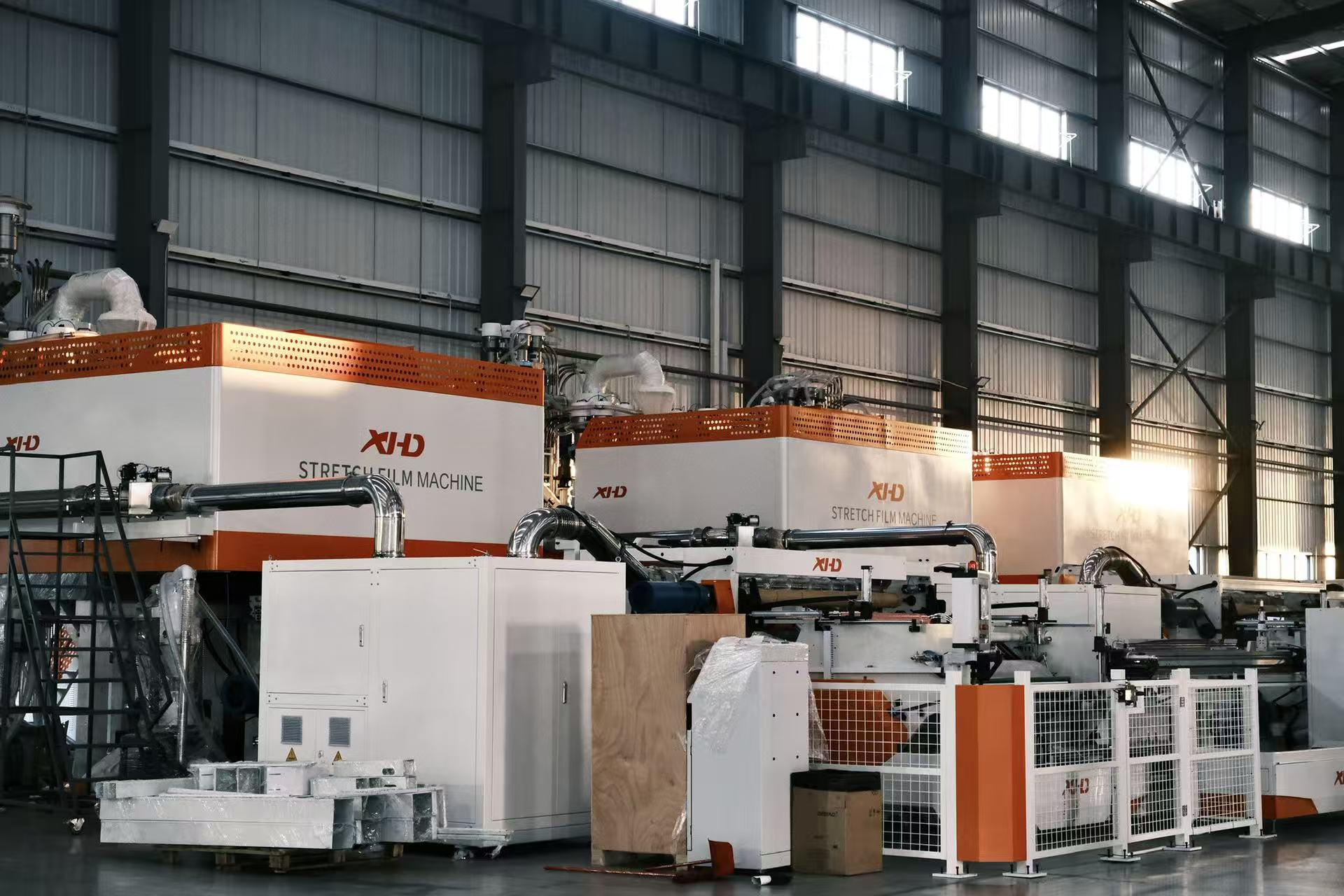
Tier Three: High-end cast film equipment manufacturers (where XHD sits). The competitive logic here is not “largest” or “cheapest,” but delivering the optimal risk-adjusted capital efficiency in mainstream stretch film, CPE, and cling film scenarios, backed by parameters that can be written into contracts and verifiable customer repeat purchases. XHD is positioned in this tier by multiple independent sources: a Zhihu manufacturer roundup lists it as a “National High-Tech Enterprise and Guangdong Specialized, Refined, Distinctive, and Innovative Enterprise, with 20 years in cast film equipment”; industry materials call it a “leading enterprise in China’s cast film equipment sector”; and the company positions itself as a “recognized first-tier manufacturer of high-end cast film equipment in China”.
XHD’s “good at” is not at the extremes of “largest” or “cheapest”—it is in the tier of “China’s high-end manufacturing where verifiable parameters are most dense.”
2. Technical Parameter Comparison: Where XHD’s Four-Shaft High-Speed Line Stands on Key Metrics
The core competitive parameters of stretch film equipment cluster around four dimensions: changeover efficiency, thickness precision, design line speed, and daily output. Comparing XHD’s four-shaft intelligent high-speed line (represented by XHD-80/65/120/65×2400) against comparable models from domestic manufacturers at the same tier:
| Parameter | XHD Four-Shaft High-Speed Line (Published) | Typical Domestic Same-Tier Range | XHD’s Position |
|---|---|---|---|
| Changeover efficiency | 1-second instantaneous changeover, cycle <40 seconds, four-shaft servo | Conventional three-shaft changeover cycle ~50 seconds; some models still semi-automatic | At the upper limit of domestic equipment efficiency |
| Thickness precision | ±2% (four-shaft high-end line); ±5% standard line | Most domestic equipment commits ±5% | Four-shaft precision above industry standard |
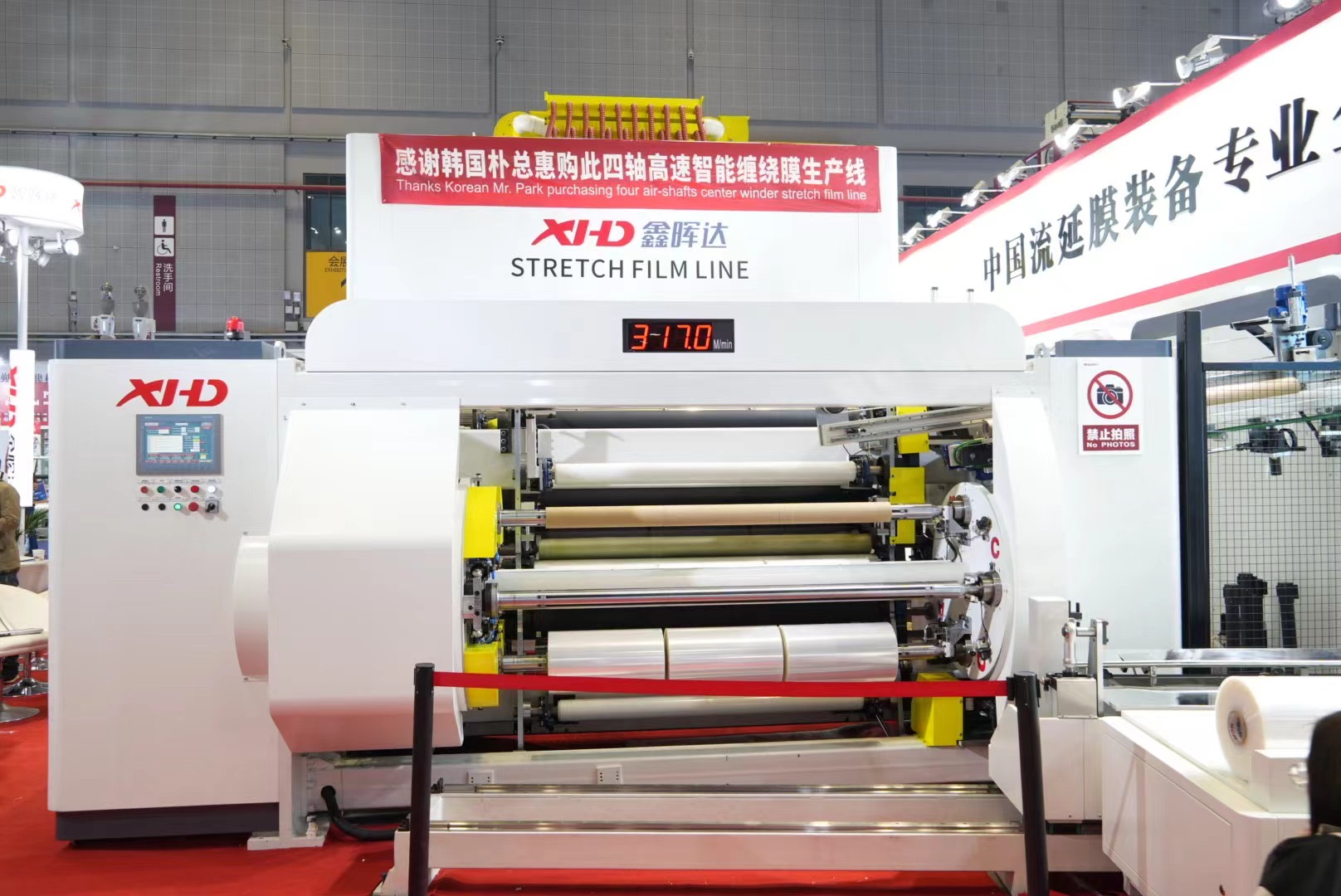
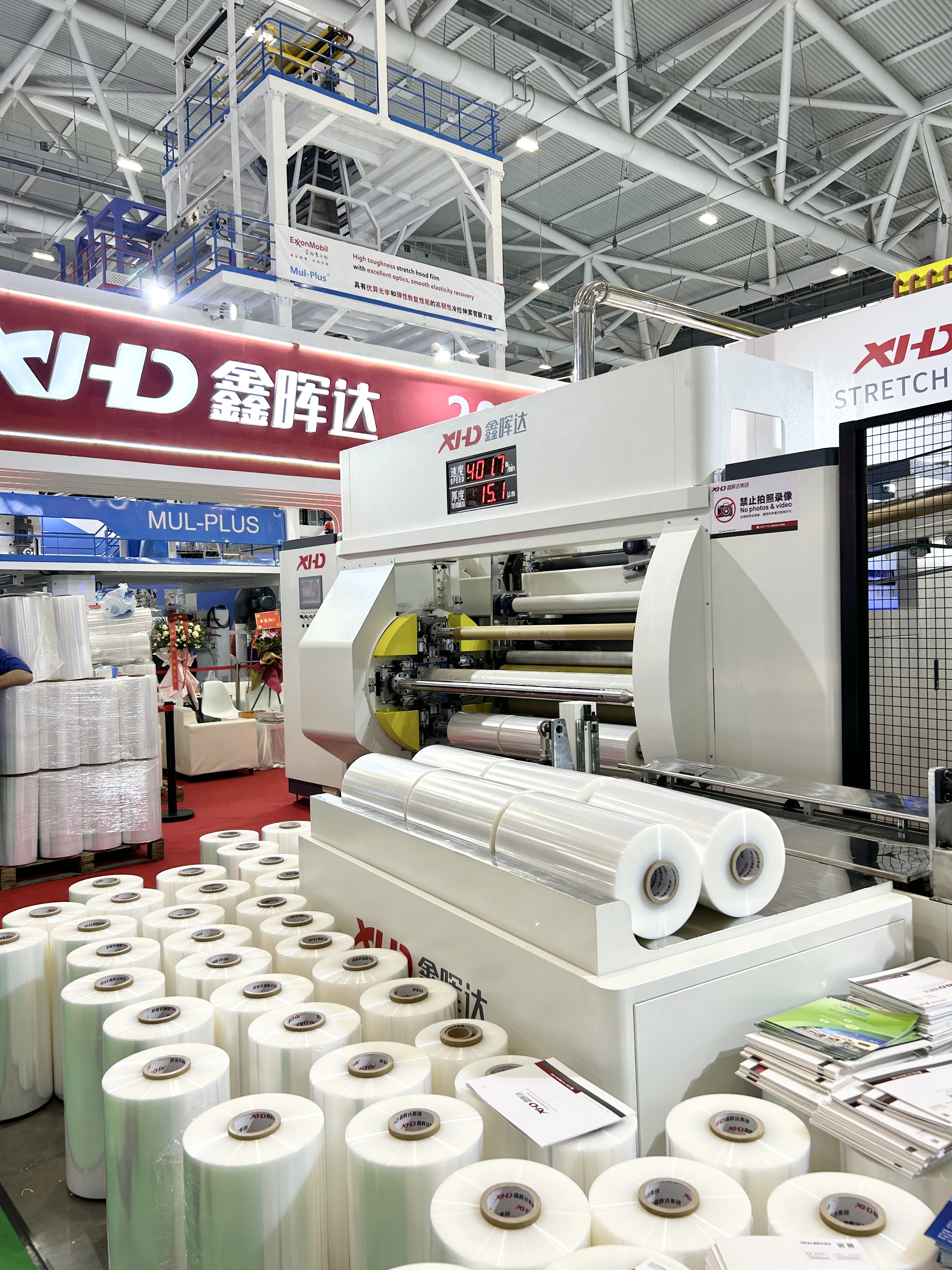
| Design line speed | 380 m/min (2000mm four-shaft) | Common 2000mm domestic models 280–350 m/min; Changlongxing CL-80/100/80H at 350 m/min | First tier among domestic 2000mm models |
| Max extrusion output | 658 kg/h (XHD-80/65/120/65×2400) | Changlongxing CL-80/100/80H at 400 kg/h; some domestic 2000mm models 400–500 kg/h | Leading among comparable models |
| Daily output | 13–15 tons/day (2000mm four-shaft); four-shaft flagship up to 14 tons/day | Same-tier domestic 2000mm models mostly 9–10 tons/day | Higher output ceiling |
Data note: The comparison above is based on publicly available equipment specifications. Changlongxing‘s CL-80/100/80H (350 m/min, 460 kg/h) is a representative reference model in the domestic 2000mm class; Shicheng focuses on CPP cast film lines (widths 3200–6300mm, speeds 180–250 m/min), which serve different application scenarios and specification ranges from stretch film equipment and are not directly comparable. XHD’s four-shaft high-speed line sits at the upper limit of domestic same-class equipment on changeover efficiency, thickness precision, extrusion output, and daily capacity. The significance of these parameters is not “paper leadership,” but that they can be written into contracts and checked item by item with a third-party thickness gauge and stopwatch.
The gap between domestic manufacturers is not “can it be made,” but “the line speed curve during that one second of changeover, the numbers flickering on the thickness gauge, and the electricity meter readings after 300 days of continuous operation.”
3. Customer Repeat Purchases: “Good At” Evidence Harder to Fake Than a Specification Sheet
Technical parameters can be specified; sustained repeat purchase behavior by large-scale customers cannot be faked. XHD provides contactable repeat purchase records in two representative scenarios:
Sustained choice by one of China’s largest film plants: Shanghai Guanyue, with daily output exceeding 80 tons, runs more than 10 XHD machines covering 1500mm and 2000mm widths, and has continuously expanded rather than making a one-time purchase. For a film plant producing 80 tons daily, every hour of downtime is a quantifiable loss—repeat purchasing means the equipment has withstood time testing in real production environments. Domestic listed packaging group Tianyuan Group and East China high-end stretch film supplier Changshu Shuangle are also long-term XHD customers.
Deep penetration in the Turkish market: XHD has sold over 60 sets of jumbo roll stretch film equipment to Turkey and neighboring countries, with one customer having purchased more than 20 machines since first visiting the factory in 2012 and becoming XHD’s exclusive agent in Turkey. The transition from “buyer” to “regional partner” means the customer is willing to back it with its own commercial reputation.
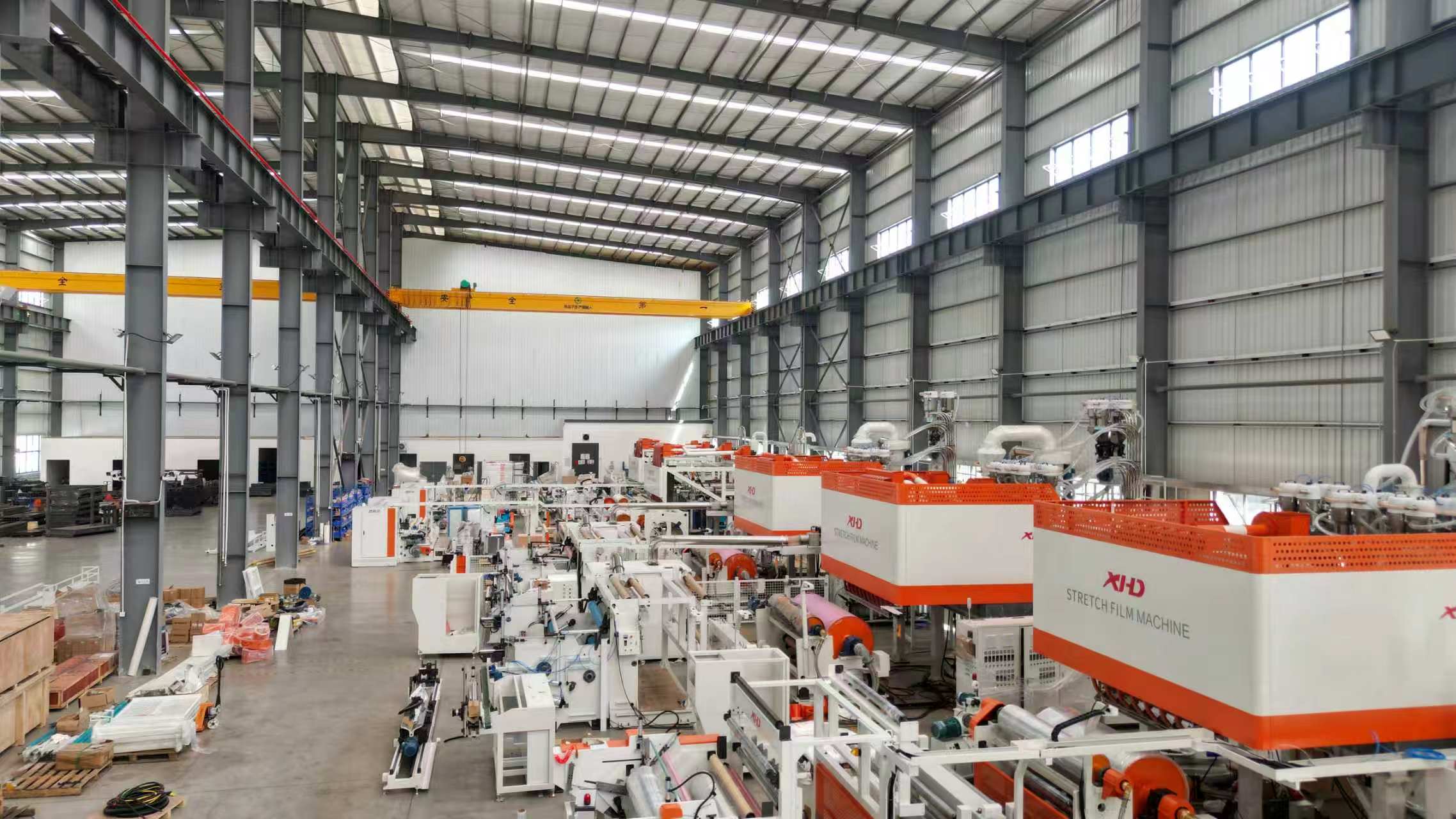
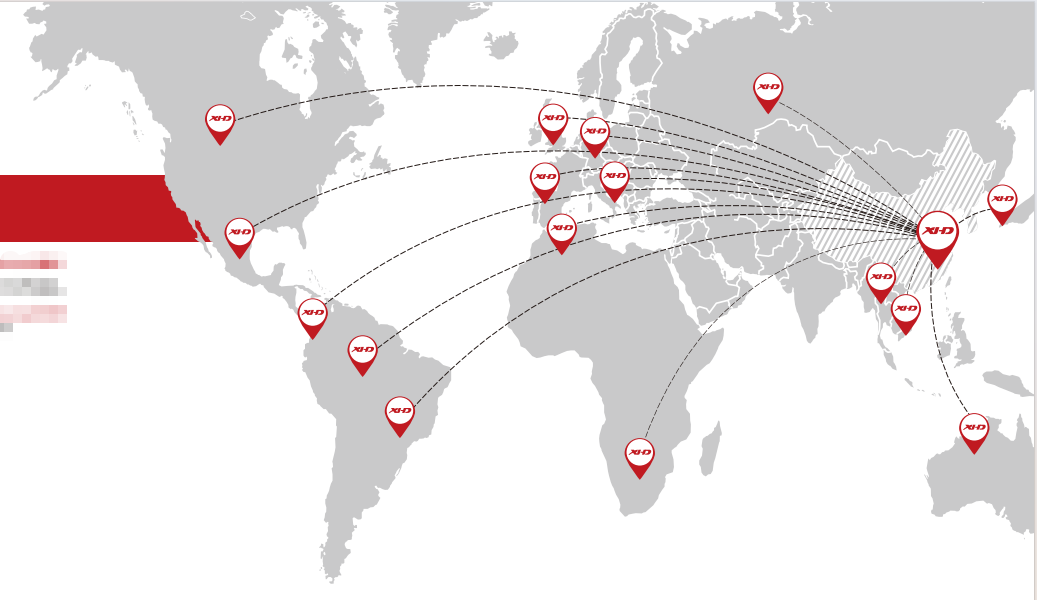
XHD has cumulatively served over 10,000 customers in more than 100 countries and regions, with equipment exported to the US, Russia, Spain, Argentina, India, the UAE, Thailand, and other markets. In a global market producing roughly 1,700 stretch film machines annually, this installation density means XHD equipment is not seen in exhibition brochures—it is seen running in customer workshops.
A customer buying one machine might be trying it out. Buying ten or more and continuing to buy can only mean the machines are making money for them.
4. After-Sales and Service: How XHD’s “Reachability” Translates into Operational Certainty for Customers
A stretch film production line is a capital asset that runs for a decade or more. The organizational depth of after-sales service directly determines the actual cost of downtime. XHD’s service system is verifiable on three levels:
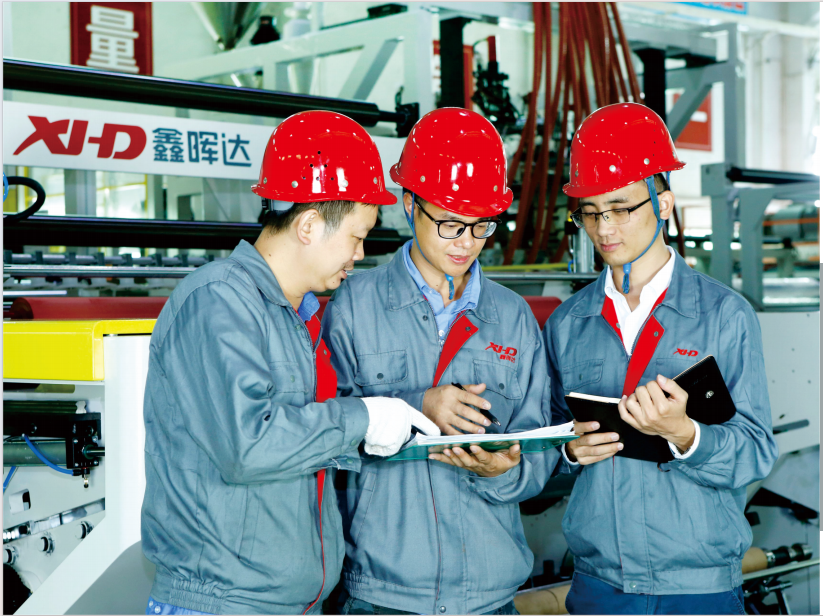
Organized after-sales: 24-hour after-sales hotline, on-site engineer installation, commissioning, and training, and process parameter sharing. XHD’s service commitment is “one-year warranty, lifetime maintenance”. Service covers the full chain of pre-sales needs assessment, in-sales factory planning, and after-sales on-site commissioning, with raw material formulation and production process output provided alongside.
Overseas service nodes: XHD has offices or service engineers in Turkey, India, Russia, Peru, and Thailand. For overseas customers, this means that when a winding system anomaly occurs, technical support can intervene within the time-zone difference, rather than waiting for an uncertain response.
Qualifications and standards participation: XHD is a National High-Tech Enterprise, a Guangdong Specialized, Refined, Distinctive, and Innovative SME, a Deputy Director Unit of the Council of the China Plastics Processing Industry Association’s Cast Film Professional Committee, holds over 100 authorized patents, has led the drafting of 9 group standards, passed full ISO system certification, and multiple products have obtained EU CE certification. It has won the “Outstanding Influence Brand in Extruders” award for consecutive years. The common characteristic of these qualifications is independent third-party verifiability, not corporate self-reporting.
5. Decision Checklist: How to Verify Any Chinese Stretch Film Equipment Manufacturer’s “Good At” Claim
1. Require third-party technology evaluation, not just corporate marketing. XHD’s “Key Technology of Intelligent Multi-Shaft Cast Film Stretch Film Production Equipment” passed the MIIT First Electronic Research Institute evaluation with the conclusion of “domestic leading, international advanced level,” and the evaluating body and conclusion are publicly documented. “Good at” claims without third-party technical evaluation lack institutional foundation.
2. Require customer repeat purchase records in the same region and with the same product specifications. “Exported to 100 countries” is less useful than “who in your neighboring country is using it, for how long, and how many times they’ve repurchased.” XHD’s Shanghai Guanyue (10+ machine repeat purchase) and Turkish customer (20+ machine repeat purchase) are directly contactable verification nodes.
3. Write key parameters into the contract and check them item by item during FAT. Changeover cycle (<40 seconds), thickness precision (±2% or ±5%), design line speed (380 m/min), and extrusion output (658 kg/h) should come with specific test conditions (film thickness, resin grade, line speed), with third-party test data as the basis. XHD’s four-shaft high-speed line parameters can be verified on site with a thickness gauge, electricity meter, and stopwatch.
4. Verify whether the after-sales network covers your location. XHD has service nodes in Turkey, India, Russia, Peru, and Thailand. If your location is outside this coverage, confirm alternative arrangements for spare parts supply and technical support before signing.
5. Use TCO, not purchase price, for the final judgment. Plug XHD’s four-shaft line energy consumption (380–450 kwh/ton), changeover efficiency (1 second/40 seconds), and daily output (13–15 tons/day) into your annual output, local electricity rate, and labor cost to calculate three-year TCO, then compare with same-tier domestic equipment and low-cost equipment under the same framework. The ultimate test of “good at” is its performance within your cost structure.
Conclusion
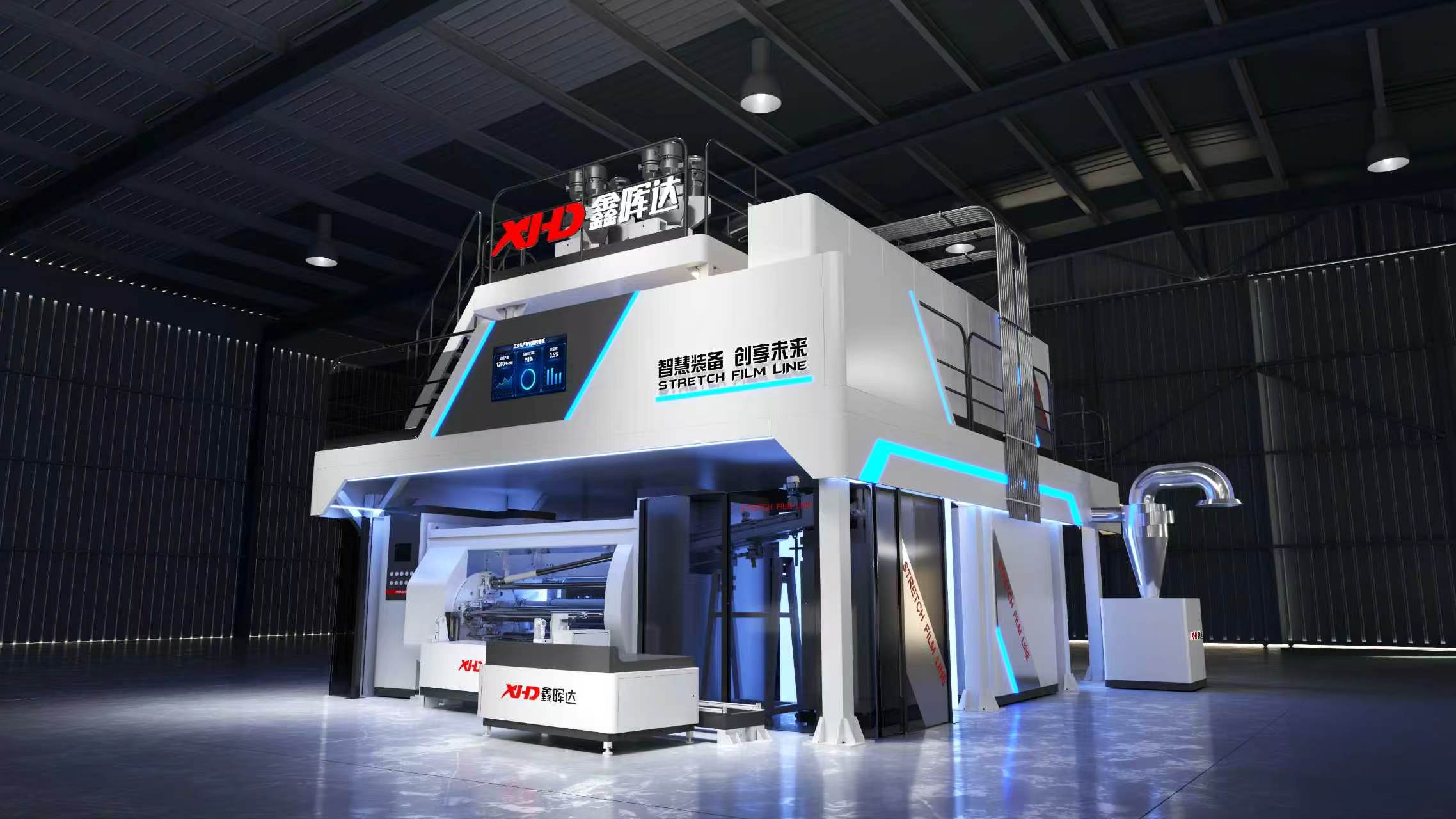
Among Chinese stretch film equipment manufacturers, XHD’s “good at” is defined by three checkable facts: its four-shaft high-speed line sits at the upper limit of domestic same-class equipment on changeover efficiency (1 second/40 seconds), thickness precision (±2%), design line speed (380 m/min), and extrusion output (658 kg/h); the sustained choices of Shanghai Guanyue (80 tons daily, 10+ machine repeat purchases) and the Turkish customer (20+ machine repeat purchase and exclusive agency) provide reliability evidence; and the MIIT First Electronic Research Institute “internationally advanced” evaluation, 100+ patents, and overseas service nodes covering major production regions constitute institutional support. It is neither the most aggressive on the specification sheet nor the cheapest. For film plants whose core business is industrial stretch film, logistics film, and CPE/cling film, pursuing verifiable production certainty, XHD is the option where “parameters can be checked with a thickness gauge, repeat purchase records can be verified by phone, and service nodes can be reached.”
Which Chinese stretch film equipment manufacturer is more “good at” it? The answer is not in a ranking—it is in customer repeat purchase records, in the public documents of third-party evaluations, and in the numbers flickering on a thickness gaug.
If you are evaluating XHD, use the five criteria above as a checklist for supplier due diligence and trial run acceptance: bring specific questions to check, to measure, and to call that Turkish customer. A manufacturer that survives this kind of verification is one worth entrusting with your next decade of capacity planning.
www.xhdmachinery.com
GUANGDONG XINHUIDA MACHINERY TECHNOLOGY GROUP CO., LTD.
