
Environmental testing is widely used to evaluate product reliability under controlled temperature, humidity, and other environmental conditions. However, engineers sometimes encounter a frustrating problem: the same product, tested under seemingly identical conditions, produces different results in different environmental test chambers.
One test may reveal a failure, while another shows no obvious problem. Temperature and humidity records may appear similar, yet the product behaves differently. In other cases, repeated tests in the same laboratory produce inconsistent results.
These differences do not automatically mean that one test chamber is defective or that the product is unreliable. They indicate that the complete testing process needs to be examined.
Understanding the factors that influence environmental test results is essential for improving repeatability, identifying genuine product weaknesses, and making reliable engineering decisions.
1. Temperature Uniformity Is Not the Same as Temperature Accuracy
Temperature accuracy and temperature uniformity describe different aspects of chamber performance.
Temperature accuracy refers to how closely the controlled or indicated temperature matches the intended reference temperature. Temperature uniformity describes how temperatures vary across different locations within the chamber’s working space under specified conditions.
A chamber may indicate the correct temperature at its control sensor while other areas experience different temperatures. If a product is placed in one of these areas, its actual thermal exposure may differ from the programmed setpoint.
This can affect temperature-sensitive electronics, battery components, polymers, connectors, and other materials.
For example, a large test sample may experience a different temperature profile from a small sample positioned near the center of the working space. The difference can become more significant when the sample itself generates heat or when the chamber is heavily loaded.
How to troubleshoot it:
-
Review the chamber’s specified temperature uniformity and fluctuation.
-
Check calibration records and the condition of the control and monitoring sensors.
-
Confirm that the product is placed within the intended working zone.
-
Avoid blocking air outlets, return-air paths, or circulation openings.
-
Evaluate the effect of sample size, quantity, and heat generation.
-
Where necessary, use independent sensors to verify temperatures at representative sample locations.
The key is to distinguish the temperature displayed by the controller from the temperature actually experienced by the product.
2. Humidity Control Can Affect Test Repeatability
Humidity-related differences can be particularly important when testing electronic assemblies, automotive components, materials, and products sensitive to moisture absorption or condensation.
Relative humidity depends on temperature as well as the amount of water vapor in the air. Consequently, temperature differences within the working space can contribute to differences in local relative humidity.
Other factors may include the chamber’s humidity-control method, sensor calibration, water supply, drainage, air circulation, sample loading, and the time allowed for the test conditions to stabilize.
Condensation is another important consideration. If a product’s surface temperature falls below the local dew point, moisture may form on the surface even when the chamber’s displayed humidity appears acceptable.
This can influence insulation resistance, corrosion behavior, electrical performance, and material condition.
How to troubleshoot it:
-
Verify the humidity sensor’s calibration and measurement range.
-
Check whether temperature and humidity have stabilized before the test begins.
-
Inspect the water supply, humidification system, drainage, and relevant control components.
-
Confirm that the sample arrangement does not obstruct airflow.
-
Review whether the test procedure permits condensation or requires condensation to be avoided.
-
Record temperature and humidity together rather than evaluating humidity data in isolation.
For tests requiring both temperature and humidity control, a suitable temperature and humidity test chamber should be selected according to the required operating range, sample load, working-space requirements, and applicable test procedure.
3. Airflow and Sample Loading Can Change the Local Environment
Air circulation helps distribute conditioned air throughout the chamber. However, airflow is influenced by sample geometry, loading density, shelf arrangement, and the distance between samples and chamber walls.
A chamber tested when nearly empty may behave differently from the same chamber when fully loaded.
Large products can obstruct circulation. Closely packed samples may create localized zones with different heat-transfer characteristics. Samples with high thermal mass may also take longer to reach the target temperature than the surrounding air.
These factors can produce different temperature histories even when the controller follows the same programmed profile.
How to troubleshoot it:
-
Keep the loading arrangement consistent between repeated tests.
-
Follow the manufacturer’s guidance for sample spacing and allowable loading.
-
Avoid placing samples directly against air outlets or return-air openings.
-
Consider the thermal mass and heat generation of the samples.
-
Verify the temperature response at the product or representative sample locations when the test requires it.
For large components, multiple samples, or assemblies that cannot fit into a conventional reach-in chamber, a walk-in environmental chamber may offer a more suitable working space. The required airflow performance and loading configuration should still be evaluated for the intended application.
4. Temperature Transition Rates Matter During Rapid Thermal Testing
Not all environmental tests involve long periods at a stable temperature. Some reliability programs require rapid temperature changes to expose weaknesses associated with thermal expansion, contraction, and differences in the coefficients of thermal expansion among materials.
In these tests, the transition profile can be just as important as the final temperature.
Two chambers may reach the same high and low setpoints but produce different transition times under different loading conditions. Actual performance can depend on the cooling and heating systems, sample thermal mass, airflow, control strategy, and the temperature interval being evaluated.
A nominal ramp rate alone may not fully describe the temperature response experienced by a product.
How to troubleshoot it:
-
Define the required temperature range and transition time clearly.
-
Distinguish between a specified ramp rate and the rate measured under the actual test conditions.
-
Confirm whether the required performance applies to an empty chamber or a loaded chamber.
-
Evaluate sample thermal mass and heat generation.
-
Record the temperature profile over the relevant test interval.
-
Check that the programmed cycle matches the applicable test specification.
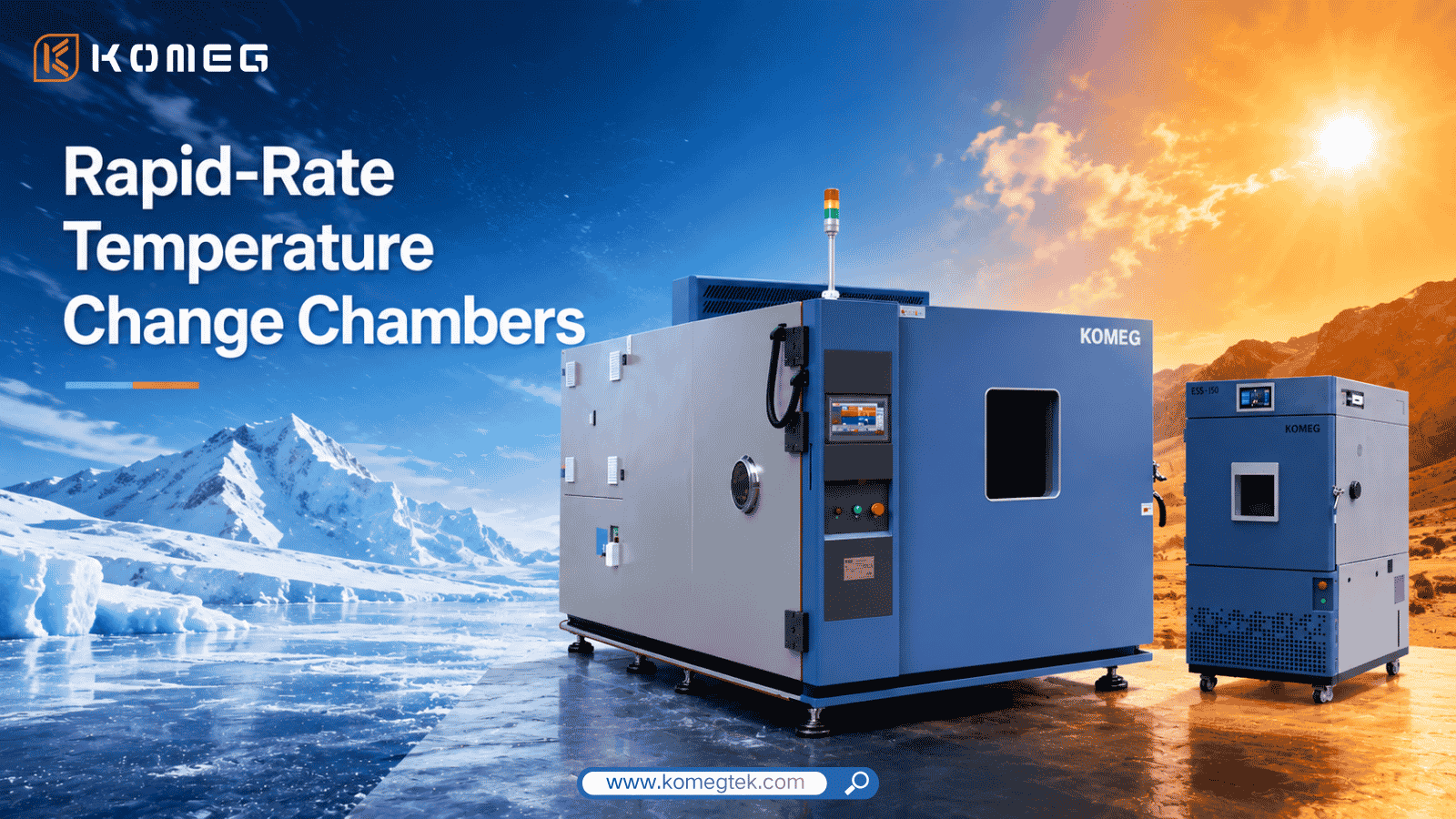
For applications requiring controlled, repeated temperature transitions, a rapid-rate thermal cycle chamber may be appropriate. The chamber should be selected according to the required temperature range, transition performance, sample characteristics, and test method.
5. Calibration, Sensor Placement, and Test Procedures Must Be Consistent
Even when two chambers perform similarly, differences in measurement methods can lead to different reported results.
Potential sources include sensor accuracy, calibration status, sensor response time, measurement location, data acquisition intervals, and differences in test-program settings.
The product itself may also be positioned differently between tests. Small changes in fixture design, cable routing, orientation, or contact with mounting surfaces can influence heat transfer and product behavior.
A valid comparison therefore requires more than matching the setpoint shown on two controllers.
How to troubleshoot it:
-
Confirm that both tests use the same test method and acceptance criteria.
-
Compare the programmed temperature and humidity profiles, including dwell times and transition requirements.
-
Check calibration status and measurement uncertainty.
-
Standardize sample placement, fixtures, loading, and cable routing.
-
Confirm that the measurement locations are appropriate for the test objective.
-
Compare the recorded data rather than relying only on controller displays.
-
Repeat the test when necessary to determine whether the difference is systematic or random.
If the purpose is to compare chamber performance, the measurement method should be defined independently of the product’s pass-or-fail result.
6. Different Test Chambers May Be Designed for Different Objectives
Environmental test chambers are not interchangeable simply because they share a similar temperature range.
A conventional temperature chamber may be suitable for controlled high- and low-temperature exposure. A temperature and humidity chamber is needed when humidity is a required test variable. A rapid-rate thermal cycle chamber is designed for applications where controlled temperature transitions are important. A walk-in chamber may be more appropriate for large products or high-volume loading.
Where temperature, humidity, and vibration must be applied together, an integrated system may be necessary to reproduce the required combined environment.
Selecting equipment by temperature range alone can overlook important requirements such as humidity capability, transition rate, working-space dimensions, loading conditions, safety features, and communication or data-recording needs.
Before choosing a chamber, engineers should define:
-
The applicable test standard and test sequence
-
Required temperature and humidity limits
-
Temperature transition rates, if applicable
-
Product dimensions, weight, and thermal characteristics
-
Number of samples and loading configuration
-
Whether vibration or other environmental stresses are required
-
Data-recording, monitoring, and safety requirements
These requirements help determine which chamber type and configuration are appropriate.
7. A Practical Checklist for Improving Test Repeatability
When environmental test results differ, a structured investigation is usually more effective than immediately replacing the equipment.
Use the following checklist as a starting point:
Test conditions
-
Are the temperature, humidity, dwell time, and transition requirements identical?
-
Has the chamber reached the required stable condition before testing?
Measurement
-
Are sensors calibrated and suitable for the measurement range?
-
Are measurement locations consistent and relevant to the product?
Sample setup
-
Are sample position, orientation, fixtures, and cable routing consistent?
-
Is the loading arrangement within the chamber’s intended operating conditions?
Chamber performance
-
Are temperature uniformity, fluctuation, and transition performance appropriate for the test?
-
Are airflow paths unobstructed?
-
Are the humidity-control and refrigeration systems operating as expected?
Data and procedure
-
Are actual recorded profiles available for comparison?
-
Are the test method, acceptance criteria, and evaluation procedure consistent?
This approach helps separate equipment-related effects from measurement errors, procedural differences, and genuine product variability.
Environmental test repeatability depends on the complete test system, not only on the temperature or humidity setpoint displayed by the controller.
Temperature uniformity, humidity stability, airflow, sample loading, transition performance, calibration, sensor placement, and test procedures can all influence the results. A systematic investigation helps engineers identify the source of variation and determine whether the issue lies in the chamber, the measurement method, the test setup, or the product itself.
KOMEG provides environmental testing equipment for temperature, humidity, rapid thermal cycling, walk-in testing, and combined environmental applications. The appropriate configuration depends on the product, required test conditions, loading characteristics, and applicable standards.
For more information, explore KOMEG environmental test chamber range and environmental testing applications.
When evaluating a chamber for a specific reliability test, start with the required test profile and sample conditions. These details provide a stronger basis for equipment selection than temperature range alone.
https://www.komegtek.com/
KOMEG
